

NASA Released New Images Of Interstellar Comet 3I/ATLAS You Need To See
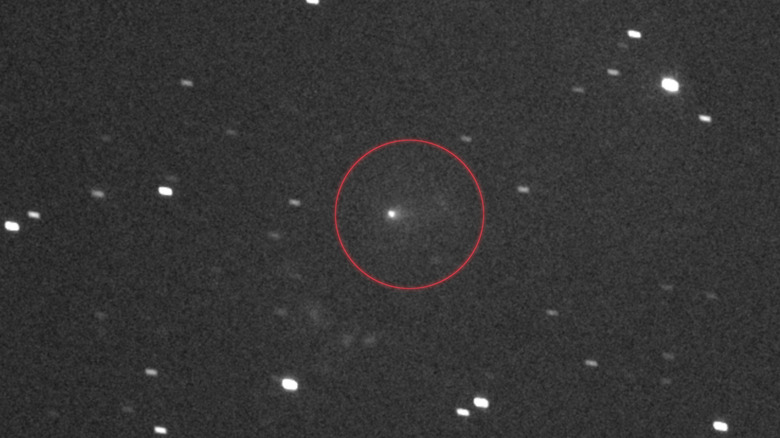
Comet 3I/ATLAS is the third known interstellar object to pass through our solar system, a cosmic rock first discovered by the NASA-funded Asteroid Terrestrial-impact Last Alert System (ATLAS) telescope in Chile on July 1, 2025. At this point, 12 NASA cameras have captured imagery of 3I/ATLAS as it's traversed our solar system, but a brand-new batch of NASA photos — taken between late September and mid-October — expand on that catalog with some of the clearest and most detailed looks at the comet so far.
The images were taken by NASA's sun-observing PUNCH satellites, the Solar and Heliospheric Observatory, the Mars Atmosphere and Volatile Evolution mission, and the Perseverance Rover on Mars. The photos mostly show 3I/ATLAS as an illuminated dot, but some also showcase the comet's tail as a faint, elongated smudge. Non-U.S. cosmic cameras have taken photos of the comet, too, including the European Space Agency and Russia's Federal Space Agency's shared probe, the ExoMars Trace Gas Orbiter.
At this time, 3I/ATLAS isn't visible to ground-based telescopes because of its proximity to the sun, but it's expected to fly by Earth on December 19, at which point it should be viewable by the James Webb Space Telescope and ground tech like the W.M. Keck Observatory in Hawaii. Scientists and space enthusiasts are elated by comet 3I/ATLAS's pilgrimage through the inner solar system. The only other confirmed objects to have visited from different areas of the galaxy were 1I/'Oumuamua in 2017 and comet 2I/Borisov in 2019 — the former of which helped NASA discover seven more dark comets.
Our solar system seldom gets interstellar visitors
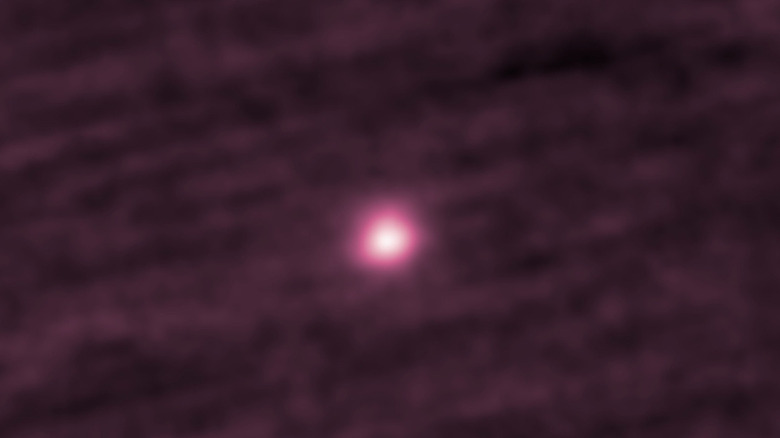
3I/ATLAS's emergence has stoked the extraterrestrial bonfire, with some folks thinking the comet could be a form of alien technology. But Nicky Fox, the associate administrator of NASA's Science Mission Directorate, speaking to NBC, confirms that all observations thus far point toward nothing more than a rock in space. "We certainly haven't seen any techno signatures or anything from it that would lead us to believe it was anything other than a comet." Still, that doesn't mean we can't learn more about distant star systems from 3I/ATLAS, especially as it gets closer to Earth. "It could be from something that existed before our own solar system. That is so cool," remarked Fox.
In the weeks ahead, scientists should be able to gather data on 3I/ATLAS's chemical makeup, appearance, speed, and a potential place of origin. And if you're wondering if comet 3I/ATLAS could be a threat to our planet, rest assured, the cosmic comet is expected to stay 170 million miles away as it flies by us.
Researchers have already speculated that comet 3I/ATLAS's acceleration might not be caused by gravity, and we already know that 3I/ATLAS is rich in carbon dioxide. Here's hoping we get to learn even more about this space-bound boulder when it rears its head again in mid-December.