

How Does Wireless EV Charging Actually Work?
Wireless device charging has existed in a commercially-available capacity since around 2009, with one of the most commonly used device categories to have broadly adopted this technology being smartphones, with smartwatches and wireless earbuds sharing this honor. Smartphones like the iPhone 17 use Air Fast Charging to wirelessly receive power instead of needing to be plugged in. The emergence of this technology has led to a burgeoning sector of wireless charging methods, like Satechi's wireless charging pads and Mophie's wireless charging stands. While wireless charging hasn't supplanted traditional charging methods, it is a fascinating concept that could one day make general power upkeep much simpler than it currently is. A big step toward that potential future: If something substantially larger than a phone, such as an electric vehicle (EV), could be charged wirelessly.
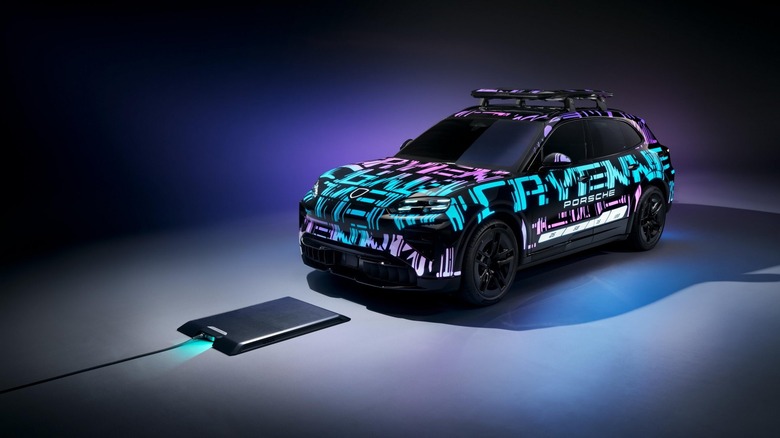
Like smartphones before them, EVs have begun to catch the wireless charging bug, with the most prominent example being the 2026 Porsche Cayenne Electric. Just like a smartphone regaining its charge on a small pad, so too does this new EV recharge its battery — in this case, from being parked over a relatively small mat on the ground. While charging a car is certainly a different proposition as compared to charging a phone, the inductive charging technology is more or less the same, and at least based on preliminary looks, it seems to work quite well.
Inductive charging sends energy through a magnetic field
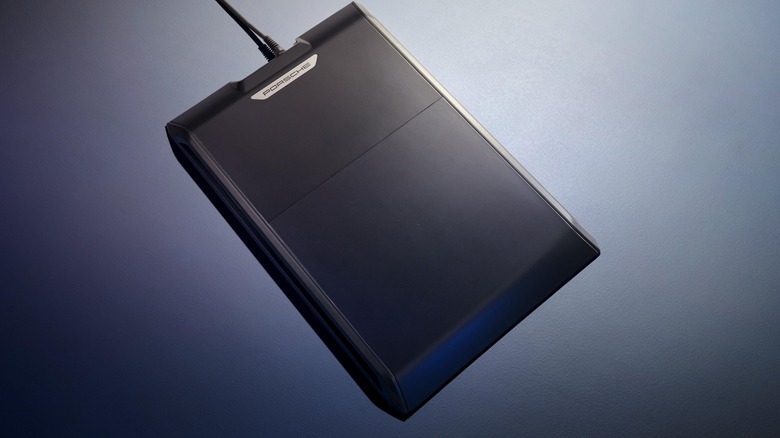
The wireless charging system present in the 2026 Porsche Cayenne Electric utilizes the inductive charging framework, the same used by small rechargeable devices like smartphones or toothbrushes. To clarify, there are actually two predominant forms of wireless charging, inductive charging and magnetic resonance charging. Both forms operate similarly, with a few key distinctions.
Both kinds of wireless charging start by drawing energy from an outlet and converting it into magnetic waves. These waves generate a small magnetic field within a wire coil on the charging pad. When a device with the proper receiving coils enters the magnetic field, a current is induced, converting the magnetic waves back into electricity and funneling it into the device's battery.
The difference between the two wireless charging formats is that, with inductive charging, the transmitting and receiving coils in the charging pad and device need to be lined up to send energy, so the device needs to be right on top of it. Magnetic resonance charging produces a large enough field that any receiver coil in its range can convert energy from it, so it can charge multiple devices simultaneously.
An inductive charging pad can match the speed of a traditional EV charger
While the 2026 Porsche Cayenne Electric uses the same charging framework as a wirelessly-charging smartphone, the question is whether or not it actually works. The last thing you'd want, after all, is a fancy charging system you can't rely on when you need it. Based on preliminary testing conducted by Car and Driver's Austin Irwin, the charging system used by the Cayenne Electric seems to be fairly reliable.
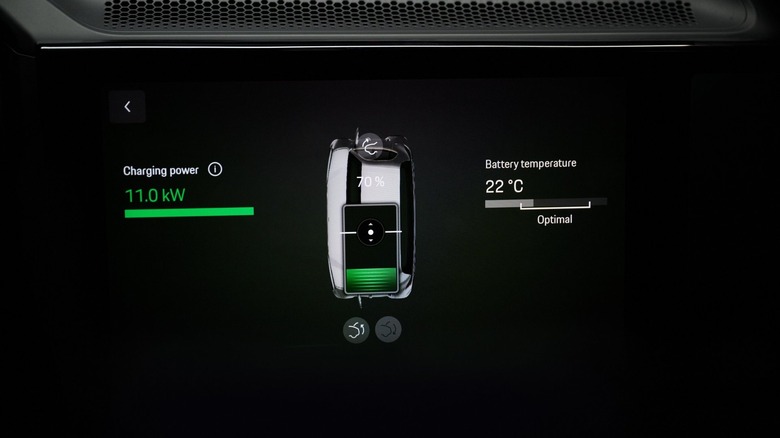
The wireless charger used by the Cayenne Electric is a specially designed base plate. The plate is placed on the ground, and the vehicle is driven over it and parked right above. Within the vehicle is a DC charging unit, which is plugged directly into the car's battery and liquid-cooling system. This unit serves as the receiver coil in the equation, receiving 11 kilowatts of power from the magnetic field generated by the base plate — roughly equivalent to the charge speeds you'd get if you used the regular charging cable. For the driver in the cabin, when you approach the base plate, the infotainment screen shows how close you are to it and helps you line the plate up with the front of the car. The base plate is 31 inches across, with a tolerance of 3 inches of deviation, so there's a bit of wiggle room in terms of docking.
Irwin said that the charging system works quite well, and according to Porsche, the base plate is resistant to dirt, snow, and extreme temperatures — so it won't break even if you accidentally drive on top of it.