

3 Reasons Why Mesh Wi-Fi Systems Are Better Than Regular Routers
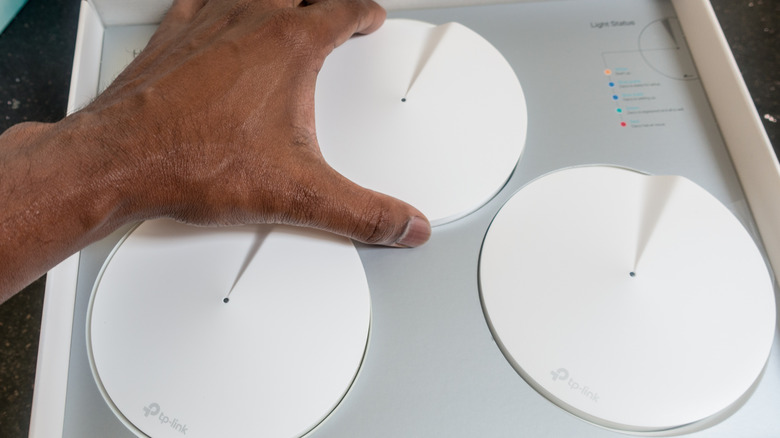
Whether you're planning to buy one of the best Wi-Fi routers for a brand-new internet connection or looking to upgrade an old model to get new features, it's natural to wonder: Should you go with a regular router, or is investing in a mesh Wi-Fi system the better decision? While both regular routers and mesh systems serve the basic purpose of delivering internet and network access across your home, they do things a bit differently.
Traditional Wi-Fi routers have a single point of wireless signal transmission, whereas mesh networks employ multiple nodes, working together, to deliver connectivity across your property. This difference in approach gives mesh networks an edge in several areas. The major mesh network systems are known for their versatility, scalability, and ease of use, and are generally recommended if you're dealing with Wi-Fi dead spots or need to cover a big home. So, here are the top reasons why you should consider buying a mesh Wi-Fi system over a regular standalone router.
They offer seamless scalability

One of the biggest benefits of a mesh Wi-Fi system is its easy scalability. Unlike a regular router, with which you are typically limited to less-than-ideal solutions, such as Wi-Fi extenders, when looking to expand your Wi-Fi coverage, the mesh systems let you seamlessly scale your network by adding a new node or satellite. For example, if you buy a two-node system today and realize after a few months that it's not enough and you want better coverage in your backyard, balcony, or a newly finished basement, you can add another node to get better Wi-Fi coverage. This flexibility also comes in handy when you move to a bigger house. There is no need to upgrade the whole setup; you can simply adjust the number of nodes as needed, and you are ready to go.
More importantly, adding a new node in a mesh Wi-Fi system is effortless. You pair it using the device manufacturer's mobile app, and everything else is typically handled behind the scenes. Additionally, mesh systems are quite adaptable to different property layouts, and you don't have to worry about their placement as much as you would about placing a regular router.
Mesh systems deliver better and more reliable coverage

Coverage is another aspect where mesh networks shine. Although traditional routers can suffer from dead spots in tricky layouts or larger homes, mesh systems have no such problem because they are not trying to cover the entire area from one location. Multiple nodes can seamlessly deliver Wi-Fi to every nook and cranny of your home with little effort. If you have added proper wired backhaul, which is used for communication between different satellite nodes and the primary node of your mesh system, there will be little variation in your internet speed as well, no matter where you are in your property. While the internet speed will go down with a wireless backhaul, you'll still get respectable speeds.
Moreover, as you move across your home, your device's Wi-Fi connection is seamlessly handed off to different nodes to ensure your device is getting the best coverage at all times. If a node of your mesh system somehow stops working, other nodes seamlessly take over its load so that you are not left without connectivity.
They are better at handling a large number of devices

Modern households, especially some homes, can have dozens of internet-enabled devices. This many devices can quickly create a traffic bottleneck for a standalone router when multiple devices are running high-bandwidth processes. However, the connected devices are distributed across nodes in a mesh network. For example, devices in your living room could be connected to one node, where devices in your basement would connect to a different one. This makes it easier and more efficient for the mesh system to handle a large number of devices. Individual nodes don't typically get overwhelmed and continue to deliver a good performance despite the number of devices on the network.
Modern mesh systems also benefit from advanced technologies like MU-MIMO (Multi-User, Multiple Input, Multiple Output) and OFDMA (Orthogonal Frequency-Division Multiple Access). While select standalone routers support these features too, they remain limited to a single access point. In contrast, a mesh network allows each node to employ these technologies, enhancing efficiency and performance across the entire network.