

Can Your USB-C Laptop Charger Also Charge Your Phone?
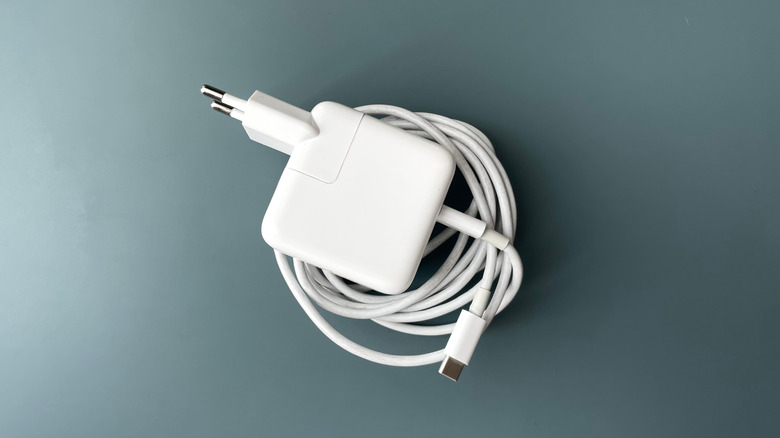
USB-C chargers are increasingly becoming a common way to charge most mobile devices, from smartphones to laptops. This shift has led many smartphone makers to stop including a power brick in the packaging of a new smartphone. However, wall chargers are still mostly bundled with laptops, and many times, they are USB-C chargers, like in the case of MacBook models, Chromebooks, and many Windows laptops. This begs the question: If you received a USB-C charger with your laptop, can you also use it to charge your smartphone?
The short answer to this is yes, especially for smartphones released in the last few years. But you may be wondering how this is possible, what charging speeds you can expect, whether your phone's fast charging feature will be utilized, and if it's safe to use your powerful laptop charger with your phone on a daily basis. Here's everything you need to know.
Charging your smartphone with your USB-C laptop charger

As mentioned, it's typically okay to charge your phone with your laptop's USB-C charger. However, there is a lot going on behind the scenes that governs how this charging process works. The process is simplest when both your devices support USB-PD, aka USB power delivery. It's a charging standard developed by the USB Implementers Forum (USB IF), and if both your laptop and phone support it, it's easy for the charger and phone to check how much power the latter can accept. The charger will then start charging the phone at the best it can offer.
You can use this combination every day. The beauty of USB-PD is that it allows your charger to work with any other USB-PD-capable device, phone, tablet, or handheld console, seamlessly. Similarly, your phone, as long as it supports USB-PD, can be juiced up by any USB-PD charger, whether it was shipped with another phone, a laptop, or a portable gaming console.
As USB-C has become more common, USB-PD support has started showing up in more and more devices. For example, all recent iPhones, MacBooks, iPads, Google Pixel phones, Samsung Galaxy devices, and almost all Chromebooks support USB-PD. It's also supported by many Windows laptops and smartphones from a lot of other Android smartphone makers. However, things become slightly more complicated when one or both of the devices doesn't support the USB-PD standard.
What happens if a laptop charger, phone, or both don't support USB-PD?
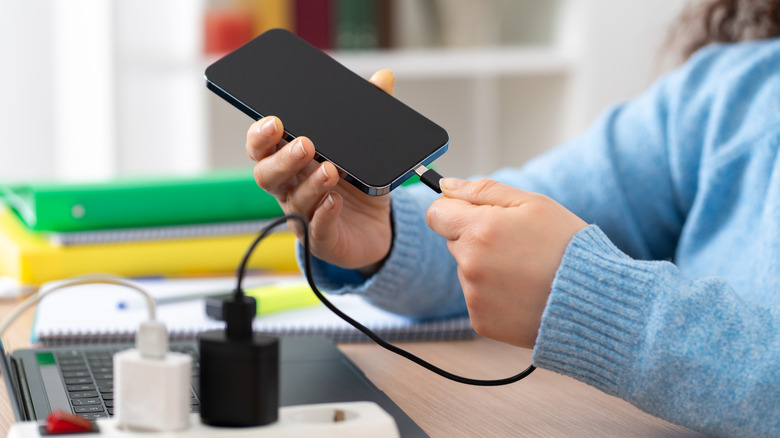
It's still largely safe to charge your smartphone with a USB-C laptop charger even if one or both of the devices don't support USB-PD but are compliant with the basic USB-C specifications. If the charger supports USB-PD but the phone doesn't, the power delivery negotiation won't happen, and the charger will default to safe lower power mode, supplying only 5V. Depending on the phone, the current accompanying the voltage can be 1.5A or 3A, resulting in charging speeds of up to 7.5W or 15W. Thanks to the safety features built into the USB-PD standard, a higher voltage is never applied unless explicitly asked by the charging device.
Similarly, if the laptop charger doesn't support USB-PD, the non-PD charger will typically default to 5V. The phone will then detect the current via the resistor configuration of the Configuration Channel (CC) pins on the charger. The maximum supplied current is 3A, resulting in a charging rate of up to 15W. This means that if both the laptop charger and the phone don't support USB-PD, you most likely won't get fast charging support or faster charging than 15W.
However, if you are unsure whether the charger or the phone is compliant with USB-C specifications, it's best to avoid charging your phone with your laptop charger to mitigate risk. Finally, it's always a good idea to use a high-quality USB-C cable to charge your phone, as that can also impact the charging process and the speed.