

NASA Lost Contact With Its MAVEN Mission - Here's What We Know
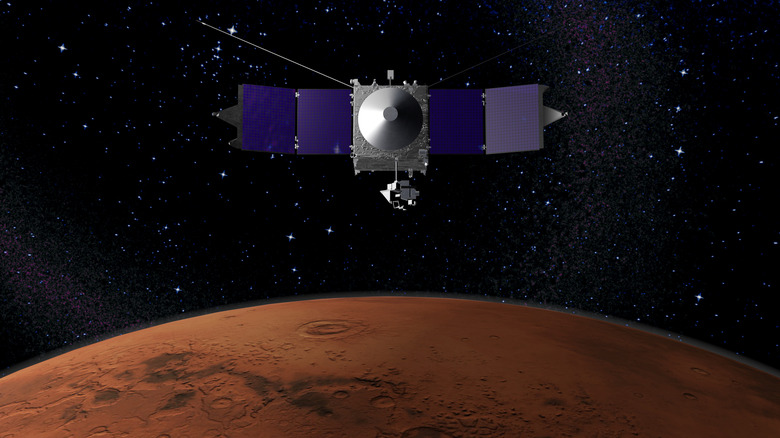
NASA has lost contact with MAVEN, a spacecraft that launched in 2013 and began orbiting Mars about 10 months later, remaining there for over a decade. According to NASA's original announcement, it was working normally before orbiting around the red planet, and around December 6 when it emerged, there was no signal between the craft and NASA's Deep Space Network. The appropriate teams are investigating, and continue to do so, but there has been no successful reconnection as of yet.
According to recent analysis, after re-emerging, MAVEN's rotation was abnormal, as it was "rotating in an unexpected manner." Via the tracking signal's frequency, NASA's teams surmised the craft's "orbit trajectory may have changed." NASA has given no indication or inclination as to why the orbit and trajectory has changed. It's possible it was struck by an anomalous object, or it changed course because of a malfunction or failure.
MAVEN stands for "Mars Atmosphere and Volatile EvolutioN," and its overall mission was to explore the red planet's upper atmosphere, ionosphere, and how it interacts with the sun and solar wind; particularly to understand why the planet experienced atmospheric loss. The data collected eventually led to NASA confirming the sun as responsible for leaving the planet cold and barren. The Curiosity surface rover also helped confirm an extreme amount of evaporation left the planet waterless, and that's also why Mars is so dead.
What else do we know about MAVEN?

MAVEN is also a communication relay for other craft in the area; including Curiosity and Perseverance, the two Mars rovers. NASA is working to "mitigate the effect" of MAVEN's communication issues on its surface rovers. That's good news since Perseverance took one of the clearest panoramic photos of the Mars surface recently. They're still working great, and the panoramic photo indicates there's still a lot more to learn and see on the red planet.
There are three other orbiters at Mars as well: NASA's Mars Reconnaissance Orbiter, which celebrated 15 years of operation back in 2020, Mars Odyssey, and ESA's (European Space Agency's) ExoMars Trace Gas Orbiter, all of which are operational. While unrelated, NASA is still looking to retrieve samples from the planet's surface, which would involve a multi-mission campaign, including an ESA orbiter similar to MAVEN.
NASA's teams continue to try and contact MAVEN to regain communication and control, and also to find out why the signal loss happened, and why it's trajectory might have changed.