

Can You Really Tell The Difference Between High Speed And Cheap HDMI Cables?
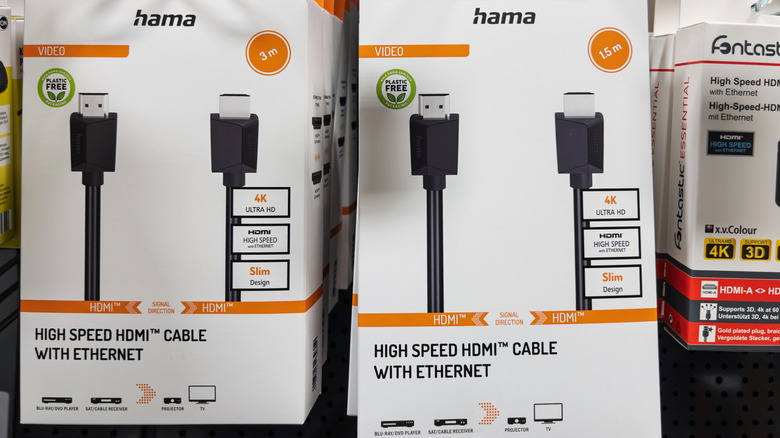
HDMI cables have become one of the most vital components in entertainment technology. They connect our PCs to our monitors, our game consoles to our TVs, and much more. However, not all HDMI cables are made equal; there is a distinct difference, for instance, between your average bargain bin HDMI cable and an HDMI cable specifically rated as high speed. The improved data transfer speeds of a high-speed cable are necessary to stabilize performance.
It's easy to assume that all HDMI cables are the same; as long as they connect a display to a source, it doesn't matter whether it's high-speed or not. If all you wanted to do was connect them, that would be true, but if you really want to optimize your entertainment experience, you need one of the best HDMI cables with high-speed or greater capability. After all, higher-fidelity video and audio mean a greater influx of data, and if your HDMI cable can't facilitate that influx, you won't be seeing or hearing any of it.
High-speed HDMI cables can transfer more data faster
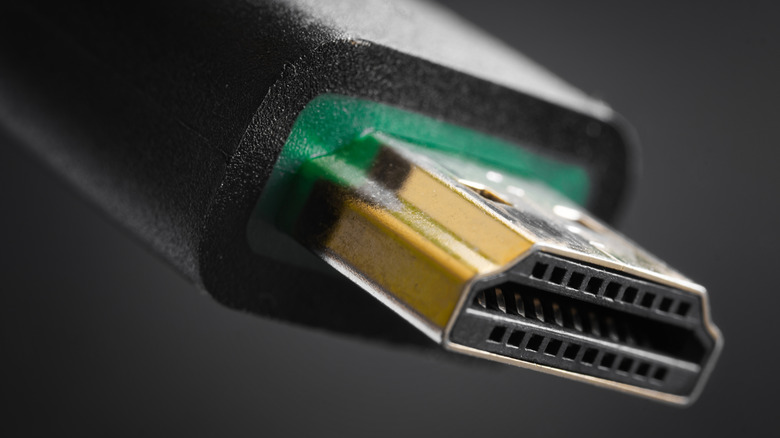
As the name implies, a high-speed HDMI cable is designed to increase the speed at which data is transferred from a source like your PC or streaming player to a display such as a monitor or TV. HDMI is a framework that transfers video and audio from a source to a display as interconnected streams of data.
The average HDMI cable has a data bandwidth of about 5 Gbps. If all you wanted was to get something from a simple source to show up on a display, that's more than enough bandwidth to facilitate it. However, as visual and audio systems have improved, scaling up to 4K or higher resolution requires more data to generate higher-quality video. You need a higher-bandwidth cable to handle this influx, or else your display may experience glitches and interruptions like signal dropouts and digital noise. The simplest analogy here is to liken it to a highway; with standard definition video, that highway can safely accommodate all the cars and deliver them where they need to go in a timely fashion. If you've got 4K data streaming in, though, the highway becomes choked with incoming cars, and everything becomes completely gridlocked, a total interruption of service. It's similar to having insufficient bandwidth on your home internet, resulting in slow Wi-Fi speeds.
High-speed cables lead to stable video and audio
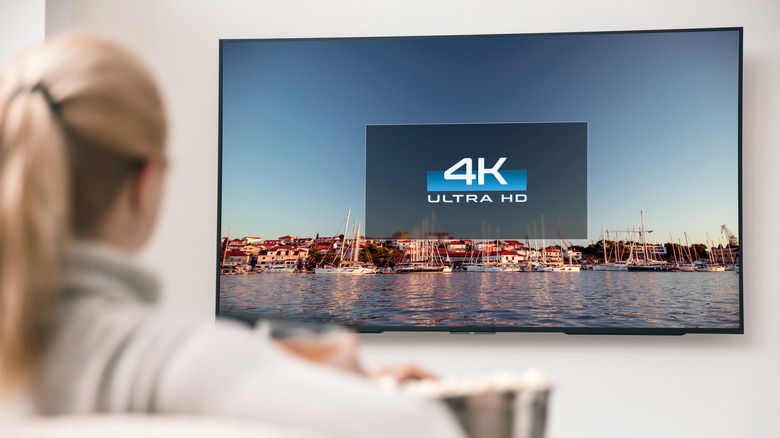
An ordinary HDMI cable's data capacity can facilitate video quality up to 1080p. When the HDMI format was first introduced, it was the highest-definition available, and indeed, regular cables are still the best choice for older sources like DVD players or previous-generation game consoles.
You could technically plug a newer, higher-definition source into a display with this kind of cable, but the performance might be spotty and unstable, as the cable wouldn't be able to transfer all the data needed to generate a 4K picture. Switching to a high-speed cable increases the bandwidth to around 10 Gbps, which is enough to produce a consistent 4K video. There are also higher-level HDMI cables that increase bandwidth to 18 or even 48 Gbps, which could support 4K video at higher framerates or 8K video, respectively. Since HDMI is a multimedia framework, faster cables are also necessary to get the cleanest, most stable audio. High-speed cables are necessary for audio-enhancement features like Dolby Atmos, and are a must-have if you have a dedicated home stereo or soundbar setup.
In short, whether or not you can tell the difference between cheap and high-speed HDMI cables depends entirely on what you're doing with them. If you're not trying to get the highest-quality experience, then the difference is negligible, but if you want 4K video with true-to-life surround sound, the right cable is a vital factor in preserving TV image quality and functionality