

Robotaxis And Driverless Cars Need A Fourth Traffic Light - Here's Why
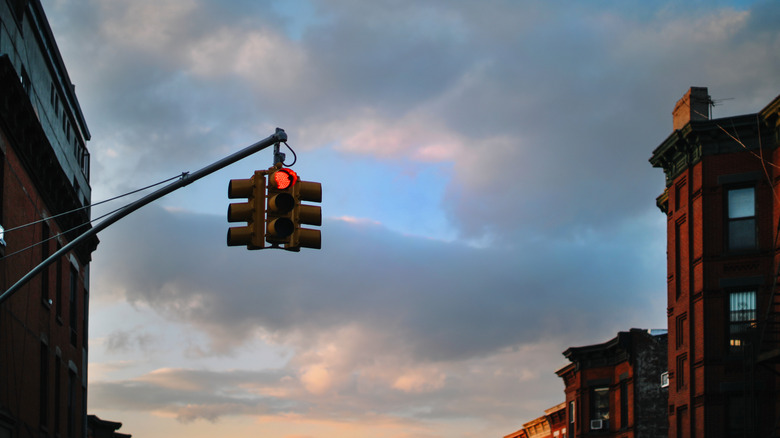
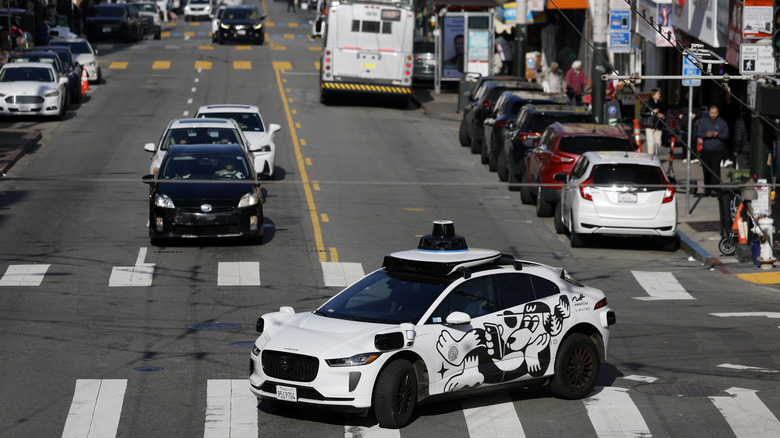
Cars that drive themselves are no longer just a concept you'd see in sci-fi movies imagining the near future. Companies like Waymo are already using self-driving cars, and you can ride in a robotaxi in various U.S. cities now. The road infrastructure may need to adapt to accommodate the growing fleets of autonomous vehicles (AVs) in the coming years. A team of transportation engineers at North Carolina State University has been working on one part of said infrastructure since 2020: adding a fourth traffic light, which they suggest could be white (though it could really be any new color).
When the white traffic light comes on, human drivers will know that they need to do one thing: Follow the car in front and do exactly what that car does until the light changes. The idea stems from the fact that AVs can communicate with both each other and the traffic signals. The white light would turn on only if there are enough AVs at a busy intersection. When a human-driven car arrives to the intersection, it would follow the lead of the AVs. Drivers would keep observing traditional traffic light rules until the fourth light signal comes on, but if a certain number of human-driven cars were at the intersection they would revert back to the traditional light system.
The premise is that AVs connected to a smart traffic light would be able to improve the flow of traffic and reduce fuel consumption. The initial proposal called for a single computing system to collect data about the number of AVs in its proximity, in addition to directing traffic in the intersection. In 2023, the researchers proposed a new distributed computer system.
What are the benefits of AVs using a fourth traffic light?
According to Ali Hajbabaie, corresponding author of a 2023 paper and an associate professor at NC State, the new solution is more efficient and less prone to communication failures. The authors of the paper conducted experiments to test whether a fourth traffic light would speed up traffic while also reducing fuel consumption. The tests involved microscopic traffic simulators that took into account several parameters, including real-world traffic and vehicle behavior. The researchers studied the traffic with and without the white phase.
Not only did AVs improve the flow of traffic on their own, but the proposed white phase further improved traffic flow. As Hajbabaie explained in a press release, "This also reduces fuel consumption because there is less stop-and-go traffic." Finally, the team reported that "the higher the percentage of traffic at a white phase intersection that was made up of AVs, the faster the traffic moved through the intersection and the better the fuel consumption numbers."
The fourth traffic light would streamline traffic even if only a fraction of the cars at the intersection drive themselves. For example, when 10% of vehicles are AVs, delays are reduced by 3%. Bump the number of driverless cars to 30%, and delays are reduced by 10.7%. These figures also suggest that the system would have specific thresholds for activating. That said, implementing the system is easier said than done. The process would require upgrading traffic lights and ensuring that all AVs run on a common protocol. Also, human drivers would have to become accustomed to the new traffic light system.