

Christopher Nolan's Interstellar Predicted A Scientific Breakthrough
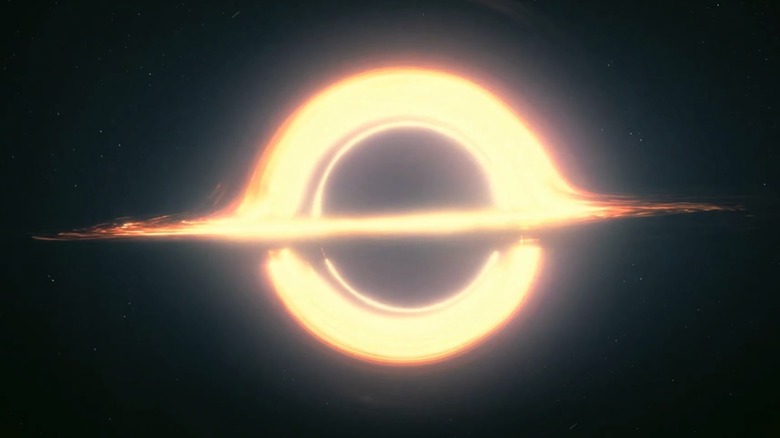
"Oppenheimer" (2023) may have won Christopher Nolan a well-deserved Oscar for Best Director, but "Interstellar" (2014) is arguably a more spectacular Nolan creation, an ambitious sci-fi movie that manages to be grounded in real science while focusing on one of humanity's primordial feelings, love. The combination of striking visuals, a mesmerizing score, and several unexpected twists makes "Interstellar" a must-see film, one that's easy to rewatch after the initial experience. That's probably because "Interstellar" tells a believable story. The Earth is slowly dying and humanity's salvation lies many light-years away, in the vicinity of Gargantua, a massive black hole that's easily one of the most stunning settings in the movie. It turns out that Nolan's depiction of Gargantua was quite accurate. A team of researchers managed to capture the first photo of a black hole in 2019, with the blurry image offering us a strikingly similar look.
Nolan collaborated with relativity expert Kip Thorne, who was involved in the making of "Interstellar." The scientist advised the production from writing to editing to ensure that the audience was given a sci-fi experience they would believe. The Gargantua black hole is one of the main sci-fi concepts Nolan proposes in "Interstellar," and it's based on existing scientific knowledge. Part of that science is explained during the movie, allowing the viewer to easily grasp concepts such as time and gravity.
Time is a crucial concept driving the plot. The lead character, Matthew McConaughey's Cooper, embarks on the space mission to save Earth fully knowing that he'll miss years with his kids — and possibly never return. The events occurring near the black hole, where time passes a lot more slowly than on Earth, end up breaking Cooper's heart. Gargantua's massiveness seems inescapable.
How did scientists photograph a black hole?
The science-backed visual effects won "Interstellar" an Oscar in 2015. But while Nolan's movie made us believe that black holes looked like the Gargantua design, we had no way of knowing how accurate this depiction was. Gargantua may have seemed logical, but it was still just a concept imagined for a movie. It wasn't until 2019 that the Event Horizon Telescope project delivered the first blurry image of the Messier 87 (M87) black hole, which The New York Times published. Seen in the clip above, the black hole doesn't precisely resemble the beautiful Gargantua, but does look strikingly similar. At the center of it, there's a circle (sphere) devoid of light. That's the black hole. The orange circle surrounding the dark core, the accretion disk, is made of light and glowing gases.
M87 is a galaxy in the Virgo constellation, some 55 million light-years away from Earth. The black hole in it is several billion times more massive than the sun, according to The Times. It's also "unleashing a violent jet of energy some 5,000 light-years into space." That energy, the light and gas, is what makes the photography possible. The astronomers at the Harvard-Smithsonian Center turned to a telescope network the size of Earth to capture the photo. That's the Event Horizon Telescope, which is made of eight radio observatories placed on six mountains on four continents. The work started in April 2017, when the observatories studied the target for 10 days.
The Event Horizon team worked for two years on the data collected. That data was so large scientists couldn't transmit it over the internet. Instead, they flew hard disks back and forth to move the information to one place. Four separate teams then worked on the data to prevent bias.
A massive discovery for humanity
"Interstellar" scientific adviser Kip Thorne won the Nobel Prize in 2017 for discovering gravitational waves from colliding black holes. The Times noted in 2019 Thorne's appreciation for the black hole photography. "It is wonderful to see the nearly circular shadow of the black hole," the astrophysicist told the paper in an email. "There can be no doubt this really is a black hole at the center of M87, with no signs of deviations from general relativity."
This first photo doesn't just confirm Einstein's theories regarding relativity and black holes. It also suggests Nolan made the right call by relying on science to deliver the haunting Gargantua (seen in short "Interstellar" clip above). More importantly, the image helps astronomers move forward with black hole research. As The Times reported, the scientists were able to measure the size of the black hole and determine its mass: 6.5 billion solar masses, or much heavier than previous estimates.
While "Interstellar" isn't likely to get a sequel, the Event Horizon team is likely to produce similar black hole images in the future. M87 was just the start. A black hole at the center of our Milky Way with a mass of about 4.1 million suns, which makes it harder to photograph than M87, is next. Movie fans can rewatch "Interstellar" on Netflix.