

Are TPMS Sensors Actually Reliable?
We may receive a commission on purchases made from links.
Tire pressure monitoring systems (TPMS) have been a staple of the automotive industry since 2007, and they don't appear to be going anywhere in the near future. While they're a welcome tool when functioning correctly, it can be frustrating to see your TPMS warning light up the moment the temperature drops below freezing. It can be equally upsetting to check your tire pressure shortly after, only to discover that your PSI is exactly where it should be. This raises the question: Are TPMS sensors actually reliable?
Generally speaking, your best bet is always to confirm your tire pressure with some type of manual gauge, because TPMS sensors aren't always reliable. We would give this advice even if you knew your vehicle had state-of-the-art TPMS sensors that never fail. You can even invest in this ETENWOLF Tire Pressure Gauge on Amazon, or in a digital one we highlighted as one of the best car gadgets for under $50.
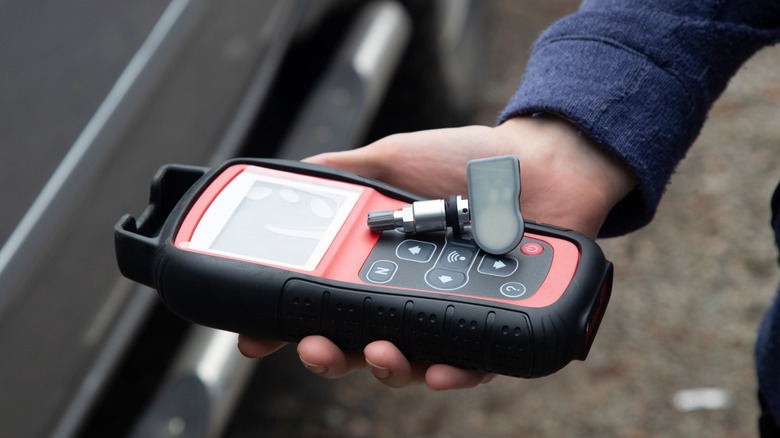
Much like any other vehicle sensor, your tire's TPMS rig is prone to failure, especially if you've been driving your vehicle for more than a few years. This isn't just a gas car problem either: Electric vehicles, which require special tires, are also monitored by TPMS sensors, and most modern vehicles use direct TPMS. This is a system wherein each tire contains a battery-powered sensor that measures pressure and transmits that data wirelessly to the car. Those batteries typically last five to 12 years, after which the sensor can begin sending intermittent or incorrect readings. In some cases, your TPMS light may permanently stay lit. To the driver, this may look like a faulty system, even though the sensor is simply reaching the end of its lifespan.
What your TPMS light is (and isn't) telling you

Environmental factors matter more than most drivers realize. Tire pressure naturally drops in cold weather, about one PSI for every 10-degree Fahrenheit drop in temperature. When winter rolls around, and the TPMS light suddenly pops on, the system usually isn't acting up or misreading anything. It's just doing what it's designed to do and responding to physics.
The issue is that TPMS doesn't offer any context. It won't tell you why the warning light came on, only that one or more tires have crossed a preset pressure threshold. To the average car driver or truck operator, that lack of explanation makes the system feel inaccurate or overly sensitive, even when it's usually reporting correct data.
That's why TPMS works best as a reminder, not a final diagnosis. When the light comes on, especially during a large temperature swing, it's worth grabbing a pressure gauge and doing a quick manual check before assuming something's wrong. Inflating your tires to the manufacturer's recommended PSI, not the number printed on the tire sidewall, will usually clear the warning and keep it from coming back. If the light doesn't go away after that, there's a good chance you're dealing with an aging sensor rather than an actual tire issue. Taken as a friendly warning, not a trusted mechanic, TPMS may be more dependable than its reputation suggests. If we ever reach a point where the world starts using air-free car tires, TPMS may go the way of in-vehicle ashtrays.