

Goodbye Folding Laundry - LG's New Robot Can Help You In Your Daily Life
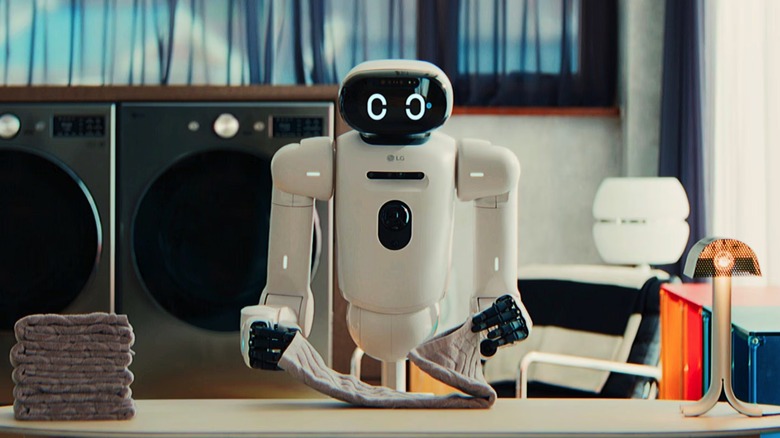
Your washing machine and dryer are easily two of the most useful home appliances. Two-in-one washer/dryer combos are often said to be even better, as they can dry your clothes as soon as the washing cycle is over. But while these devices may be the unsung heroes of home chores, humans still have to fold the clothes, an activity many people dislike. That's where an AI robot for the home could be very useful, as it could replace the human in this final step of the laundry cycle. In fact, LG's new robot, CLOiD, does more than fold laundry. It can talk to other home appliances, especially devices made by LG, and perform more chores at home — including loading the washer, cleaning the dishes, and preparing food.
Unveiled at CES 2026, LG CLOiD is part of the company's "Zero Labor Home" vision, which involves having intelligent machines and robots handle the repetitive home chores that humans have to perform. The new robot won't just fold clothes at home once it's available commercially. It'll be able to load the washing machine, as seen in a demo LG offered at CES. LG also launched a new two-in-one washer/dryer product that could finish the laundry cycle while the humans are away. CLOiD would then fold the laundry and handle other aspects of the smart home. A video that LG showed has the new robot interacting with the AC unit and the lighting system to manage the temperature and lights at home. The robot can also interact with a smart fridge to see what ingredients are stored and heat food via a smart oven.
Unfortunately, LG has not announced availability details for CLOiD. The new robot may impress buyers, but there's no release date or price as yet.
How LG CLOiD folds laundry
The new robot isn't exactly a humanoid robot, as it lacks human-like legs. It features a head, a torso, and two hands each with five fingers. The head is where the new robot's brain resides. It features the computer (running AI processes), a display that shows facial expressions, a speaker for voice interaction with humans, and cameras and sensors so the robot can see its surroundings. To perform chores at home, CLOiD runs a complex AI system that combines a Vision Language Model (VLM) and a Vision Language Action (VLA). VLM is a technology that allows the AI to understand images and video. The VLA is what translates visual and verbal inputs into actions.
CLOiD's torso can tilt to adjust its height, allowing the robot to pick up objects from knee level. Each arm has seven degrees of freedom, with LG saying this feature matches the mobility of a human. "The shoulder, elbow, and wrist allow forward, backward, rotational, and lateral motion, while each hand includes five independently actuated fingers for fine manipulation," LG explains. This arm-hand configuration is what will let CLOiD perform the fine movements required to fold laundry.
The torso sits on a wheeled base featuring autonomous driving technology based on LG's robot vacuums. LG explains in a press release that it selected this form for stability, safety, and cost-effectiveness. A robot on a wheeled base has a lower center of gravity and won't tip over as easily if a child or pet pushes it. The downside of using a wheeled base instead of legs, as other concept robots shown at CES 2026 adopted, is that the robot can't handle stairs. That may be a problem for households where the washing machine and dryer are stored in a basement or loft.
The secret ingredient behind CLOiD
The AI component is key for making a device like LG CLOiD work. The Korean company says it has trained the VLM and VLA models on tens of thousands of hours of household tasks. This process taught CLOiD to interpret user intent and execute actions. Also, CLOiD can interact with LG's appliances that support the ThinQ AI Home platform and the ThinQ On smart home hub. This is what lets the new robot orchestrate actions as seen in one of the demo videos LG shared at CES 2026.
But in addition to the AI brain that CLOiD will use to manage a smart home and perform repetitive chores like folding laundry, LG unveiled a key hardware component that robot builders may not always detail in announcements. This is a new Axium actuator, seen in the LG CES 2026 presentation video above. The actuator sits in the new robot's joints. It includes a motor that powers the force required to move and rotate the arms, and a reducer that handles speed and torque.
The CES demos show CLOiD performing actions at slower speeds than a human, but they appear to be precise nonetheless. Instead of using a brake to stop the movement, the actuator uses a regenerative slowing process that turns the excess motion into energy to recharge the battery. This sounds similar to the regenerative braking technology that some electric vehicles may feature to increase the car's range by recharging the battery as the car slows down.
That said, LG did not offer battery life estimates for CLOiD. However, the new robot would likely handle chores while humans aren't at home and pause for recharging, but that's just speculation.