

America's Doomsday Plane Still Uses 1980s Tech For A Reason
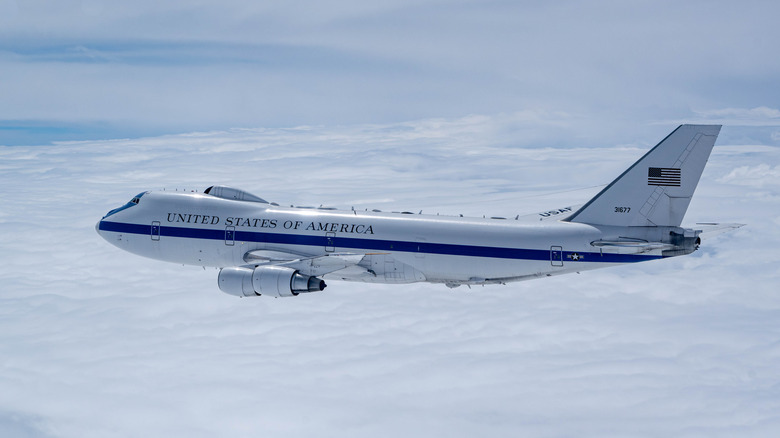
When the U.S. military launched an unarmed nuclear missile in November 2025, it caused some people to wonder where the President of the United States goes during a nuclear war. The answer is a converted Boeing 747 known as the National Airborne Operations Center, a roaming command and control center equipped with advanced communication systems and a structure reinforced against nuclear shockwaves. Like much of the country's nuclear defense infrastructure, America's command and control operations depend on technology that is a lot older than you'd think. First delivered to the U.S. Air Force in January 1980, the E-4B, nicknamed Nightwatch and popularly known as the 'Nuke-Proof' Doomsday plane, can ward off electromagnetic pulses while supporting advanced satellite and electronics systems.
Despite turning 45 in 2025, the Air Force isn't set to replace its four Nightwatch jets until 2036, meaning the U.S.'s 'Doomsday' planes will be nearing their 60th birthday when they finally retire. The reason behind this is laughably simple: due to the size of the plane's communication network, the E-4B needs larger four-engine aircraft. Unfortunately, manufacturers like Boeing and Airbus largely stopped making such large aircraft, necessitating that the Air Force obtain their 'doomsday planes' secondhand. As it stands, the country operates four E-4Bs, ensuring that one is always ready to take off at a moment's notice. However, the reliance on larger, older planes has always created several maintenance and operational issues, prompting the United States to initiate its successor program in 2024.
An aging technological marvel
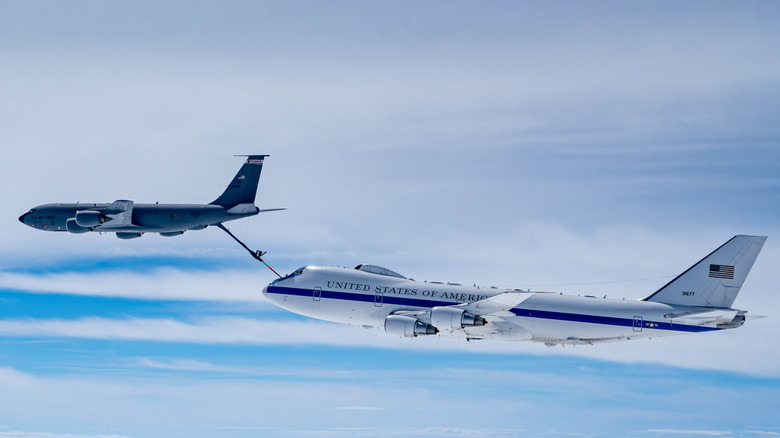
Several features enable the plane to execute these high-level functions. A four-engine, long-range, high-altitude aircraft capable of seating up to 111 people, the E-4B functions like a flying Pentagon, with a main deck divided into six subdivisions, including a command, conference, communications, briefing, operations, office, and rest areas. The aircraft has an incredibly complex communications system that harnesses all major forms of electromagnetic communication. Reportedly, the plane houses several communication programs, like the state-of-the-art Milstar satellite system, a jam-resistant, multi-satellite constellation, which enables the aircraft to send launch orders to the U.S.'s stockpile of missile silos, submarines, and bombers using specially crafted electronics and transmitters. The Nightwatch even possesses a low-frequency antenna that can trail roughly 5 miles behind the plane. Another major benefit is its ability to fly for long durations. The aircraft is capable of flying for twelve hours before refueling midair, thus ensuring that U.S. leaders can remain safely in the air during a nuclear war.
These features come with a hefty cost, however, as the Air Force must rely on secondhand jets to accommodate larger communications architecture. This is due to the need for larger, four-engine airplanes to support the vast communications network. Powered by four GE CF6-50E2 turbofan engines, America's four Nightwatch are among the oldest 747-200s in the skies today. Currently, no American commercial airlines fly the plane. Although not the only time the U.S. has used secondhand jets — the Air Force used secondhand Boeing 707s to form its E-8 Joint Stars fleet in the 90s — the age of the E-4B has posed several problems over the years, leading to higher costs and extended maintenance and reliability issues.
Old (un)reliable
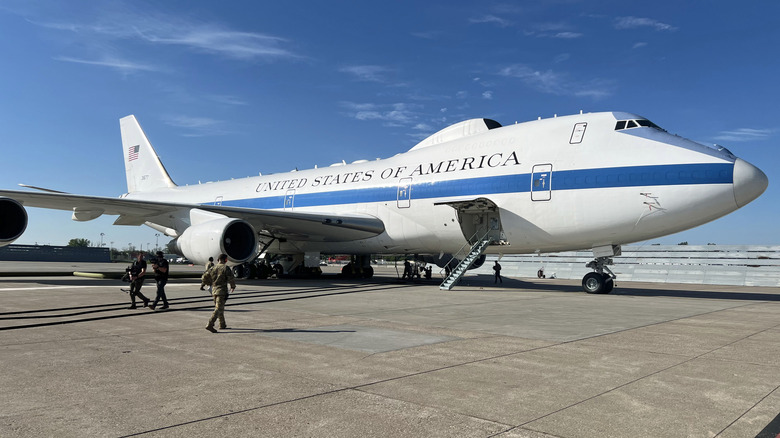
Because the U.S. must depend on a larger, older model, maintaining the E-4B has been a constant issue, particularly as the plane has aged. Showing signs of wear, the Nightwatch has begun to show notable reliability issues, maintaining a mission availability that hovers around 55%. And while the planes are inspected regularly, repairs can be extremely difficult, as the model's lack of widespread popularity continues to complicate the logistics behind its maintenance. In the 50-odd years since its debut, several of the plane's specialized parts have become obsolete or fallen out of development, as vendors have begun to discontinue many of its parts. According to Air Force General Charles Q Brown in a Senate Appropriations Committee meeting in May 2024, these costs have spurred the Air Force to seek alternatives, stating "At some point, it gets more costly to maintain than to move into a new capability."
In April 2024, the Air Force announced its intention to find a successor to the E-4B, striking a $13 billion deal with the Sierra Nevada Corporation to build its Survivable Airborne Operations Center. As per Reuters, Sierra Nevada Corporation has already bought five 747-8s from Korean Air for $674 million. Reportedly, Sierra Nevada Corporation expects to deliver the fleet by 2036, meaning the Nightwatch will be 56 years old before it enters retirement. And while several technological advancements are sure to occur in the next decade, with the U.S. Air Force developing everything from hypersonic jets to AI pilots, one thing is certain: the Survivable Airborne Operations Center will surely constitute a much-needed upgrade.