

Gemini's New Personal Intelligence Gives Android The Assistant iPhone Keeps Promising
Google on Wednesday announced a new Gemini feature that will turn the chatbot into a personal assistant that other rivals can't offer. Called Personal Intelligence, the new experience will allow Gemini to extract personal information from other Google apps, including Gmail and Google Photos, to offer responses tailored to the user's needs. The new Personal Intelligence features may sound similar to what Apple wanted to do with Siri on the iPhone last year. However, the big Siri upgrade for Apple Intelligence was postponed, and it's not coming for at least another few months. On that note, Apple partnered with Google to use a custom Gemini model for the Siri revamp.
Google will have Personal Intelligence deployed on Android before the iPhone gets that smarter Siri experience. Personal Intelligence will be available in beta in the U.S. initially. Google AI Pro and AI Ultra subscribers will get the more personal Gemini experience starting next week. Only personal Google accounts will be included in the early rollout, though it's unclear when Workspace accounts will get Personal Intelligence. Google said in its announcement that Personal Intelligence is also coming to AI Mode in Search, without offering more details on the matter.
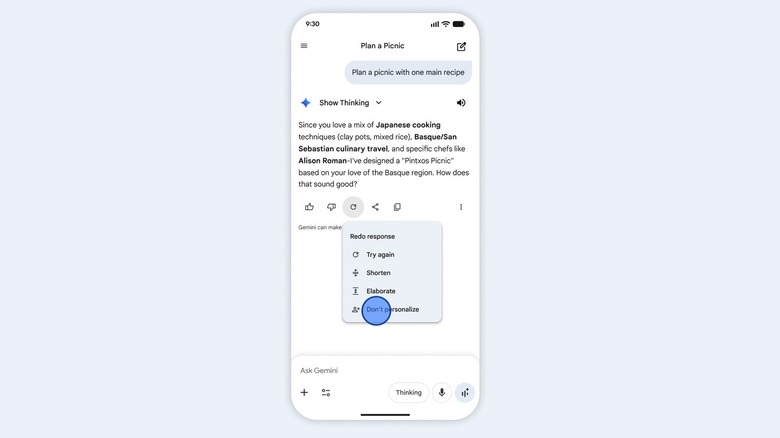
Eligible users should see an invitation in the app to enable Personal Intelligence. Otherwise, they can go to the Settings menu, tap Personal Intelligence, and select the apps they want Gemini to extract information from. Personal Intelligence will be off by default, meaning apps aren't connected automatically. Users can turn the feature on and decide which apps Gemini can access. Users can also use temporary chats or regenerate responses without personalization.
How Personal Intelligence works
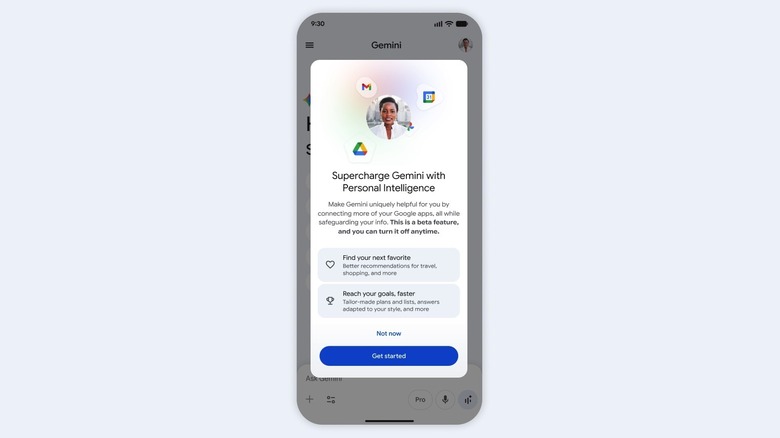
Personal Intelligence will be available on Android, iPhone, and the web, and across Gemini models. That should ensure a similarly personalized experience across devices. In a whitepaper, Google explained that Personal Intelligence will require longer processing. Gemini will offer faster responses for prompts that do not require personalization. That said, Google examples and demonstrations focus on the Android experience, which is where personalized AI assistants make the most sense. Gemini will be able to formulate complex responses that include personal information from the user's Gmail inbox, Google Photos, YouTube, Google Search, and other apps they may connect. Users can choose exactly which apps to give Gemini access to.
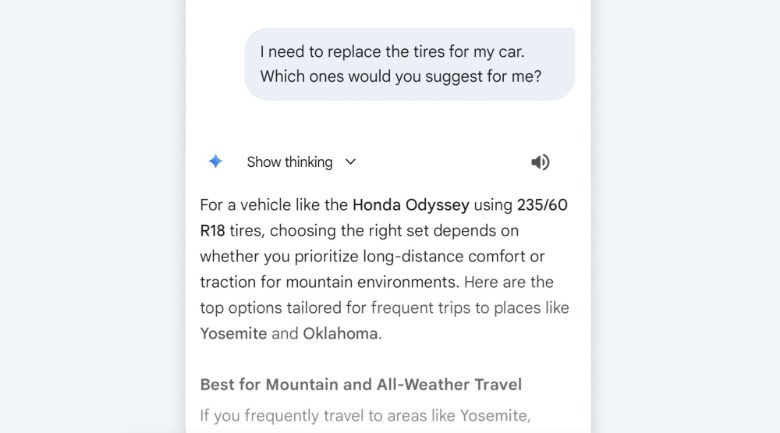
Josh Woodward, Google's vice president for the Gemini apps, Google Labs, and AI Studio, said in a blog post that "since connecting my apps through Personal Intelligence, my daily life has gotten easier." He offers an example of a situation many people will find familiar: Standing in line at a car shop, he realized he didn't know the tire size or license plate of his minivan. He asked Gemini, and the AI quickly offered suggestions based on information in Google Photos from a family trip. The license plate was extracted from an image in Google Photos, while the car's trim came from Gmail.
The executive also said he's been getting "excellent tips" for books, shows, clothes, and travel via Personal Intelligence. In a different scenario, Gemini used Personal Intelligence to extract information from Gmail and Google Photos to help Woodward plan a family spring break vacation. The AI "skipped the tourist traps" by looking at the personal information in the Google apps and suggested an overnight train trip and board games for the journey.
Privacy protections and potential personalization problems
Personal Intelligence seems like the AI assistance we'll want from the next-generation AI tools, including Gemini, Siri, ChatGPT, and other apps that can connect to personal data sources. To make Personal Intelligence features possible, users will have to trust companies like Google with highly sensitive information. They may worry that Google trains its Gemini models on Personal Intelligence content. Woodward explained in the same blog post the privacy protections in Personal Intelligence.
Gemini will refrain from making assumptions about sensitive data like your health. The AI will discuss that data if you ask. Also, users can correct the AI when it's offering personalized information to ensure Gemini remembers what the user likes. Google offers an example of Gemini inferring that the user likes golf, based on the number of Google Photos items showing golf courses. However, Gemini is missing the nuance: The user was there because they love and were supporting a family member. Similarly, Gemini may make mistakes concerning relationships (like divorces), interests, and event timelines.
The blog post details a key privacy protection in Personal Intelligence. Google won't "train directly" on Gmail inbox and Google Photos library. Instead, Google trains Gemini on "limited info, like specific prompts in Gemini and the model's responses." For the minivan example, Gemini won't use the Google Photos images and the Gmail emails, like the license plate. Instead, Google trains the AI on the user's prompts and responses, and only after obfuscating personal data. "In short, we don't train our systems to learn your license plate number; we train them to understand that when you ask for one, we can locate it," Google said. Users who get access to Personal Intelligence early may want to visit this Google support document to understand the privacy features governing Personal Intelligence.