

Say Goodbye To 3D Printing Limits With This DIY Hack
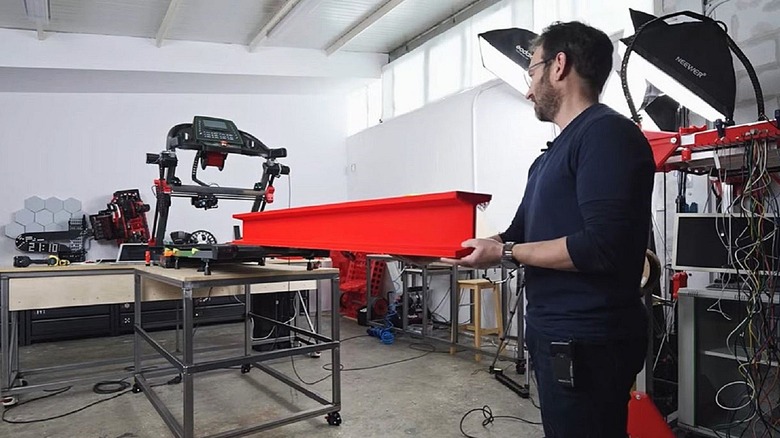
Consumer-grade 3D printers are stationary and come with a base, which is where all the printed items are made. They typically have a small, fixed workspace where the printer ejects the filament through an extruder using a configuration that's digitally transcribed — it follows a blueprint. That usually means that to print large items, they either have to be broken down and produced in smaller pieces for assembly, or the printer has to be paused while completed segments are moved out of the way.
But a resourceful duo has a solution for this issue with an unorthodox piece of equipment, a treadmill to be specific. Ivan Miranda and Jón Schone have taken a treadmill and turned it into a large-scale 3D printer, with the rubber belt used as a conveyor. The oversized 3D printer features an extra-large extruder, linear rails, custom wiring and power modules. It's designed to print incredibly large pieces like you'd find in an industrial setting. They can use it to make furniture, architectural models, mechanical parts, and more.
The extruder prints on a single plane, but at an angle, while the treadmill belt moves the finished segments away. They've used it to create a roughly 6.5-foot long plastic girder, something absolutely unheard of for normal 3D printers. By comparison, the world's largest 3D printer can make a whole house in under 80 hours, but that's obviously not something you'd do at home.
The 3D printer treadmill is custom built
It's important to note that Miranda and Schone didn't simply take a treadmill and use it as-is. The extra-large extruder was uniquely tooled to work with the belt, and it prints on a single plane, but at an angle versus a level plane like with a normal system. The belt and moving parts are powered by integrated stepper motors meant to deliver more precise movements, as opposed to what would happen with a standard treadmill — jerky, fast, and uncontrollable movements.
The team also had to calibrate the belt's speed to match the printer's output. There was a lot of trial and error involved, as you might expect. Imagine using this contraption to print large items, or even single, layered sheets of pieces for assembly — it would make the creation process of all the must-try 3D printing projects faster than ever. Think minutes or hours, not days.
However, while this DIY hack would remove some limitations of 3D printing applications, it might also be a bit too technical for the average person to replicate. Especially novice users, as some of the best 3D printing projects for beginners are small, simple, and quick to make. A large 6-foot-plus plastic I-beam might be a bit of a stretch.