

China's First 'Flying Aircraft Carrier' Just Completed Its Test Flight
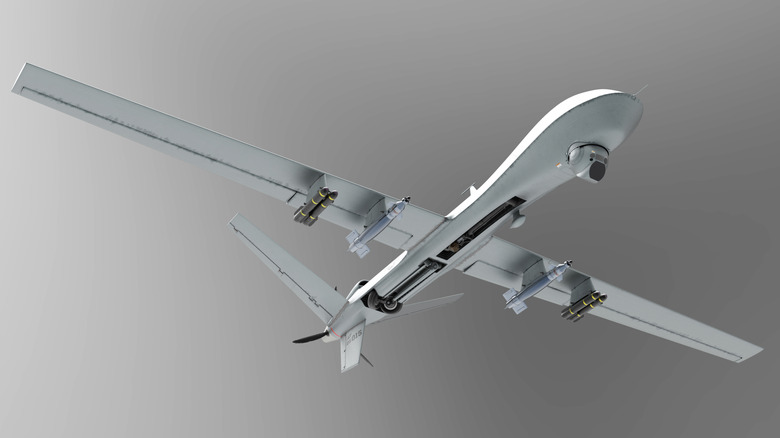
We have seen a myriad of drone advancements in recent years — from solar-powered drones designed to fly forever to swarms of MIT-created insect drones to help with pollination. However, China's latest advancement, a massive drone mothership called Jiu Tian, has to be one of the most intriguing to hit the runway yet.
The massive aircraft, which has a 25-meter wingspan and measures 16.35 meters long (roughly an 82-foot wingspan and 54-foot length), has actually taken off. Its developer, the Aviation Industry Corporation of China (AVIC), performed the craft's maiden voyage in December 2025 over the Shaanxi Province, roughly a year after its original introduction.
Videos of the massive UAV taking off and landing have appeared online since its debut, with reports about the aircraft noting that it supports a maximum takeoff weight of 16 metric tons as well as a payload capacity of 6,000 kilograms. It is also slated to operate for up to 12 hours, with a maximum ferry range of 7,000 kilometers, the AVIC told CGTN Europe. This makes the aircraft ideal for deep ocean missions, and its maximum capacities and designated hardpoints mean it can carry a variety of weapons, with a capacity of 100 drones.
A UAV built to carry drones
The reason Jiu Tian has become such an intriguing development is that military experts have noted that it is built to take advantage of both a composite aircraft's design and act as an arsenal plane capable of not only providing reconnaissance but also striking when it finds its target. This would eliminate potential downtime between scouting and actual strike missions, as the drones onboard the Jiu Tian could be released as soon as they were needed.
Beyond simply being a military concept, though, China also claims that the Jiu Tian can support a fully modular payload, allowing it to take on multiple roles such as emergency communications, surveying geographic areas, and providing disaster relief to remote regions of the world. The basic idea here seems to be that as long as the aircraft can reach the target without running out of energy, then it can provide air coverage, no matter what that seems to entail.
This is, of course, just one more way that China is expanding its military concepts to include unmanned aircraft, robotics, and more. We've previously seen the country experimenting with rifle-toting robot dogs, as well as motion-controlled military robots designed specifically for remote combat encounters.