

Why Do Power Lines Have Orange Balls On Them?
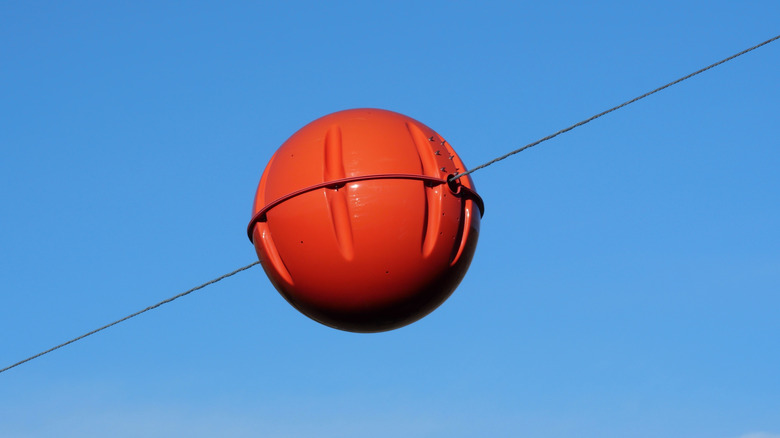
We've all seen the orange, yellow, or white balls on power lines, while driving or walking past them. The colored balls seem to always be there, and there's a good reason for that: The safety of low-flying airplanes and helicopters. These orange and white balls hanging from America's power grid are wire markers designed so aviators can spot them from a distance. Typically referred to as aerial marker balls or spherical markers, they'll usually appear near airports and heliports to ensure the power lines are visible to aircraft pilots.
The markers may also be seen on river and canyon power line crossings, and other places where aircraft — including AI-driven flying taxis — can fly lower than usual. Without the orange balls in place, the wires would effectively be invisible. They aren't painted to stand out and power lines are relatively thin, meaning pilots may find them difficult to spot until the last minute. But with the colored balls in place, the wires are more visible, and pilots can adjust course as needed. These orange and white balls aren't optional.
The FAA started advising the installation of marker balls in the 1950s, and the safety markers are used worldwide by other countries that employ them for similar purposes. While the aviation orange color is chosen because it stands out so well, the spherical markers can also come in white and yellow, and wires can alternate between different colors. Made from two separate halves, the balls can be partially assembled on the ground into a clamshell shape, before being mounted on wires from helicopters.
Guidance on using these orange balls comes from the FAA
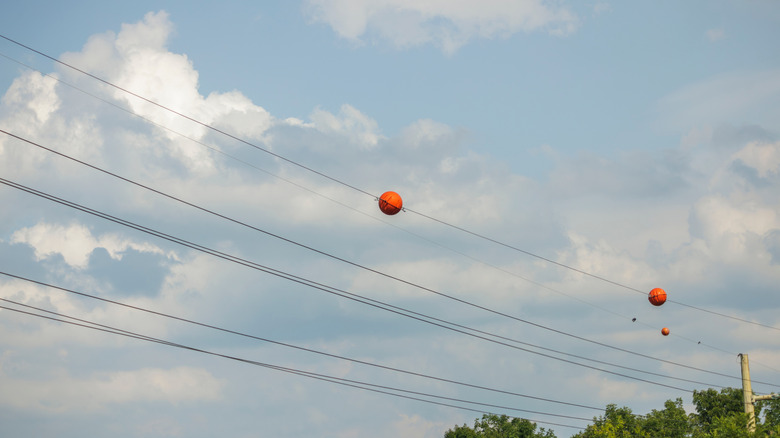
The orange safety balls used to help aviators spot power lines can be as small as nine inches in diameter and as large as 36 inches, depending on the application. FAA guidance suggests alternating colors to increase visibility in regions with varied backgrounds. Importantly, the balls are unlighted. It's the differently colored paint that makes them visible to pilots during the day, including those behind the wheel of the nearly-ready Xpeng flying car. However at night, the colored balls may only visible in certain conditions.
So, the FAA also allows the use of lighted markers for high-voltage catenary hazards near airports, canyons, and lakes, where aircraft may fly lower than normal. If they're installed on a power line that is positioned below the highest catenary wire, however, unlighted markers are recommended. High-voltage power lines may be placed on taller structures than lower-voltage wires, which only need orange balls for daytime warning. That said, the FAA notes that lighted spherical markers still require a minimum line load. As for the shape, these aviation markers need to be spherical or cylindrical, so they're not confused with other items.