

China's Thermal Battery Breakthrough Might Change Everything
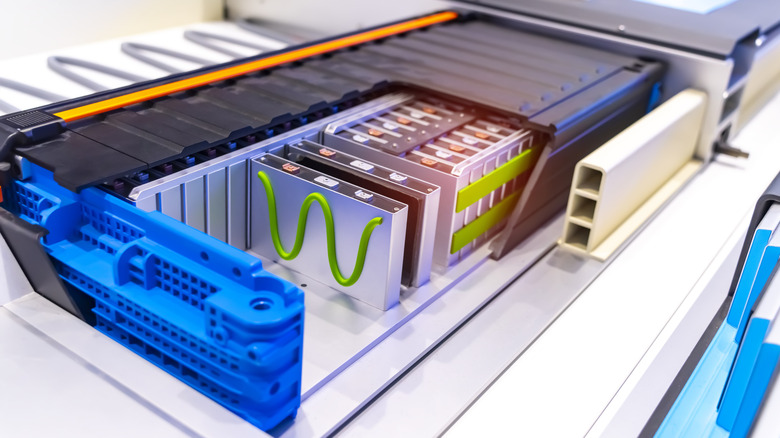
Battery tech has come a long way over the years, with new solid state batteries which hold almost double the charge of some Tesla EVs, and even research that looks at using energy-storing concrete to turn buildings into giant batteries. Likewise, thermal batteries offer a lot of potential for various applications. However, they also suffer from a pretty debilitating issue called the shuttle effect — which is one of the most common issues that these batteries haven't taken off in recent years. That's because, due to the shuttle effect, these batteries tend to lose their capacity over time, leading to a lower charge efficiency. But new research from scientists in China may have found a way to overcome this issue.
To fully understand what the new research (published in Advanced Science) means for thermal batteries, we first have to look at the shuttle effect more closely. This effect typically happens when certain components in the batteries — specifically the intermediate polysulfides — experience dissolution. This causes a loss of sulfur that cannot be reversed, leading to the decay and lack of charging efficiency that scientists have been trying to overcome.
Over the years, several attempts have been made to address these issues, such as adding different types of sulfur electrodes to the batteries. While some have proven effective at suppressing the issue overall, this new research offers a very promising foundation that could help scientists and engineers design future high-density thermal batteries using a novel cathode material that not only increases the performance of the battery but cuts down on the loss experienced due to the shuttle effect.
How they did it

The research team, which was led by Professor Wang Song and Zhu Yongping from the Institute of Process Engineering of the Chinese Academy of Sciences, builds off similar ideas from previous research of adding barriers to the internal design of the battery. This ultimately changes how the materials in the battery are set up, allowing them to minimize the amount of loss experienced due to the shuttle effect. To do this, the researchers focused on creating a special barrier that surrounds specific particles in the battery's internal design, allowing for certain ions to travel freely as needed, while locking others from moving around and dissolving.
The center of this barrier's creation centers around a shell made from covalent organic frameworks, or COFs. These porous materials feature crystalline and well-defined structures that the researchers were able to convert into a coating that allowed them to cover tiny passageways while still letting the ions that need to move around to do easily.
The researchers say that this creates a strong foundation for future designs to incorporate the overall idea, as it would allow for better control and suppression of the materials in the thermal cells. Research like this is vital, as it could help us find new materials to use in batteries beyond just lithium.
A development that could change everything
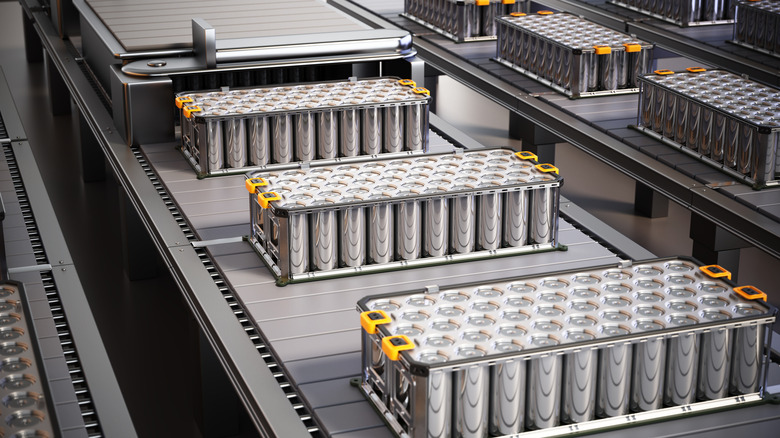
As we already noted above, thermal batteries have been eyed by scientists and engineers for a while now, mostly because they can work in places that traditional batteries can't — such as regions with extreme temperatures — and we already see these types of batteries used in military applications, certain aerospace systems, and even in equipment used for deep-well drilling, where the performance and reliability of a battery much be heavily controlled.
Typically, extreme temperatures have negative effects on traditional batteries, which is one area that thermal batteries are especially promising. That's why finding a way to overcome the issues holding back more mainstream thermal battery design is such an important goal for many. While this research doesn't fully provide a solution to the issue, it does give scientists a strong foundation to build off of as they work to improve thermal batteries.