

Apple TV Vs. Nvidia Shield - Which Is Best For Your Home Theater?
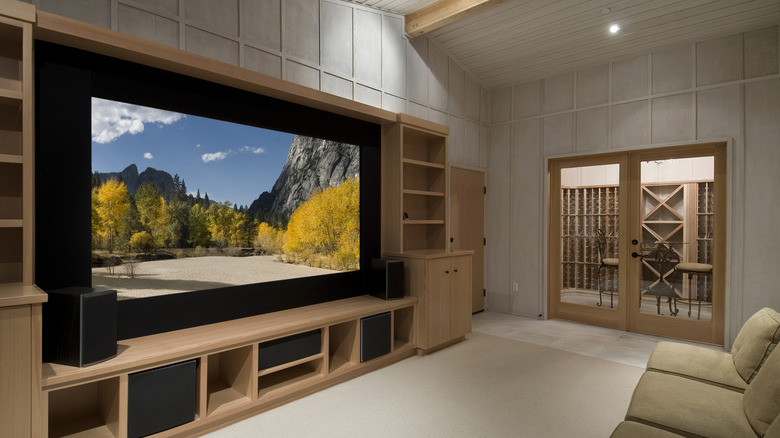
If you have assembled everything for a solid home theater setup, from a high-quality soundbar to replace your TV audio to the best 4K Blu-ray player for your physical media collection, it's finally time to pick a streaming media player. There are several major streaming devices on the market to pick from, which can get confusing. However, if you only want a high-performance media player, the choices shrink, and you are left with the Apple TV 4K and Nvidia Shield as your two main contenders.
Both are pretty feature-rich, powerful, and capable of handling most things you throw at them. While you can buy the Apple TV 4K starting at $129, the Nvidia Shield devices start at $150. However, in 2026, when the Shield devices are more than six years old, does it make sense to shell out over $150 for them, or will you be better off with the now three-year-old Apple TV 4K? Let's find out which one's better for your usage.
Apple TV 4K
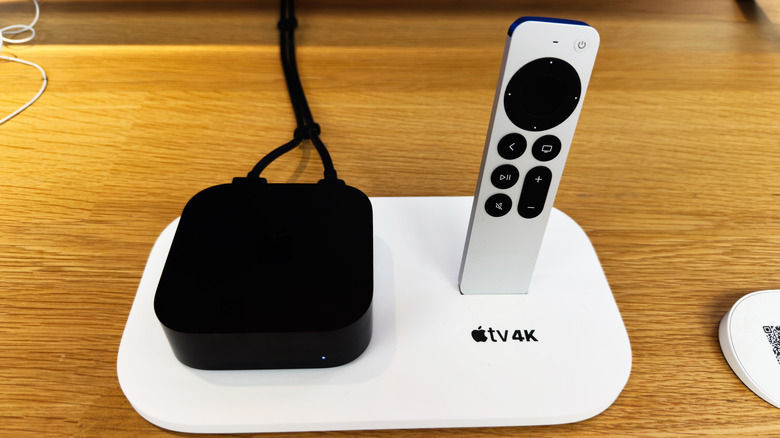
Released in 2022, the current iteration of the Apple TV 4K is one of the most powerful streaming media players on the market, thanks to its A15 Bionic chip. The Apple streamer has an unassuming but sleek design and comes with a pretty minimal aluminum remote, which people seem to have a love-hate relationship with. It runs on tvOS and can stream in 4K with HDR, and there's support for both Dolby Vision and HDR10+. It's also capable of handling a number of audio formats, including Dolby Digital Plus 7.1 surround sound and Dolby Atmos. However, the support for DTS audio is missing. There is access to all popular streaming services as well as apps for Plex, Jellyfin, VLC, VPN services, and a lot more. It can also stream Apple Fitness+ content and supports Apple Arcade, which is a subscription service for casual games.
Plus, you can make FaceTime calls on your Apple TV 4K using your iPhone as the webcam, and talk to Siri for voice control. Another highlight of the Apple TV 4K is its seamless communication with other Apple devices, including iPhone, AirPods, and HomePods. You can also control compatible smart home devices directly via the streamer. Finally, the tvOS software is clean, simple, easy to use, and devoid of advertisements. As a result, it's an excellent choice for most home theaters, but it makes the most sense if you are already a part of the Apple ecosystem so that you can make the best of many helpful features. However, it's not without its faults. For example, it doesn't pass raw audio data to your AV receiver or soundbar, and its Match Content feature can cause a black screen for a couple of seconds when you start a new video.
Nvidia Shield
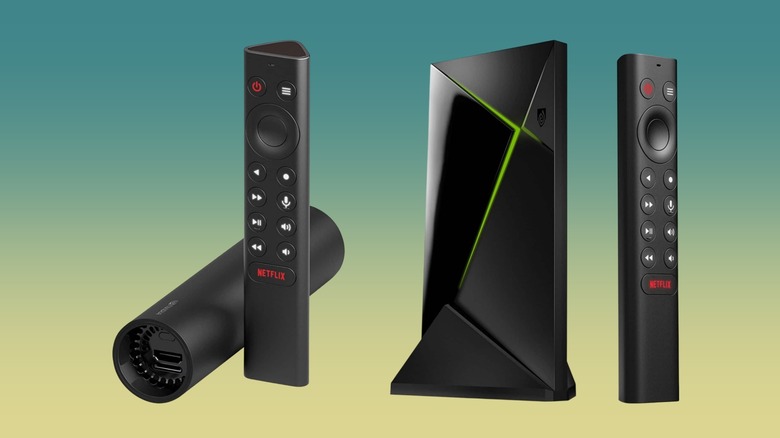
The current version of the Nvidia Shield family, consisting of the Nvidia Shield and Shield Pro, was introduced in 2019. Both devices use Nvidia's Tegra X1+ processor and run on the Android TV platform. The Shield devices — particularly the Shield Pro — are quite popular among home theater users due to their versatility and expandable storage. More importantly, the Shield Pro can function as a Plex media server or a network-attached storage. Connect an external hard drive, and you have a basic media server. Both devices can also stream 4K HDR content, plus there's Dolby Vision support. However, support for HDR10+ content is absent. Audio format support is solid, and it can process Dolby Atmos on its own and can pass DTS:X to your soundbar or AV receiver. Plus, it's known for its superior AI-enhanced upscaling.
Another advantage of the Shield devices is the built-in support for the GeForce Now cloud gaming service. Being Android TV devices, these have access to the Google Play Store, which houses apps for all popular streaming services, VPNs, and more, and are also tinker-friendly. However, the Shield devices have started showing their age, and even though they continue to receive software updates, the hardware obviously remains the same. They also lack hardware decoding support for AV1, a modern and more efficient codec increasingly being used by streaming services. You also have to deal with advertisements as part of the Android TV interface. So, if you want a media streamer that's tinker-friendly and supports Plex media server and audio passthrough, you can pick one of the Shield devices per your needs. They also make sense if you aren't really part of the Apple ecosystem, but are mindful of their age and how long you plan to keep the device.