

Does Your Old TV Emit Radiation? Here's What You Need To Know

If you're a classic collector, you might've been lucky enough to snag yourself one of those old retro TVs, a CRT (Cathode Ray Tube). The tech has been around for over a century, having been invented in 1897 by Karl Ferdinand Braun. The bulky TV sets and monitors boomed in popularity until the early-2000s, when Plasma and LCD TVs and monitor displays began replacing them. Flat-panel tech completely took over, but you can still find CRTs.
People still sell and buy them on online marketplaces like Craigslist, eBay, Facebook Marketplace, and even at facilities that recycle electronics. Given the age of CRTs, you might have some concerns. One concern is radiation. While it's true that CRTs emit a small amount of radiation, it's not nearly enough to be dangerous.
If you pay attention to history, that wasn't the case in the 1960s, which was enough of a concern to force health regulations, like the Radiation Control for Health and Safety Act of 1968, to help limit emissions. So what led to CRTs becoming safer, and why are some still worried about the radiation that this ancient tech is responsible for?
CRTs do emit radiation, but it's not as bad as you think
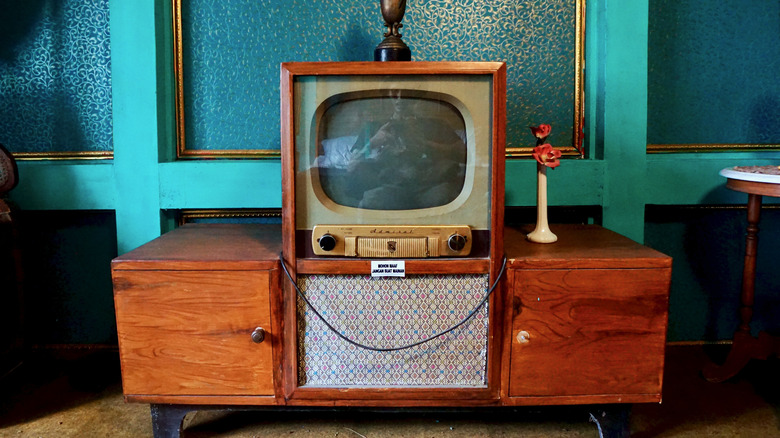
Before diving into why CRTs' radiation levels aren't considered dangerous, it's essential to understand how CRTs emit radiation and why it was once a concern. Simply put, radiation is produced by unstable atoms. One of the possible energy products from an unstable, decaying atom (outside of ionizing radiation) are X-rays. X-rays are similar to gamma rays. X-rays are what's being produced by CRTs. What happens is the electron gun creates high-energy electrons, which strike the screen (phosphorus coating), causing rapid deceleration. When rapid deceleration occurs or when Bremsstrahlung radiation is produced, electrons lose energy, emitting X-rays as a byproduct. From what we already know, it's X-rays that can harm the human body, and while medical technology uses them, there are always strict safety procedures medical professionals have to follow in order to limit exposure.
The reason you shouldn't be worried, especially if you're a retro gamer and enjoy using retro technology to recreate nostalgic experiences, is that newer CRTs have a way to control the dosage (or the exposure) of the emitted X-rays. Modern CRTs are equipped with specialized, lead-doped glass shielding. The lead-doped glass shielding uses lead, barium, or strontium to absorb X-rays and prevent them from escaping.
It's also used to absorb X-rays, converting them to heat before they leave the tube. That reduces exposure by a lot, almost to a minuscule amount. So, no, the radiation emitted won't kill you; in fact, it's close to harmless thanks to the enforced safety precautions placed by the radiation safety act. CRTs TVs and monitors manufactured in the 1970s or later should absolutely be safe to use.