

Your Future Robot Companion Might Actually Be A Human Stranger — Here's Why
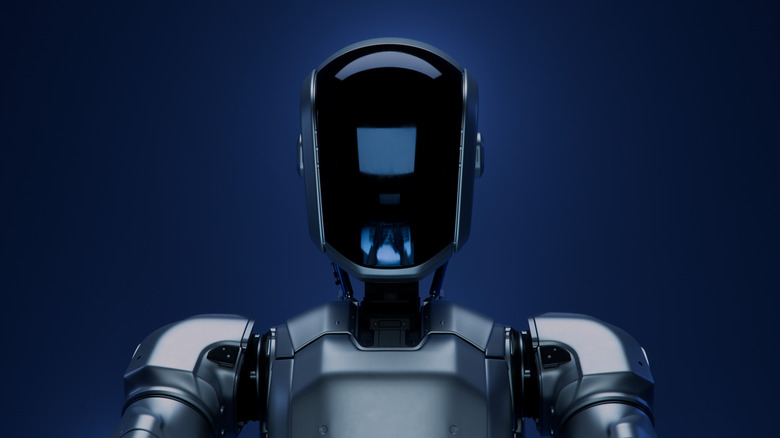
A hotly-anticipated line of humanoid robots is giving a whole new meaning to the concept of "stranger danger". The 1X NEO robot is set to become one of the first mass-marketed humanoid robots available for home service. It's produced by Silicon Valley robotics company 1X Technologies, and is already available to pre-order online at the price of $20,000 (or a $499 per month subscription). NEO is specifically designed to help people with tedious household chores, such as vacuuming, folding laundry, and doing the dishes. However, NEO is not fully autonomous. Anything beyond its most basic tasks will require a real human to operate it remotely, meaning they'll be able to see all around your home.
At this point, NEO can only perform the most basic tasks autonomously, such as opening a door. If a task takes more than 30 seconds, it's probably too much for the robot to handle on its own. That's where the remote-assistance feature comes in. Users can schedule chore sessions, during which an employee at 1X will take over, operating the robot remotely from the company's California headquarters. During this time, the 1X employee will be able to see through NEO's eyes and hear through its ears. Naturally, this has raised significant privacy concerns, but 1X has emphasized that there is an option to opt out of certain data collection and sharing practices from the real-time video feed.
Why can't robots just work autonomously?
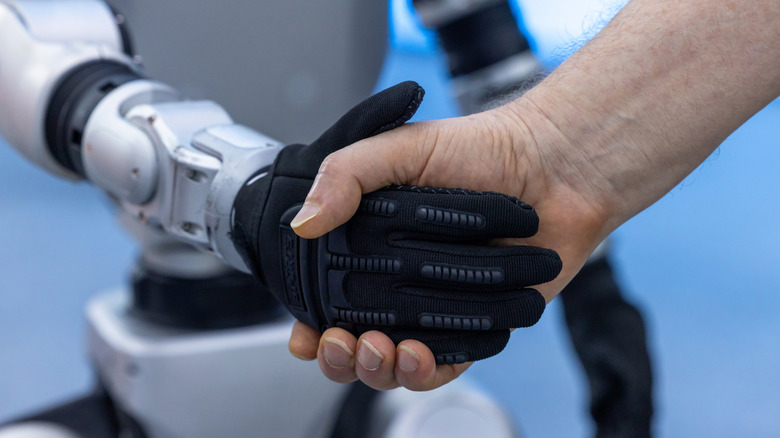
The idea of someone remotely operating a robot in your home is not just eerie; it fundamentally goes against the definition of a robot, which is supposed to operate automatically. When a real human being is in control of NEO, it's really just a very high-tech puppet. That technology is impressive in its own right, but it's probably not what people are expecting when they picture a future of robot assistants.
The team at 1X is well-aware of this fact, and they've explained that teleoperation is a short-term plan intended to help NEO become fully autonomous in the future. In an interview with the Wall Street Journal, 1X CEO Bernt Børnich framed the first shipments of NEO as an experimental process, with customers collectively helping the robots learn vital skills. He aims for NEO to be fully automated one day, but acknowledged that this may only happen by gathering significant amounts of data with permission from early users.
As anyone who has ever had a job knows well, you can't get to work without going through training first. Artificial intelligence is no different. Just as AI chatbots use data from user interactions to learn conversational skills, humanoid robots also need to learn to emulate their flesh-and-blood operators. This requires training in the field (i.e., your home) to learn chores, and during this learning period, teleoperation will be needed. This is why NEO can gather data from what it sees in your home, building a massive database of knowledge, motion, and navigation skills.
How teleoperated robots will work in the home
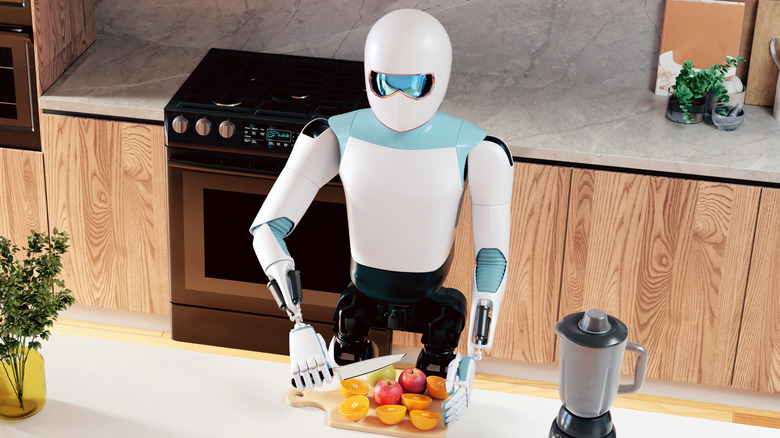
Teleoperation will be a necessary reality in these early days of humanoid robotics, regardless of the manufacturer. Chinese company Unitree has made a similar pitch to 1X, telling customers that most tasks will require teleoperation in order to train their robots. Even Tesla's much-hyped Optimus robot was seemingly busted for teleoperation at a tech expo in 2025. However, the idea that a stranger could be spying on you and your family through a robot's eyes remains a frightening prospect to many.
Proponents of these robots argue that we already sacrifice our privacy every time we call a human housekeeper, electrician, plumber, or other home service provider. But skeptics worry that even if the teleoperators are vetted, live-in robots present unique concerns if hacked. What's important for NEO owners to know is that these particular models will only be teleoperated upon request. All NEO owners will have to download an app to schedule tasks, which they can terminate at any time. Additionally, when a teleoperator has permission to take over NEO, the robot's ears will light up blue, so users know when someone has eyes and ears on their home.