

China's Farming Robots Are A Lot More Than Just Fancy Tractors
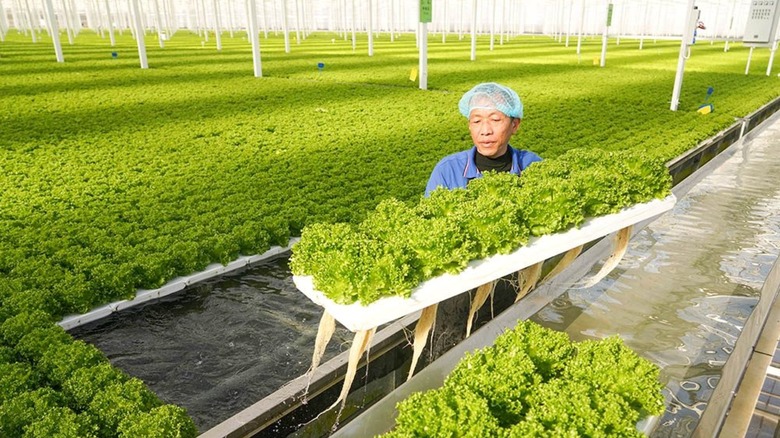
Much has been made of the AI race between the U.S. and China as the two national powers jockey for leadership in the world's fastest-growing industry. To some Western observers, China's progress in autonomous robotics is a cause for concern. But the nation's robotics revolution extends far beyond surveillance and military uses, existing at the junction of increasingly capable computing, manufacturing, and industrialization capacities. This confluence is perhaps best exemplified by China's advancements in smart agriculture, where engineers are bringing autonomous robots to the country's crop farming, livestock, and aquaculture industries. By developing autonomous robots to help plant and harvest crops, control pests, identify diseases, monitor livestock health, and even socially engineer fish behavior, China has achieved several major milestones in its robotic farming program.
Beijing highlighted its ambitions to boost AI farming in the Ministry of Agriculture and Rural Affairs' National Smart Agriculture Action Plan. In the plan, the government outlines its expectation for more than 30% of its agricultural production to be led by information-driven systems by 2026. Spearheading this nationwide smart-farming initiative is the Chinese Academy of Sciences, which has developed a national strategy for fostering groundbreaking advancements in robot-assisted farming throughout several Chinese provinces. To accelerate these developments, Beijing has established 34 innovation labs and 35 IT laboratories dedicated to smart agriculture. As a result, farms across the country have begun employing LLMs and autonomous robots in their operations. This trend could pioneer a new global agricultural landscape in which AI drives progress in multiple endeavors, from fighting potato blights to genetically modifying crops.
Automation is becoming a fixture in Chinese farming
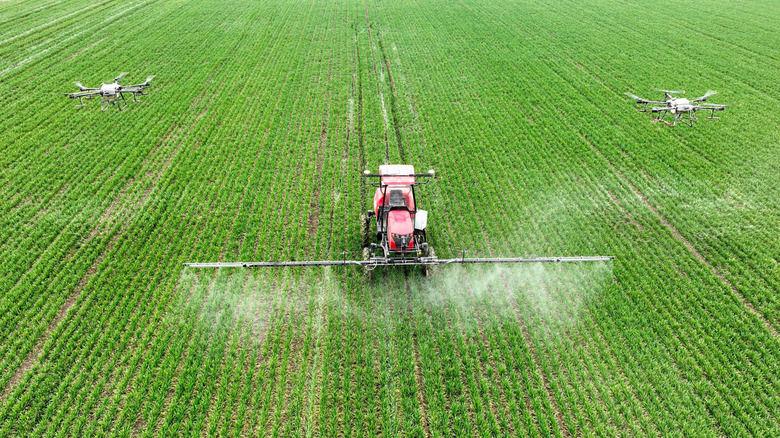
Robotics is playing an increasingly important role in China's crop management systems. For instance, in China's Sichuan province, autonomous robots inspect rice fields using blacklight cameras, funneling data through their built-in AI systems to flag both pests and diseases. At another farm, "smart brain" systems remotely monitor fields to gather data on soil quality, crop health, and environmental trends, enabling forecasts on crop growth, yields, and pest outbreaks. One WeChat-controlled set of farming robots can plant seeds, harvest crops, and remove weeds.
Some projects have even applied AI-driven robotics to crop breeding, with one team of scientists having sped up crop development by 400% using the technology, per SCMP. This process was facilitated by "robot-friendly" crops that are designed to be easier for robots to pollinate and harvest. By employing these same autonomous robotic systems, some Chinese farms have been able to fully automate their crop cultivation processes.
Beijing's use cases for robotics in farming go beyond crops, however. One robot developed by Muyuan Foods Co., Ltd. utilizes smart sensors to monitor and analyze animal biometrics. Fisheries have also begun developing high-tech autonomous solutions that monitor fish behavior and growth patterns. For example, at Beijing's National Innovation Center for Digital Fishery, robotic fish modeled after tuna and dolphins swim through breeding tanks to monitor fish patterns, environment health, and net infrastructure; they achieve this without disturbing their aquatic counterparts. Developers hope these robotic fish might eventually lead schools of fish to designated harvesting and feeding areas, on top of potentially being used for deep-sea exploration.
Advancements in Chinese robotics fit into broader economic trends
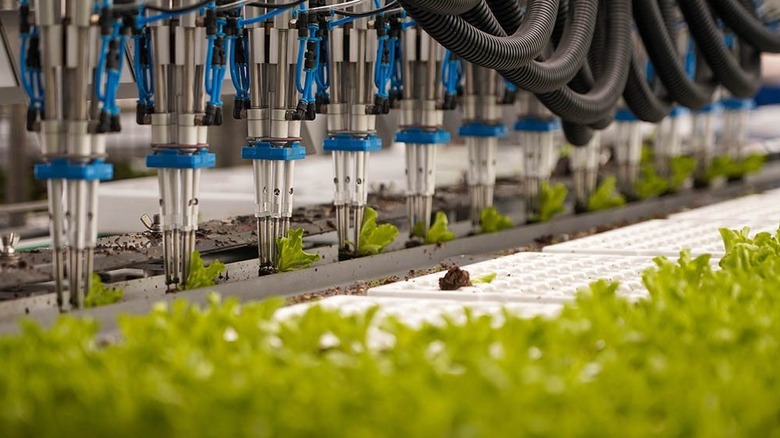
China's robotics revolution coincides with broader leaps in data analysis and agricultural machinery. Using data from autonomous robots, drones, and other intelligent farming systems, Chinese engineers may be able to take the guesswork out of irrigation, pest control, and planting schedules. Farmers have begun using smart farming to analyze factors impacting crop growth — including temperature, rainfall, soil moisture, and mineral levels — to better define irrigation needs, plan drought responses, and predict ripeness. In one farm, autonomous drones collect crop maturity data to produce horticultural maps that can guide harvesting.
Compounded with its advancements in robotics, China is also seeing substantial growth in its domestic machinery production. The nation exported $9.3 billion in agricultural machinery in the first half of 2025 — a 26.5% jump from the previous year, according to Global Times. Domestically produced intelligent harvesting technology, including AI-assisted corn harvesters, points to a major shift in an agricultural industry that has historically depended on imported high-end machinery. According to a Xinhua English-language report on seed technology, the northwestern Xinjiang region of China has seen particular success from these advancements, achieving a 97% mechanization rate in its cotton farming practices.
Some experts do question the scalability of intelligent automated farming systems, particularly in a country with a diverse climate, geography, and crop output. These variables introduce significant challenges in building standardized, cost-effective autonomous farming systems — and given the industry's historically small profit margins, cost is a particularly pressing consideration. But combined with other technological leaps, such as "smart soil" that grows bigger crops with less water and insect drones that can pollinate crops, the global agriculture industry just might be on the precipice of its next technological revolution.