

NASA's Artemis II Rocket Has A Potentially Dangerous Flaw That Has Experts Worried
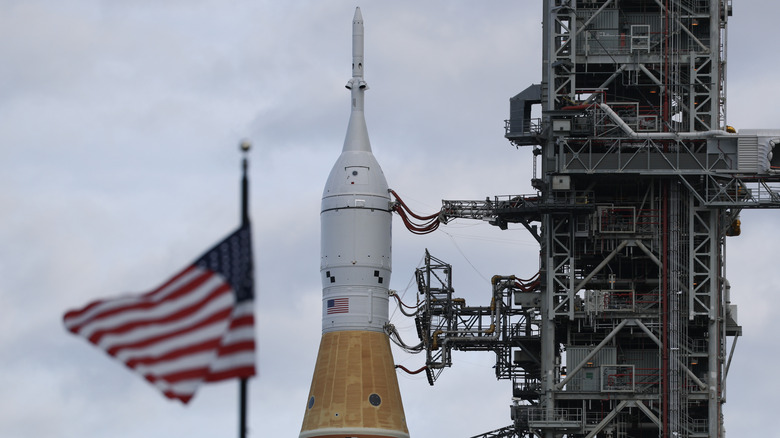
NASA is sending some astronauts on a little trek out of Earth's orbit and around the moon, which is just the start of its current plans to send crewed missions back to the lunar surface. This is an unprecedented and extraordinary time for space exploration as the new-age space race aims to expand what is known about Earth's celestial neighbors, but there's one glaring issue with Artemis II's Orion spacecraft that most experts are worried about. As it turns out, the heat shield on the craft — a special coating on the bottom of the craft to help protect inhabitants from extreme temperatures — may be faulty if the prior mission is any indication.
The Orion from the historic Artemis I had a near-identical heat shield, and upon its re-entry, its heat shield suffered damage. As the initial coating charred, it didn't break off as predicted but instead left cavities in the material. That first mission was unmanned, but Artemis II won't be. NASA investigated the issue and believes it has taken care of the problem. According to Ars Technica, Jared Isaacman, the new NASA chief, said, "We have full confidence in the Orion spacecraft and its heat shield, grounded in rigorous analysis and the work of exceptional engineers who followed the data throughout the process."
Instead of changing the heat shield, NASA will alter the entry profile or trajectory of the craft, designed to take a higher heat load for a couple of minutes mid-flight. Using modeling and testing methods, like arc jet testing, they believe the new trajectory and higher heat exposure will produce less cracking in the Avcoat material — the coating used for the heat shield.
What are the experts saying?

While NASA's team assures that they have the problem sorted, there are some experts who don't agree. Dr. Charlie Camarda, a former mission specialist with multiple graduate degrees in engineering who flew on space shuttle Discovery in 2005, says NASA's new plan "is crazy." In a CNN report, Camarda claims NASA "keep kicking the can down the road," .
Another former astronaut, Dr. Danny Olivas, originally said, "This is not the heat shield that NASA would want to give its astronauts." But after some of the changes, particularly the new entry profile, Olivas now believes NASA has a handle on the situation. Olivas was a part of the independent review team responsible for the initial investigation of the Artemis I heat shield.
It's obviously difficult to say who is right here, as there's no reason to believe NASA would send astronauts on a mission knowing their lives are in danger, but it does paint a cautionary tale. Luckily, the Artemis II mission is expected to launch in early 2026 (no earlier than February 6), so the tension will be lifted soon.