

3 Handheld Consoles More Powerful Than The Steam Deck
We may receive a commission on purchases made from links.
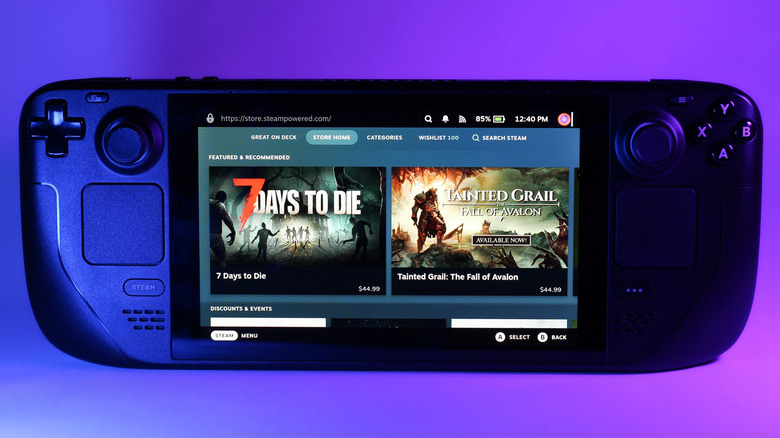
The original Steam Deck is four years old at this point, though you'll have a hard time buying it now. The company has pivoted to its late-2023 refresh as the only new model now, bringing a bigger screen and battery, a higher refresh rate, and faster Wi-Fi, all while shrinking the custom AMD APU (Accelerated Processing Unit) from seven cores to six for improved efficiency. Still, there are certainly handhelds on the market right now that are more powerful than the Steam Deck. From larger handhelds with bigger screens to Xbox-branded devices, you have a handful of options at your disposal if you're looking for a new gaming handheld that can outclass the Steam Deck on specs alone.
But just because something is technically better on paper, sporting beefier specs, doesn't actually mean the user experience is an improvement. So far, Valve has nailed its ability to offer a console-like experience on the Steam Deck, something that can't be equally said about handhelds running Windows. While Microsoft is making efforts to better compete on the UI front in handheld gaming, the truth is that even its latest attempts leave many gamers wanting.
You could argue that Windows handhelds aren't as polished as Valve's Steam Deck, since they use Windows rather than SteamOS (which is based on Linux), but at the end of the day, many offer more powerful chipsets, higher refresh rates, and larger screen resolutions, albeit with matching higher retail prices. So yes, there are handheld consoles on the market that are more powerful than the Steam Deck, but whether or not they offer gaming experiences that are more enjoyable depends on how much you require a unified console-like UI.
Asus Rog Xbox Ally X
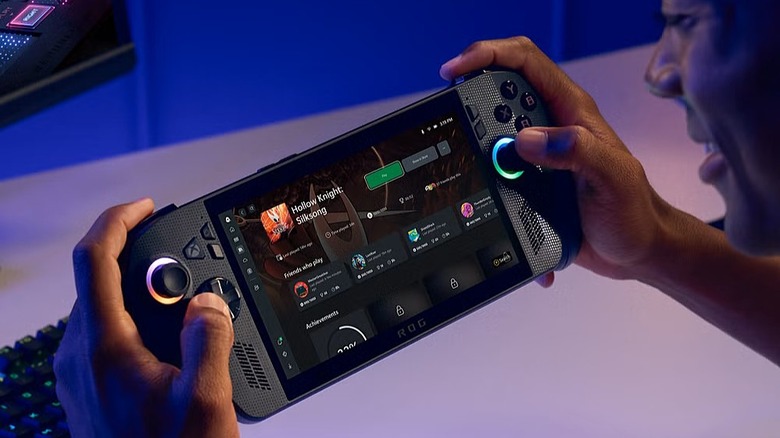
Asus hasn't done anyone any favors with its confusing naming scheme. You have the Rog Ally using a Ryzen Z1, released after the first Rog Ally using the Z1 Extreme. A refresh of the first two models, known as the Rog Ally X, is also using a Z1 Extreme. To make matters worse, Microsoft has teamed up with Asus to create two unique devices: the Rog Xbox Ally with a weaker but more efficient Z2 A processor, and the Rog Xbox Ally X, with an AI Z2 Extreme, comparable in performance to the Z1 Extreme at the high end. The Xbox Ally X is the most powerful Asus handheld at the moment, offering improvements to battery life with efficiency gains at lower power levels.
The Rog Xbox Ally X was created with Microsoft and uses an updated Windows-based gaming user experience dubbed the Xbox FSE (full-screen experience), allowing the Xbox Ally X to boot straight into a console-like UI. This new UI actually improves performance compared to booting into Windows, as it reduces RAM use. Still, unless you're a heavy Xbox user who dips into Game Pass frequently (which seamlessly works together with the FSE), Xbox FSE is considered less polished than SteamOS.
Even though the Rog Xbox Ally X is more powerful and offers a handheld that gets closest to Valve's polished console-like experience thanks to Xbox FSE and an ergonomic design, it costs almost twice as much as the $549.99 OLED Steam Deck at $999.99. You certainly won't get twice the performance, but if raw power is an absolute necessity, the Rog Xbox Ally X easily wins that battle.
MSI Claw A8 BZ2EM
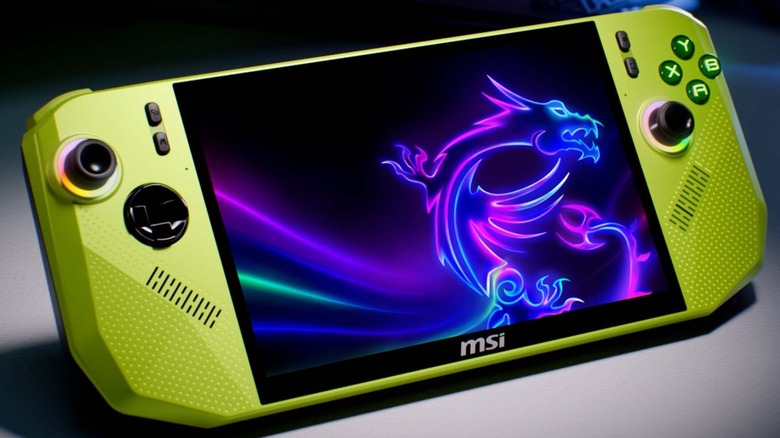
MSI offers a few different handhelds that run Windows. Much like Asus's confusing naming scheme, each MSI model offers a slightly different name, starting with the Claw 7 AI+ A2VM, which is actually built on an Intel Core Ultra 7 processor rather than an AMD chip. Then there is the Claw 8 AI+ A2VM, which uses the same chip but bumps the screen size to eight inches, along with a larger 80Wh battery and faster storage. Last is the AMD model, the MSI Claw A8 BZ2EM, packing a Ryzen Z2 Extreme, the same chip used in the Rog Xbox Ally X. This means you can expect similar performance, but with a loftier price at $1,149.99.
The Claw A8 BZ2EM offers a larger eight-inch screen compared to the seven-inch screen of Xbox Ally X, though RAM and storage are similar at 24GB and 1TB, respectively. The Claw A8 ships with its own launcher, MSI Center M, but since Windows FSE is available to everyone on Windows 11, you can easily toggle it on in Windows Settings, under Gaming > Full screen experience. This will bring the user experience closer to that of the Rog Xbox Ally X if you require a console-like experience that goes beyond the limitations of MSI Center M.
Still, this only gets you so close to the experience of using a Steam Deck, since Windows FSE still needs to be polished further. MSI's Windows UI won't beat the Steam Deck for ease of use and unified design. However, if you require the most raw power, the MSI Claw A8 easily stacks up to the Rog Xbox Ally X, since they both use many of the same internals, easily trouncing the older and weaker chip of the Steam Deck, suitable for anyone looking for an alternative.
Lenovo Legion Go 2
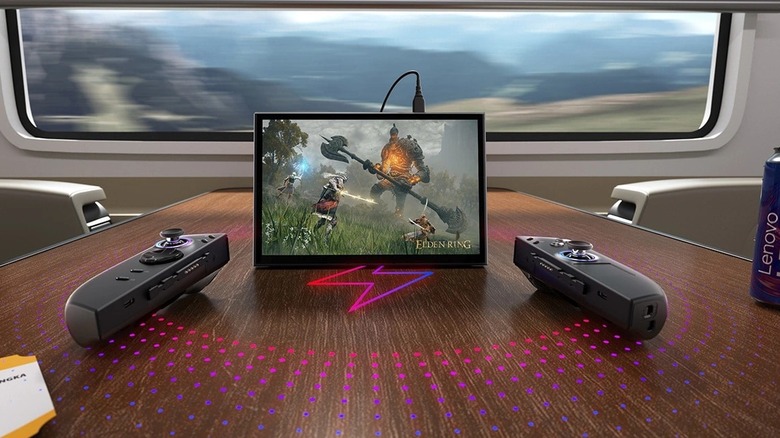
Asus and MSI aren't the only manufacturers making handhelds with the new Ryzen Z2 Extreme processor. Lenovo quickly launched the Legion Go 2, but underestimated demand and had to cancel some orders for it in late 2025. The $1,099.99 handheld boasts a Ryzen Z2 Extreme and a large 144Hz 8.8" 1920x1200 OLED screen, not to mention the brand's signature removable controllers (similar to the Nintendo Switch), making for what appears on paper to be a best-in-class handheld that doesn't compromise, explaining the high demand. Of course, Lenovo offers several PC handhelds, including the Legion Go with a Z1 Extreme processor, and the Legion Go S, which runs Steam OS on a weaker Ryzen Z2 GO.
Since demand for the Lenovo Legion Go 2 is so high, for now you'll have to keep you eye's peeled for restocks, as they do happen from time to time. Sadly, there is no telling which store will wind up with a few models to sell, so it's recommended to use a tracking website to receive alerts when the next restock happens, no matter which store is lucky enough to get a fresh supply.
Then again, perhaps you'll want to wait for the Steam OS version of the Legion Go 2, slated for release in June 2026 at $1,199, which sharp eyes will notice is actually pricier than the original Windows version. Thanks to factors like tariffs and the current RAM shortage, handheld prices can fluctuate, so the cost of the Legion Go 2 running Windows could rise to match or even exceed the Steam OS version.