

The First Live-Action Movie To Use CGI Also Spawned An Emmy-Winning HBO Series
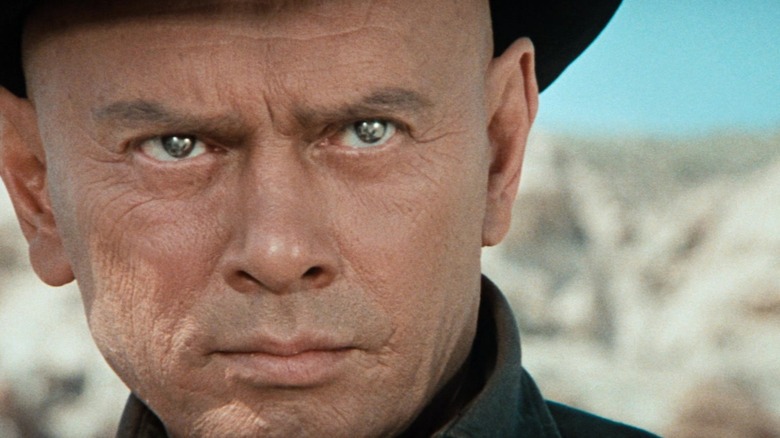
The 2016 HBO series "Westworld" was one of the most popular TV shows upon its release, as evidenced by its 57 award wins and 214 nominations throughout its run. The series earned a 2017 Emmy for Outstanding Special Visual Effects, which is fitting since the original film it's based on was actually one of the first films to implement CGI. The 1973 film, directed by Michael Crichton of "Jurassic Park" fame, called for scenes from an android's perspective, resulting in cinematic history.
Along with serving as the inspiration behind the 2016 series, the original "Westworld" also takes credit for being the first live-action film to utilize CGI within its scenes. For the original film, the process was rather complicated, needing a rather novel technique that required each frame of a CGI scene to go through a scanning and recoloring process. Just as the director of "Alien" needed a smart trick to solve a visual challenge, "Westworld" would implement a few tricks of its own.
The use of CGI isn't the only reason "Westworld" is a 70's sci-fi film everyone should watch at least once, but it certainly helped cement its legacy in Hollywood. Unfortunately, the original "Westworld" and its tale of malfunctioning androids stalking vacationers at an adult-oriented amusement park is only available to rent on Amazon Prime Video and Apple TV, meaning you'll need to drop about four dollars to see it. However, you can check out the 2016 series on Disney+, Crave, or Tubi if you're so inclined.
1973's Westworld first to use CGI with live-action
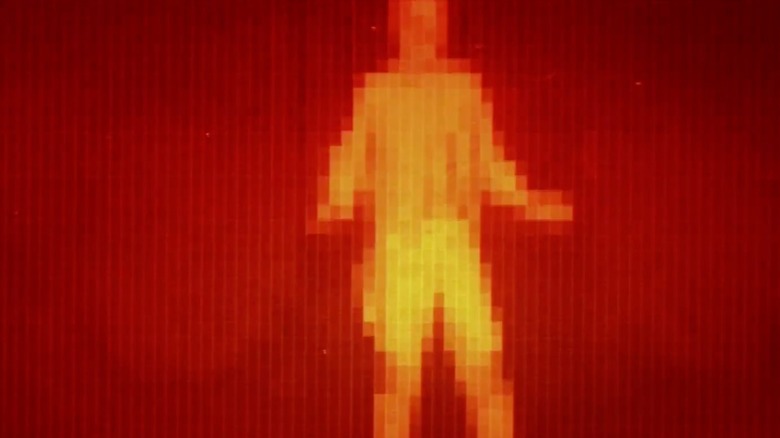
There were two movies that used CGI prior to "Westworld." Alfred Hitchcock's 1958 "Vertigo" used it for patterns in its opening sequence, whereas Stanley Kubrick's 1968 film "2001: A Space Odyssey" used it to display vector graphics on a computer. However, what makes Michael Crichton's "Westworld" special is that it blends live-action shots with CGI. Specifically, CGI was necessary to show the perspective of the android Gunslinger (Yul Brynner) as he hunts Peter Martin (Richard Benjamin) and John Blane (James Brolin).
It was John Whitney Jr. who was responsible for the visual effects in "Westworld," and he knew he was going to need new tech for the 14 computer-sequenced shots in the final movie. While NASA's Jet Propulsion Laboratory had the necessary tech, it was far too expensive. Instead, Whitney partnered with Gary Demos of Information International, Inc., who was able to color-separate and scan each individual frame of footage into rectangular blocks. From this, color was added, creating a matrix of pixels that could be added back into the film.
According to Whitney, testing this process took over two months, including determining what shots would look best from this new perspective, as well as using special costumes for actors that would appear in these scenes. "It was a slow business," Whitney wrote about the scanning process in American Cinematographer, "requiring about one minute per frame, or about eight hours for a 10-second sequence." While not an easy process, it's one that helped shape the future of CGI in movies and spawned an award-winning series.