

NASA's Artemis II Spacesuits Still Have One Big Problem, According To Former Astronauts
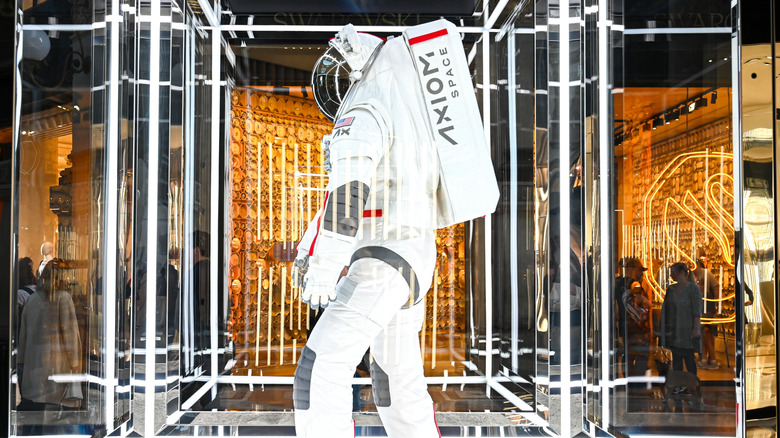
You would think that NASA has everything ironed out for its biggest mission series yet: the Artemis missions, which will eventually send a crew of astronauts to the lunar surface. But as Artemis II gears up to launch and the rocket is prepared for takeoff, NASA is still adapting, though not necessarily for the better.
For example, the Artemis II Orion craft had a potentially dangerous flaw that saw NASA adjusting its reentry trajectory to address it. That flaw was originally discovered during the Artemis I mission, when the craft's heat shield saw char loss. Meanwhile, the new spacesuits pose another big problem: They will reportedly be heavier and bulkier than those worn during the Apollo missions (dubbed the Armstrong spacesuit). After over half a century, the astronauts will be wearing suits that have taken a step backwards in the heft department. It may not seem concerning since they'll be bouncing around in zero gravity, but former astronauts put that idea to bed. Being on the moon will actually create "extreme physical stress" on the astronauts for several reasons.
Kate Rubins, former astronaut and professor of computational and systems biology at the University of Pittsburgh School of Medicine, explains that during a moonwalk, physical stress is elevated. For starters, "people are going to be sleep shifting," which means they'll barely rest. Moreover, the astronauts will be wearing the suits for up to nine hours and doing EVAs (extravehicular activities or spacewalks) every day. According to Rubins, the spacewalks she did outside the ISS were like doing multiple marathons in succession.
Why does the weight of the spacesuit matter?

As Rubin explains, the Axiom commercial suits (aka the Axiom Extravehicular Mobility Unit, or AxEMU) will create added physical exertion and stress during the moonwalks. Not exclusively from the suits, but also equipment astronauts will be wearing and carrying, like a heavy life support backpack. The suits weigh over 300 pounds in Earth's gravity, though due to the lower gravity — about 1/6 of Earth's — they're lighter on the lunar surface. They'll still be heavier than the original 185-pound Armstrong suits. Each astronaut will also have to contend with the weight of the suit, the equipment, and their body mass collectively. Artemis III will not have a rover, either, so astronauts will be taking all physical exertion upon themselves to move equipment, tools, and other gear.
The AxEMU suits do a lot of things right, per official descriptions. They're safer and built to last generations, and they offer a custom fit for everyone. NASA and the Artemis astronauts promote the increase in mobility the Axiom suits offer. With a lot of those improvements thanks to the rear-entry design. Astronauts can get in and out themselves without help. Moreover, the suit is engineered for planetary or surface walks, which means support for legs, more upper mobility, and modular support to bring various tools.
Even so, the weight may pose a challenge bigger than anyone is expecting. Former astronaut Harrison "Jack" Schmitt, from the Apollo 17 mission, once remarked he would have designed suits to have "four times the mobility, and half the weight." The AxEMU may have more mobility, but it's also heavier. We'll know soon enough how it works out, as NASA is already building the Artemis 3 rocket, which will fly after Artemis II's loop around the moon.