

The Simple Trick To Get More Range Out Of Your Car Key
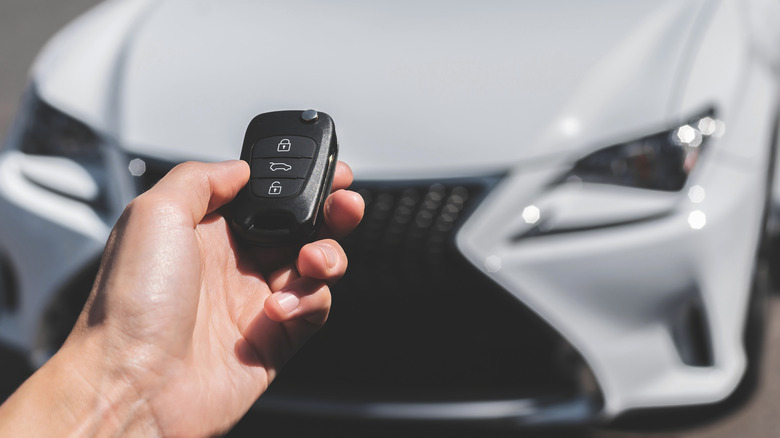
If you've ever been in a situation where you wanted to unlock your car from a certain distance or locate it in a busy parking lot but are out of range, there's a strange trick that lets you boost the range beyond its technical capabilities. All you have to do is hold the car key against your head and press the buttons. This will help extend the key fob range and the car might respond. If it does work, the doors will open, and you'll see the blinkers come on to mark the connection. The obvious caveat applies: if you're still too far from your car, the key fob's signal will not be able to reach it. You'll need to approach the vehicle if you know where it is or keep walking randomly while pressing buttons.
This is where we tell you there's a permanent fix for locating a car in a parking lot. You can use your iPhone or Android phone to save your parking spot, but you have to remember to do it every single time. However, this still doesn't fix the range problem.
So, how can the human head amplify the key fob's signal? Maybe it's just a coincidence; you raise the fob to head level, and that's how the signal works. But it turns out that the trick is real, and it's backed up by science. Your head becomes an improvised antenna, and this boosts the car key's reach. Popular car show "Top Gear" and The New York Times mentioned this unexpected tech find, while others ran experiments to prove the human head can extend the range of a regular key fob.
The car key and human head experiment
The science behind the trick indicates that the fluids in the human head can act as a conductor for the fob's signal. Altair ran an experiment that proved the human head can extend the signal's range. They used a remote keyless entry (RKE) signal and recorded its range in three scenarios. First, they recorded the signal without a human body present. Then, they introduced a human model into the experiment, who held the key with a stretched arm. Finally, the RKE was moved to touch the human model's head. The third scenario gave the key the longest range.
Jeremy Clarkson's experiment on "Top Gear," shared on YouTube in 2007, was even simpler. He used the key fob from about 40 yards (120 feet), and the blinkers turned on. He moved another 10-15 yards (30-45 feet) away from his car, at which point he was out of range. Then, he placed the key against his head, and the trick worked. The blinkers turned on again when he pressed a button.
Clarkson's quick test inspired the YouTube channel Sixty Symbols to run the same experiment a few years later. After showing that the human head acts as an antenna for the car key, Professor Roger Bowley used an unexpected prop to increase the fob's range beyond the capabilities of the human head. He placed a large bottle of water on his head, which gave the key even better range.
The method isn't perfect but worth a try
Both the iPhone and Android phones can be used to store your car key , but you may be wondering whether using a cellphone can extend the range more than the human head antenna trick. Unfortunately, while the iPhone and Android devices can be used to control cars, their range is limited by design for security reasons. For example, Hyundai says cars that support Digital Key 2 technology will unlock when the user is within 1.5 meters (4.92 feet). Similarly, some Kia cars can be unlocked remotely by the user's phone, but only when you're within a 1-meter (3.28 feet) radius.
If you need better range, you can perform the same test with your key fob to see what sort of signal boost you can count on. As Bowley notes in the video, this can be a fun experiment to do with children. By the end of your tests, you'll find out the maximum range your key fob supports when "connected" to your head.
On that note, if you're in a busy parking lot and the head trick doesn't seem to work, consider turning around. The car could be located in the opposite direction, and that's why your "head-antenna" can't reach it. Altair's experiment indicated that the human head doesn't extend the signal uniformly, so facing the car can improve the range.