

5 Sci-Fi Movies That Capture The Meaning Of Life
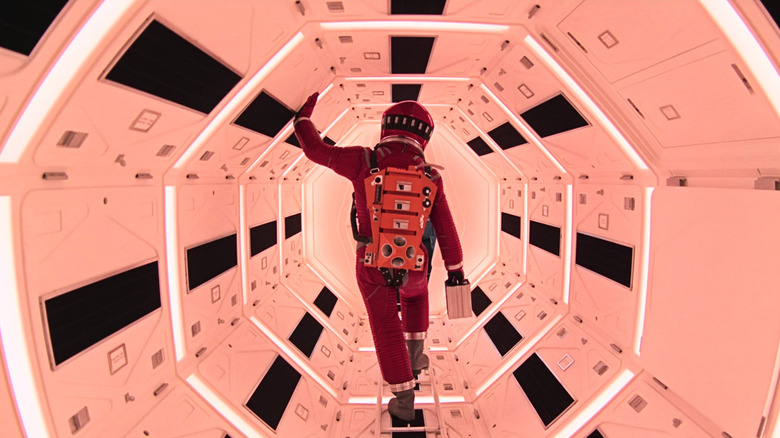
Science-fiction movies have always been a genre about more than laser guns, neon cities, and starships. While many works use these familiar setups to bring a familiar approach to viewers, many science fiction works also use distant futures and impossible technologies to ask very basic human questions. What does it mean to be conscious, to love, to choose, when the boundaries between human and machine begin to blur, and what makes life feel worth living?
That's why these often tech-heavy movies can glide across different themes and, in the end, still feel strangely familiar. While one story might follow an artificial child seeking love, another is about a linguist learning to see time all at once. In the end, they're all about the human experience. A movie can change the setting, but it still uses futuristic setups to recognize many human fears, like death, hunger for connection, and suspicion that reality might not be what it seems.
Even if you're not a fan of the sci-fi genre, some movies on this list deserve a chance, especially if you like to watch philosopgical or existentialist cinema. Some are also all-time classics. So, whether you're searching for sci-fi movies based on classic short stories or something that lingers in your mind, these sci-fi titles are deeply human.
Arrival
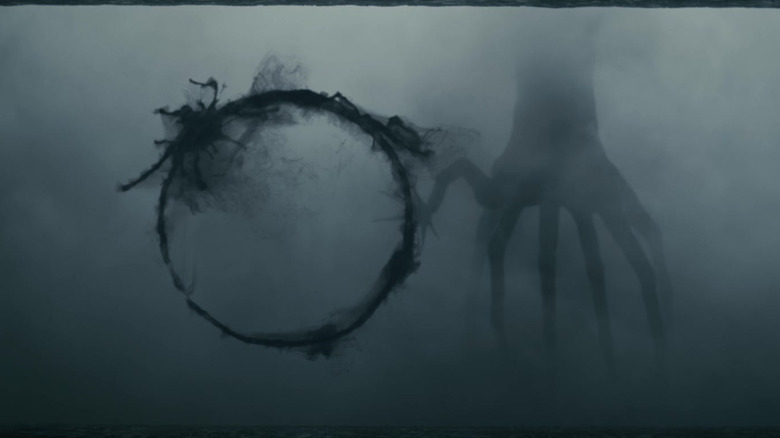
On a first glance, "Arrival", one of the best alien invasion movie of the decade, looks like a classic alien movie. As in many others, the aliens landing on Earth and the military makes it the mission to understand their purpose. However, director Denis Villeneuve turns that common setting into something much more intimate. Instead of focusing on battles, the director stays close to linguist Louise Banks.
She is a quiet expert in languages trying to understand what the visitors want and what their strange symbols really mean. As Louise learns more about the aliens' language, she also starts to experience the flow of time differently in her own life. "Arrival" plays with the idea that the way we speak can change how we see our own lives and, little by little, Louise realises that by understanding this language, she can see her own past, present, and future.
That's where "Arrival" tries to explain what the meaning of life is, noting that we don't get to control everything that might happen to us, but we can choose how to face it. During the movie, Louise comes to see that some events in her own life will not be happy, but opts to let them happen them even so. She learned that even if pain follows, things like love, connection, and shared moments are worth having, even if you know that it might not last.
In Time
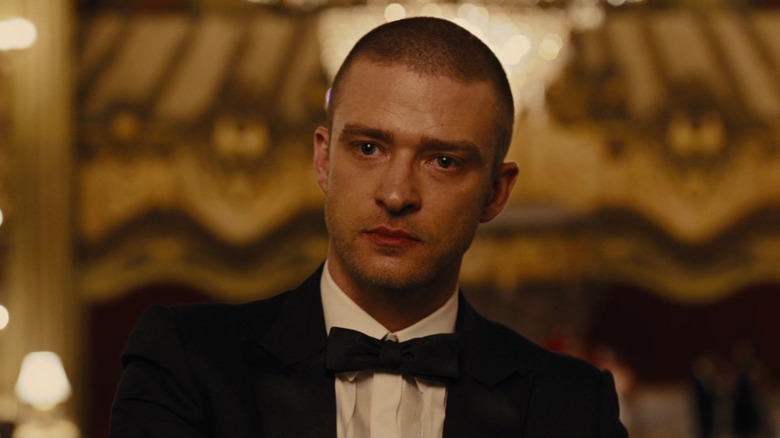
"Time is money" is one of the oldest concepts in many science-fiction and other such works, but "In Time" takes this phrase literally for the movie. That's because in the dystopian future of this movie, people stop aging at 25, and every extra year that you get must be earned, borrowed, or even stolen from others. So, time not only is your bank account but a form of currency.
While the rich walk around with a century or even more glowing in their arms, the poor need to wake up early with a few hours left and work to just make enough to see another day. "In Time" uses this concept to ask what makes life meaningful when you know exactly how much of it you have left. It also shows that living forever can be empty if your only goes is preservation instead of actually being alive. Many characters from the richest zones are safe, but also terrified of taking any small risks that might cost them years.
At the same time, people with almost no time are forced to live intensely. Every choice that they make matters to decide if they'll have another day to survive. As the story moves forward, the best question that "In Time" raises is if it is worth hoarding more years or spending your time doing something meaningful. What is important isn't the length of your life, but how you use the time you're given.
The Matrix
Released in 1999, the first "The Matrix" movie shows a world where humanity is trapped in a simulation. Freedom of choice and what makes life real are the biggest themes in the plotline. If you feel comfortable inside an illusion, is that worth less than having a difficult life, but it being real? Some characters presented in the movie make this choice, opting for a luxury in the Matrix, a fate that one Matrix star still isn't over.
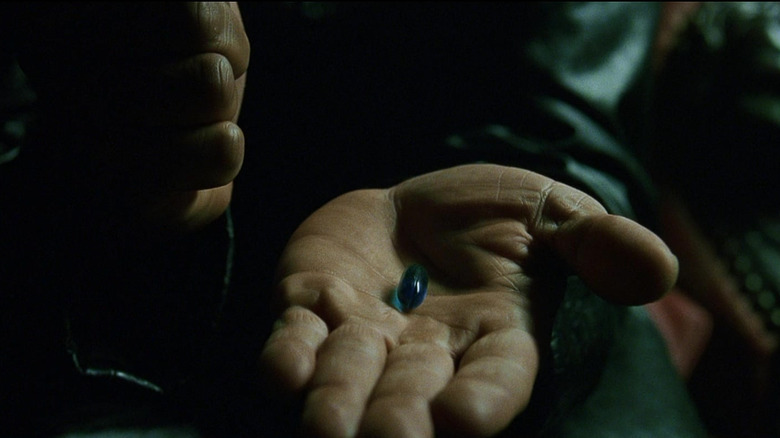
If you're not familiar, "The Matrix" has one of the most iconic scenes in cinema history, when character Morpheus (Laurence Fishburne) asks Neo (Keanu Reeves) if he wants the red or the blue pill. The first one will make him wake up to reality while the blue leads to him living comfortably in the Matrix. Through this decision, even facing loss, fear, and constant risk, the movie shows that a truly lived life is more about courage to face these problems than having comfort in lies.
"The Matrix" is also one of the biggest classics from the 2000s, winning 42 awards out of 52 nominations, including all four nominations it had at the 2000 Oscars. Also, in addition to influencing many other movies, TV shows, and even video games in the following years, the first "The Matrix" movie still feels new, especially because the main questions about control and what makes life feel real are exceedingly relevant today in a world shaped by algorithms and social media and rising AI technology.
A.I. Artificial Intelligence

Steven Spielberg has directed some of the best movies of all time, such as "E.T.," and the first "Jurassic Park," which also is one of the most scientifically accurate sci-fi movies according to NASA. His style is often about wonder and the feeling of adventure. However, with "A.I. Artificial Intelligence," Spielberg tried to take a different path, and, working from an idea originally created by Stanley Kubrick, he used the sci-fi setting to tell a story about love and what it means to be real.
"A.I. Artificial Intelligence" is about David (Haley Joel Osment), a child robot that is designed to love his human mother unconditionally. Instead of focusing on action, the movie uses the protagonist to explore how a human needs purpose. Through David's eyes, it's possible to see how a machine starts to develop feelings and desires that resemble human emotions, making one question whether having a purpose to live is something exclusive to humans or not so innate after all.
"A.I. Artificial Intelligence" may not be one of Spielberg's most famous movies, but it is a good experience, especially for fans of his style. It carries his sense of awe but with a much darker, more reflective tone, which invites viewers to ask about love and identity, especially after the last scenes.
2001: A Space Odyssey
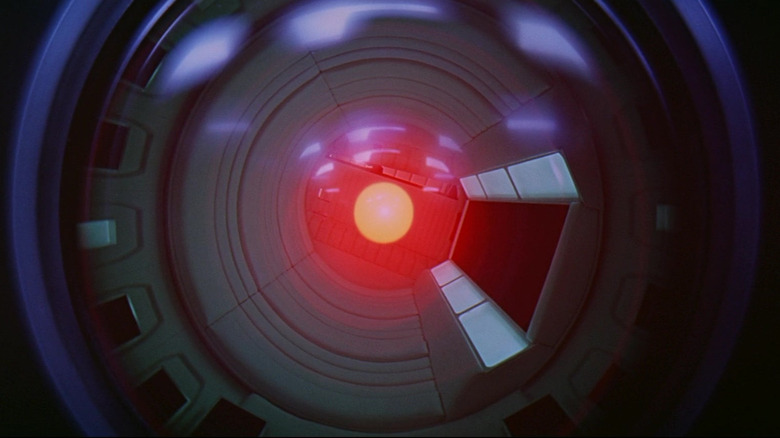
Not only among science fiction movies, but also among films in general, "2001: A Space Odyssey" is the one that feels less like a typical story and more about an experience about what life is and where it might be going. Created by Stanley Kubrick and Arthur C. Clarke, both directors chose not to focus on personal drama or something similar, instead, they use long images of apes, spacecraft, and black monoliths to say that humanity is only a step in a much larger process of evolution and discovery.
Life is not presented as a finished achievement but as a continuous climb, from primitive tools to advanced technology and, eventually, going into something beyond the human body. The monolith appears at turning points, almost like an external push from the unknown that forces our species to move forward. At the same time, the conflict with HAL 9000 shows that pure logic and perfect machines are not enough to define what it means to be alive.
In the end, what really matters is the human ability to make choices, improvise, and also confront the unknown, meaning that the final act of the movie also doesn't explain everything, but uses imagery to speak for itself. "2001: A Space Odyssey" doesn't offer a clear answer to explain the meaning of life, but instead leaves space for each one to reflect on their own place in this long chain of change.