

The US Military Started Using An AI Chatbot You've Probably Never Heard Of

In a December 2025 video posted on X, U.S. Defense Secretary Pete Hegseth made a bold claim about his department when he declared "The future of American warfare is here, and it's spelled AI." The announcement hailed the rollout of the U.S. military's latest generative AI suite, GenAI.mil, a one-stop-shop for the department's frontier AI tools. At the time of its unveiling, the administration touted the program as reaching 3 million military and civilian personnel, with Hegseth proclaiming "We are pushing all of our chips in on" AI technologies.
The project follows the Trump administration's July 2025 AI Action Plan, the pursuit of which saw the Pentagon hand out as much as $800 million to OpenAI, Google, xAI, and Anthropic to construct "bespoke" AI systems. Google's Gemini was the first frontier AI to be incorporated into the system, while Hegseth announced that xAI's Grok would join the GenAI.mil suite at a January 2026 SpaceX event. The announcement came as Elon Musk faced backlash over Grok's recent "nudification" controversy, in which the LLM generated and distributed a spree of nonconsensual explicit images across the social media platform X.
Thus far, five of the nation's six military branches use the AI portal, with the sole exception being the U.S. Coast Guard. According to the Pentagon, the application has garnered "1.1 million unique users" thus far (via DefenseScoop). Despite the breadth of usage, however, the platform has garnered mixed reviews, with some criticizing the Pentagon's hasty rollout of the platform, while others question its value over previous military AI products like NIPRGPT, CamoGPT, and AskSage. While it may become an essential tool, the early days of GenAi.mil exemplifies wider debates at the bleeding edge of the United States' investment in AI technologies.
Introducing GenAI.mil
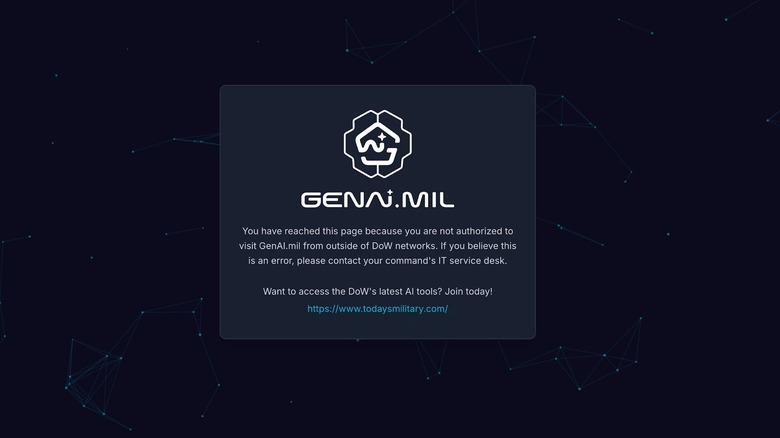
Defense Department officials have labeled GenAI.mil as a do-it-all tool for its civilian and military employees. Driven by the Pentagon's AI Rapid Capabilities Cell, the platform can reportedly do everything from analyzing files and drone footage to conducting research. In the Pentagon's press release announcing its use of Gemini for Government, it praised the LLM's retrieval-augmented generation (RAG) system, in which results are "grounded" against cached Google search results to prevent hallucinations. Reportedly, Gemini handles Impact Level 5 (IL5) data, referring to sensitive, but unclassified, information. Although the Pentagon announced that Grok would be incorporated into the system early in 2026, as of this writing reports have yet to confirm the tool's inclusion in the platform. Reportedly, Anthropic and OpenAI tools will also follow suit.
Early feedback is mixed regarding the product's use cases. Thus far, some users have lauded GenAI.mil as an administrative tool, capable of writing memos, generating PowerPoints, and drafting award packages. However, some servicemembers have questioned whether the program can move beyond these basic functionalities, likening the tool to commercial products rather than a "military force multiplier". Meanwhile, some officials have questioned the integrity of GenAI.mil's results, be it due to hallucinations, amplification of biases, or the mistreatment of sensitive information. And although the platform's RAG system is intended to offset these concerns, some servicemembers have lamented that its default incorporation of cached Google search results could corrupt its data integrity. Furthermore, while select users have praised the platform's security features, others raised concerns about incorporating LLMs into daily workflows, including potential data leaks and prompt security risks. One defense official described the platform to DefenseScoop as "a collection of stovepiped commercial products that you lock yourself into."
Is DoD's adoption of AI a case of too fast, too furious?

The Pentagon's rollout of GenAI.mil without training or technical guidance has exacerbated servicemember trepidation. According to a report by DefenseScoop, DoD officials woke up on December 9, 2025, to a pop-up message on their desktops with the lines "I want YOU to use AI" beneath a link to the GenAI.mil website, causing several to fear that their network had been compromised. Reportedly, initial guidance came later that day in a Hegseth-circulated memo directing officials to "login, learn it, and incorporate it into your workflows immediately."
The pell-mell introduction of GenAi.mil exemplifies the hurdles facing the military's adoption of AI technologies. For many users, some of whom had little experience with AI platforms, the lack of training has prompted serious concerns. Per DefenseScoop, some officials have struggled to incorporate it into their workflows, while others report difficulty balancing AI and human judgement. These questions are typical of large-scale implementation projects, where a 2025 MIT study found 95% of organizations have gain "zero return" on their AI investments. However, it's unclear if the Pentagon can afford this level of operational uncertainty.
GenAI.mil reflects the broader AI race. With the specter of China at the forefront, it seems that the administration has prioritized speed over caution in its AI initiatives. Further investments are likely, as the President's intention to increase the U.S. military budget by $600 billion in 2027will probablylean into the transformative potential of AI military systems. As DoD Undersecretary Emil Michael stated in the Pentagon's announcement of GenAI.mil, "There is no prize for second place in the global race for AI dominance." However, whether this push fulfills Michael's promise that "AI is America's next Manifest Destiny" will likely hinge on the success of its GenAI.mil initiative.