

You Should Never Fly A Drone Anywhere Near A Military Base For One Big Reason
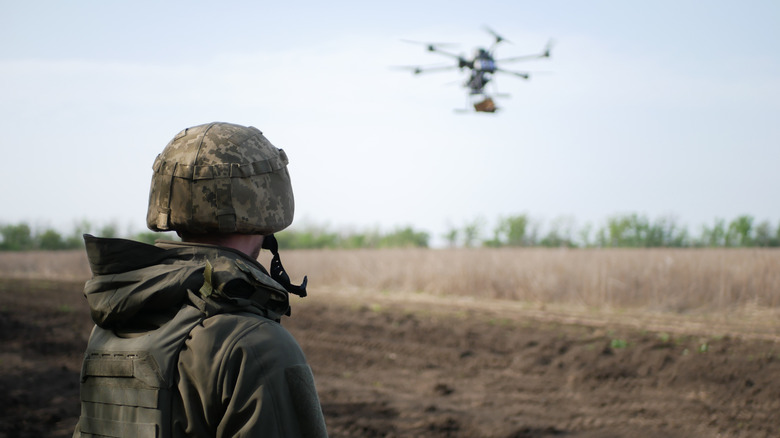
Drones are a great way to explore the world from an aerial perspective, especially if you're using built-in high-resolution cameras. You can fly them around and check things out, often on a connected device like a phone. You can even turn a drone into a handheld camera with some neat attachments. They're growing in popularity, too. The number of drones in operation was nearly 3 million in 2024 alone, according to the U.S. Government Accountability Office. Drones are used for research, business, media and entertainment, and even recreation in the form of drone racing.
However, there are some places you shouldn't be flying drones for any reason, such as at or around airports, restricted air zones, or controlled airspace. Chief among those restricted locations is within the vicinity of a military base. Flying a drone nearby is a good way to get arrested and charged for espionage, like one tourist visiting Cape Canaveral found out in July 2025 when he took images of the facility's U.S. Space Force station.
If that's not enough of a reason, you also run the risk of your drone getting shot down. While you may not necessarily pose a threat, there's still a high likelihood that military base operators will take action if you fly a drone near restricted airspace. The Pentagon is purportedly looking to install "low-collateral" kinetic drone interceptors at all U.S. military installations. DefenseScoop reports Brigadier General Matt Ross as saying net launchers and kinetic energy systems to shoot down drones are "necessary to protect homeland facilities." The Pentagon has also bolstered counter-drone actions to allow base commanders to better deal with threats after notable drone incursions at bases all around the world.
All unauthorized drones are now classified as a surveillance threat
In January 2026, the Pentagon's Joint Inter-Agency Task Force 401 has released clear guidelines for drones detected in restricted airspace. All "unauthorized" drone flights will be classed as a surveillance threat. That task force was established in August, 2025, specifically to deal with homeland drone threats.
The announcement about the changes specifically states that "unauthorized surveillance of a designated facility now explicitly constitutes a threat." It also further outlines how these threats will be handled going forward. "This, combined with the authority for commanders to make threat determinations based on the 'totality of circumstances,' grants greater operational flexibility."
As most drones are equipped with cameras, it makes sense why the military is taking this approach. One Texas town even fought to have Amazon's delivery drones grounded mostly due to privacy concerns, including one teenage girl's worries that she could be seen from above while in her swimming pool. These concerns are not unfounded — imagine what drones could capture above classified military installations. Surveillance and security concerns are also why the FCC is moving to ban one major drone brand here in the U.S. due to fears regarding the drone's Chinese manufacturer.
The new task force guidelines promote a "proactive approach" by encouraging military leaders to "assess vulnerabilities, conduct rigorous training drills, and develop a robust defensive posture to deter and defeat any aerial threat." In layman's terms, it means military installations will have the authority they need to act swiftly if and when a threat is detected. That's good news for the safety of the installations, but bad news for anyone flying an unauthorized drone nearby.