

This Cool New OLED Display Might Be The Future Of TVs
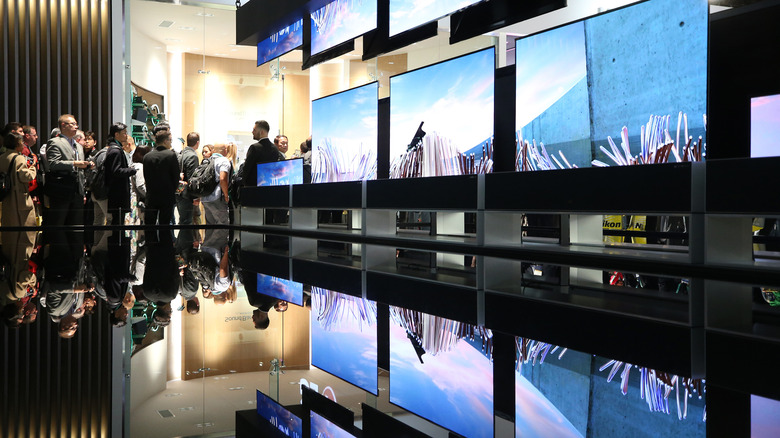
OLED stands apart from other display technology types for its wider viewing angles, deeper blacks, high contrast, and more vibrant colors. The first OLED TVs certainly weren't perfect, as they were plagued by longevity issues and hefty price tags. Since then, various improvements have made modern OLED TVs last much longer, even though the risk of burn-in remains one of the key disadvantages of buying an OLED TV. But the latest invention for OLED displays is a type of panel that can expand up to double its size, which could pave the way for devices with stretchable displays.
While trying to create OLED displays that can stretch, one of the biggest hurdles researchers have encountered for decades has been maintaining brightness. Scientists have been able to develop stretchable displays in the past, but reduced brightness has been a constant tradeoff. To achieve this incredible feat of invention, a team of researchers from Seoul National University and Drexel University used a special ultra-thin and conductive material called MXenes instead of the usual indium tin oxide electrodes, which have proven to crack and lose brightness when placed under pressure.
How researchers developed stretchable OLED without brightness loss
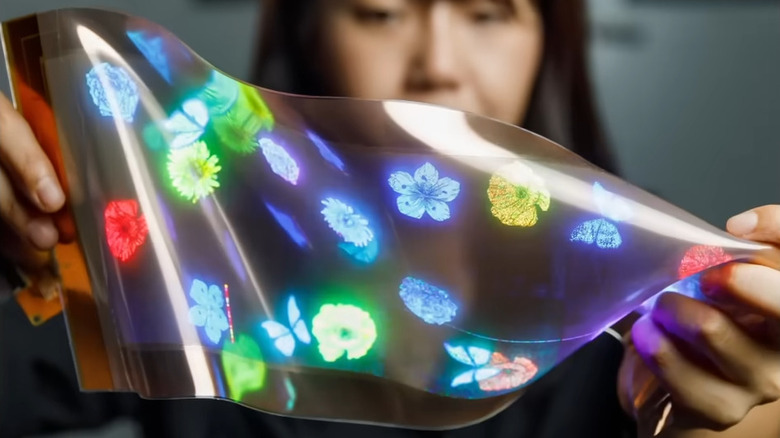
By using MXenes, the team of researchers was able to create an OLED that can stretch up to 200% (or twice the original size) without losing brightness, even after repeated stretching cycles. This is possible because, unlike the indium tin oxide electrodes in existing OLED panels, MXenes use carbides and nitrides, which make this class of material able to bend and even stretch without fracturing, thus maintaining the structural integrity and, by extension, the levels of brightness produced.
While maintaining the brightness levels of the display after stretching up to 200% is impressive, the team also managed to achieve a 17% external quantum efficiency, which measures the efficiency of the material at converting electricity to light. In practical terms, higher efficiency means more usable light for the same power draw, which is important for compact, battery-powered devices. It might seem like a small figure, but the researchers claim that the 17% external quantum efficiency is a record-breaking number for stretchable OLEDs.
A potential game-changer for TVs and other devices
While Kodak used OLED display panels in its digital cameras as far back as 1987, it took nearly another two decades before the first OLED TV graced shelves. For stretchable OLED display tech, Yury Gogotsi, a materials scientist at Drexel University in Philadelphia, one of the researchers behind the breakthrough, says flexible displays could be everywhere. "Flexible displays can be on the sleeve of your jacket. They can be rolled into a tube or folded and put in your pocket," Gogotsi told IEEE Spectrum.
Gogotsi envisions its use in a variety of ways, such as in robotics and wearable devices. We might even see this technology show up in the TV market, with manufacturers releasing models that can actually stretch when you need more screen real estate for binge-watching your favorite movies or TV shows. A TV with a stretchable display might sound inconceivable, but remember, Lenovo launched the ThinkBook Plus Gen 6 in 2025, a $3,500 laptop with a rollable display.
The journey from now until we see stretchable OLED devices launch is unclear, as the researchers achieved this breakthrough in early 2026. So it might take years before we actually see a TV with a stretchable OLED display available to buy at your local big box store or online. And that will only be possible if TV manufacturers find the technology impressive enough to consider having it in their products.