

Here's What Makes NASA's WB-57 Aircraft So Special
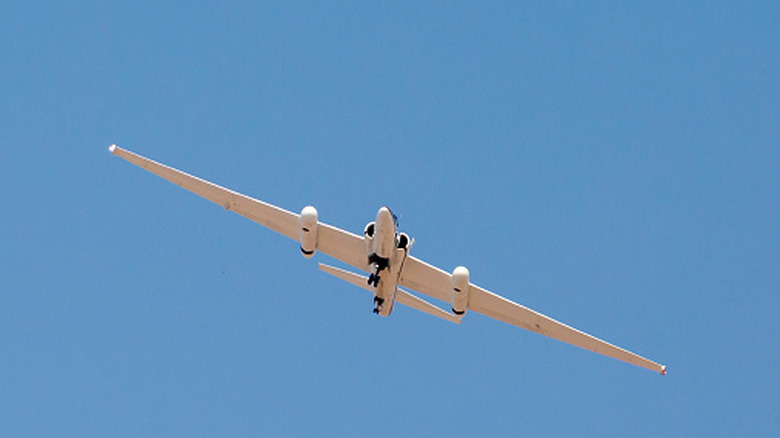
At NASA's Johnson Space Center in Texas, there are three remarkable aircraft that the agency uses for research missions referred to as the WB-57. NASA classifies it as a jet, but it's not quite the same kind of jet as NASA's X-59, which broke the sound barrier on its first test flight. Jets may not be the first object you think of when it comes to NASA, but it has been employing the WB-57 for research expeditions to study the atmosphere for the past 50 years.
It carries two people on board, including the pilot. It can usually fly for over six hours before needing to be refueled, though that can be dependent on its mission. It's able to carry nearly 9,000 pounds and reach a staggering altitude of 63,000 feet. That altitude is known as Armstrong's line, and it's not a place humans can go without protection.
The WB-57 can reach air speeds of 410 knots, which is about 471 miles per hour. It also has some high-tech instruments on it, including a Hurricane Imaging Radiometer, a Polarimetric Scanning Radiometer, and an Airborne Visible/InfraRed Imaging Spectrometer. It might not be much to look at, but the WB-57, being in service for around half a century, helping NASA understand the planet better, is impressive.
NASA WB-57's history of research missions
NASA undertakes a great deal of research missions not just to space but around the planet as a whole, as one Texan realized when a NASA research balloon ended up on their farm. Some of the WB-57's earliest missions in the 1990s involved seeing how rocket launch emissions impacted the quality of the air in the stratosphere. It took two extended missions to Costa Rica, one in 2001 and another in 2004. Both were to take atmospheric data for analysis.
In 2015, the WB-17 took part in a mission referred to as VIRGAS, short for its rather long name of Volcano-plume Investigation Readiness and Gas-phase and Aerosol Sulfur. This had it carrying multiple payloads to support atmospheric research.
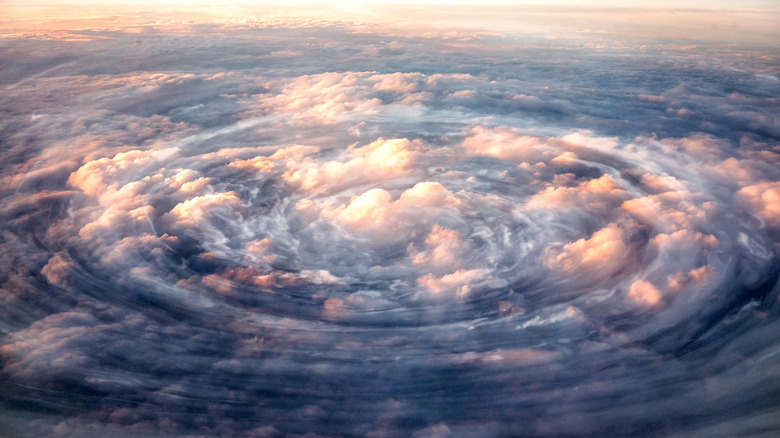
It has had two fairly recent missions focused on hurricanes, with one in 2014 and one in 2015. The 2014 mission was centered on learning more about how hurricanes form in the Atlantic Ocean. During that time, the WB-57 was critical in gathering data from storms. In 2015, it studied three systems in-depth: Tropical Storm Marty, Hurricane Joaquin, and Hurricane Patricia. At the WB-57's max altitude at Armstrong's line, it was able to capture the first-ever full structure of these storms. It also provided the most detailed tropical cyclone data ever collected at the time.
NASA WB-57's crash landing
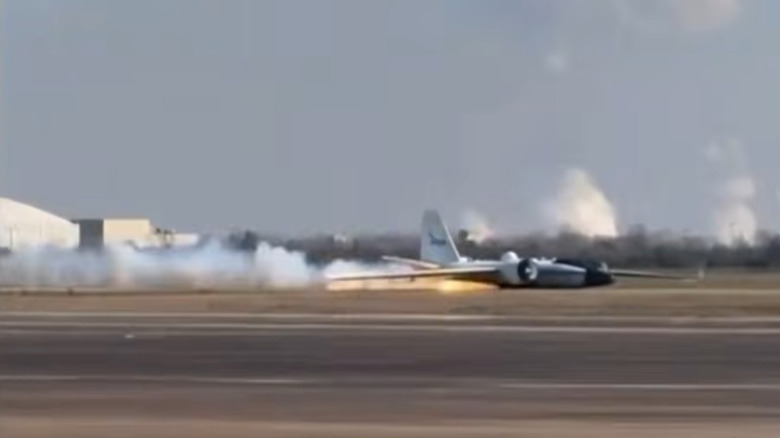
Despite its impressive specs and rather spectacular history of research innovation, the WB-57 did have a harrowing moment in late January 2026. It was landing at the Houston Ellington Field when it experienced a mechanical mishap. Its landing gear did not deploy. With no wheels down, the WB-57 instead landed right on its belly. Fire and sparks followed it as it slid across the runway to a stop.
Emergency responders were quick to the scene, putting out any fires and helping the pilot from the cockpit. A post on X from NASA communications employee Bethany Stevens assured the crew was safe. There is a video of the crash on X from the Houston Air Watch account. Sentiments in the comments expressed that people were glad no one was hurt and hoped that the specific WB-57 that crashed was not permanently damaged.
Despite this, the WB-57 has a long history of excellence behind it. With groundbreaking research, it has expanded humanity's understanding of the atmosphere and guided future discovery, as NASA looks to the future of space exploration. Hopefully, all three WB-57's can continue to fly for a long time to come.