

The 6 Different Kinds Of OLED Displays (And How They Work)
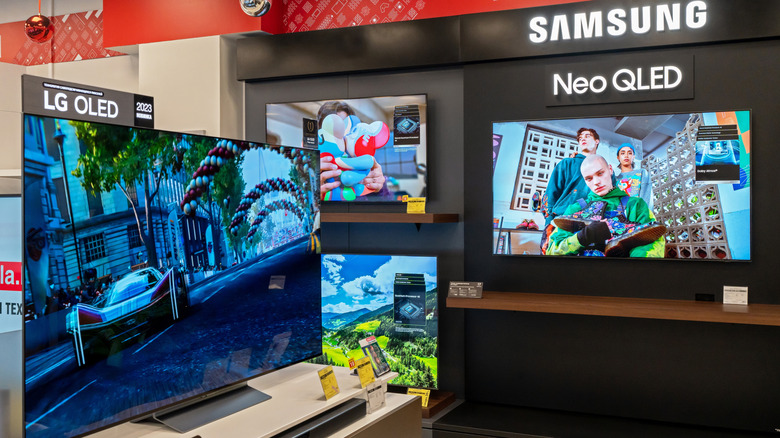
Modern displays are broadly categorized as either LCD or OLED screens, with OLEDs typically being the more premium and visually stunning option. OLED displays are capable of superior contrast and higher image quality overall. OLED displays use their namesake organic light-emitting diodes to shine light through organic compounds on a pixel-by-pixel basis, allowing for precise image control and wider viewing angles. All OLEDs use this revolutionary light emission technique, but there are actually several different kinds of OLED displays that rely on other methodologies to provide their own unique benefits.
TV makers made the switch to OLED panels starting in 2007 because the advantages in color, contrast, and quality were too apparent for the market to ignore. Since then, six main types of OLED displays have powered TVs, monitors, and handheld devices. There are passive-matrix, active-matrix, transparent, white-light, top-emitting, and foldable OLED displays. Knowing how each one works and what they bring to the table will help you sift through the jargon next time you're shopping for a new panel.
Passive-matrix OLED and active-matrix OLED
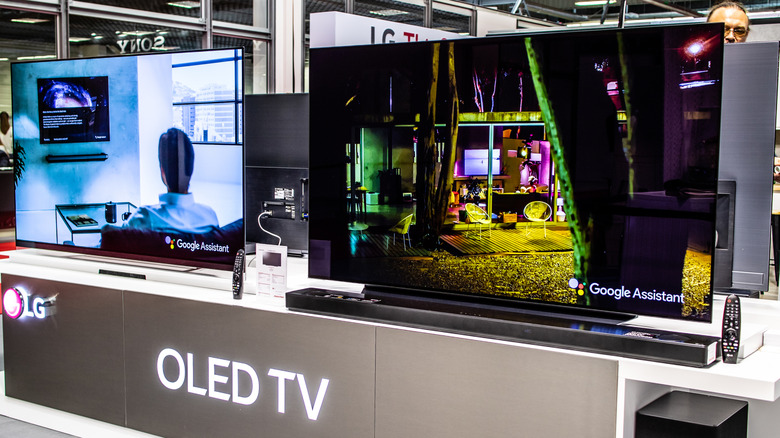
Passive-matrix OLED (PMOLED) and active-matrix OLED (AMOLED) are two different types of displays, but they work under the same principle: forming a matrix based on the arrangement of conductive anode strips. In this context, a matrix is the grid of pixels that serves as the driving electronics scheme behind the screen. PMOLEDs form a matrix by arranging anode strips perpendicular to the electron-injecting cathode strips, activating or deactivating the pixels sequentially. AMOLEDs form a matrix by laying the anode layer over a transistor (TFT) array, which contains a storage capacitor, making it possible to maintain pixel states and alter the display non-sequentially.
While passive-matrix technology is relatively simple and easier to produce, technical limitations make it hard to scale on larger panels. As a result, they are mostly used in smaller devices like smartwatches, calculators, and more. Active-matrix technology is more energy efficient and has a wider array of applications, including TVs.
Transparent OLED

See-through screens have been a futuristic novelty since the 2010s. LG unveiled its first transparent OLED (TOLED) display in 2014 and continues to manufacture transparent displays for use as commercial signage. LG released a 77-inch TOLED on the consumer market in 2024, but a $60,000 price tag demonstrated that the technology is still on the ultra-premium end of the spectrum. While you aren't likely to see a TOLED display at a typical electronics retailer, the technology does see a fair bit of use in smart glasses, industrial vehicles, and other commercial applications.
The science behind these implausible displays is fascinating. The panel consists of the glass substrate, anode, cathode, an emissive layer, and a conductive layer, all of which are transparent. TOLEDs are even more inconspicuous than the transparent LCDs of the past because they don't require any sort of backlight or enclosure. Light comes from the diodes within the display and passes in both directions. Without any borders, frames, or other opaque components to constrain the screen, the possible applications for TOLEDs are seemingly limitless.
White OLED
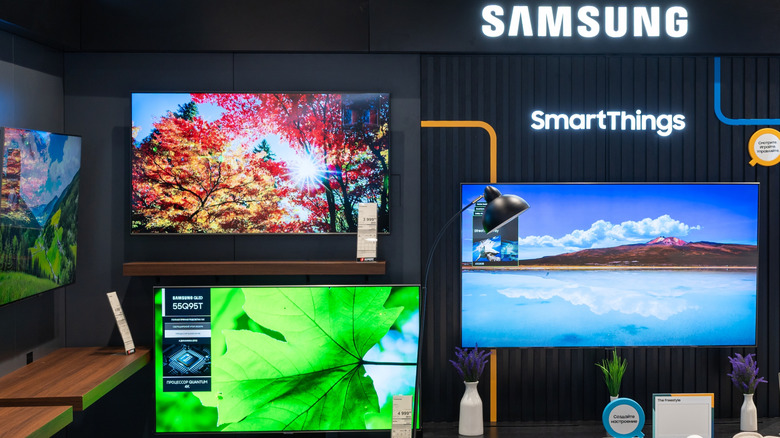
As the name implies, white OLED (WOLED) displays rely entirely on white light. Whereas other models use red, green, and blue light emissions to achieve various colors across the spectrum, WOLEDs emit white light through a color filter to achieve the same effect. As a downside, this leads to a somewhat lower efficiency and lower brightness levels as some of the light is lost due to the color filter, but the end picture quality is still extremely bright. Moreover, the accuracy and vibrancy of the final image can be improved with a high-quality color filter. Quantum dot OLED (QD-OLED) is a similar technology that instead converts blue light to other colors using quantum dots, often to even more impressive results than most WOLED panels.
WOLED technology is becoming the standard for flagship product lines from major TV manufacturers. Some companies are even making the most of other significant innovations alongside WOLED. LG's 2026 lineup heavily features its "Tandem WOLED" displays, in which the tandem technology refers to multiple layers of pixels that allow for higher peak brightness and lower reflectance levels. The hybridization of multiple forms of cutting-edge tech is a clear explanation for why OLED TVs are so expensive, but it also pushes the standard forward for budget models as well.
Top-emitting OLED

There are both bottom-emitting and top-emitting OLEDs, which refer to the underlying architecture of the panel. Top-emitting OLED (TE-OLED) is primarily seen in small devices such as smartwatches, smartphones, and even smart credit cards because compact spaces make it practical to emit light from the opposite side of the transistor layer. This is beneficial as it allows for greater efficiency and higher brightness levels compared to emitting light up and out from the substrate. That said, premium OLED TVs also use TE-OLED technology for greater efficiency and higher brightness levels.
TE-OLEDs require a substrate that is either opaque or reflective, making them more suited to panels with an active-matrix design. AMOLEDs tend to have the necessary opacity or reflectiveness because they include a TFT array that is typically not transparent. On the other hand, the opacity of the transistor would block the transmission of light if devices relied on bottom-emitting OLEDs instead.
Foldable OLED
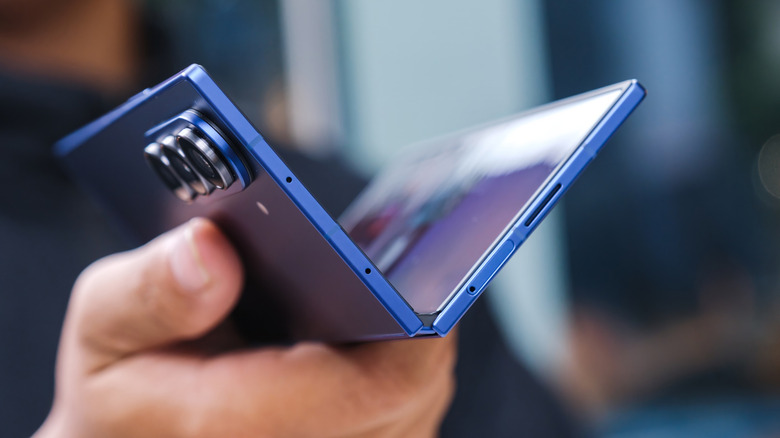
In the context of OLEDs, "foldable" does not describe any part of the electronic architecture that makes the display work, per se. Rather, foldable OLEDs are a type of form factor that enables totally new product types such as foldable phones like the Galaxy Z Fold 7. Most foldable OLEDs use industry-standard active-matrix drive schemes, but they also include flexible substrates such as polyimide to allow bending, rolling, and, of course, folding.
The use of malleable substrates is what has enabled other types of flexible OLED displays for many years. Curved OLED TVs, for example, are flexible displays that have been around since 2013, even if they aren't bendable from the end-user's perspective. The original flexible OLEDs were shaped into curved or wavy forms by the manufacturer. However, the current iterations of flexible displays have brought foldable smartphones to the mass market. The benefit of modern-day foldable OLEDs is the ability to make bigger, beautiful screens more portable. What's more, the flexible substrate provides a measure of shock resistance that makes the display more durable from physical damage.