

Old Computer Hard Drives Were The Size Of Your Washing Machine - Here's Why
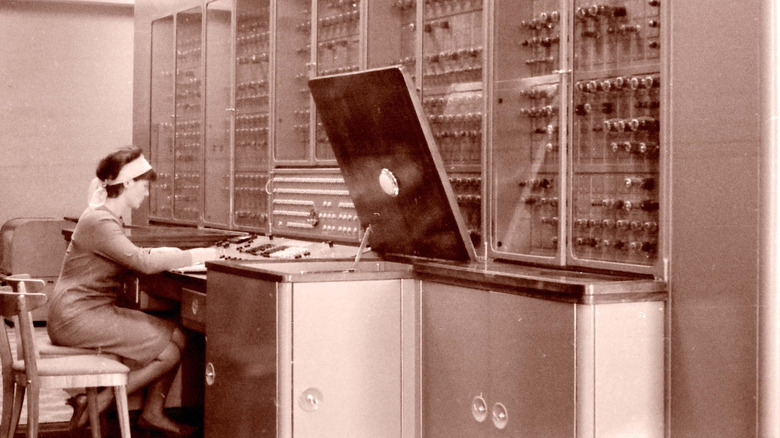
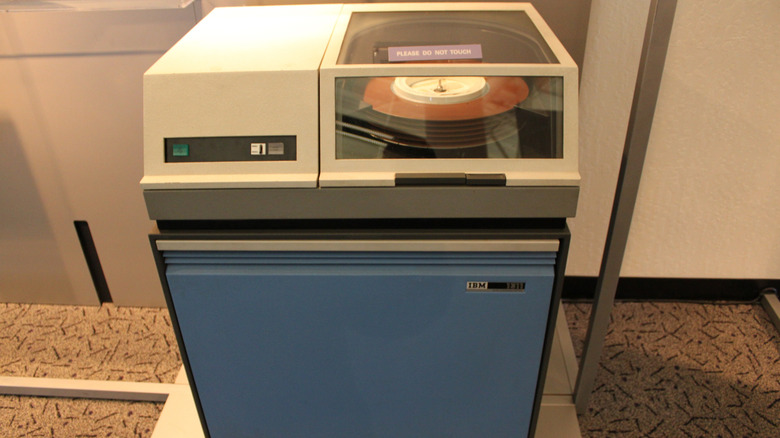
Computers were once the size of an entire room. That's right. A single, low-power computer that was significantly weaker than the phone you carry in your pocket today was also ridiculously larger. But that wasn't the only thing oversized back in the day. Old computer hard drives, which used interchangeable disk packs, were about the size of your average washing machine. There were several of them, including the Model 1311 from IBM, which used Model 1316 disk packs.
Each disk pack held a capacity of about 2 million characters or the equivalent of 12 million bits (1.5 megabytes). Even just the disk packs — not the entire hard drive, mind you — weighed about nine pounds, which is incredible considering the types of storage we carry today. A flash drive weighs a fraction of that and has much larger storage capacities.
They were so big because inside they contained large 14-inch platters, not unlike physical hard drives, that were used to store the data. The platters were so large and stacked that the pack looked more like a big metal canister than a modern hard drive. Most were intended for accountants working with large and varied numbers, and they were inordinately expensive. The disks on the IBM 1311 could be swapped out, but the task was very difficult because the disk head — the component for reading the drives — needed to be aligned properly.
Think about how these large systems might have been handled or disposed of when they ran their course. Especially since there are so many productive uses for old work computers today. Laptops are small enough to repurpose, but if they were the size of a room or washing machine, that would certainly not be the case.
How were the interchangeable drives connected to computers at the time?
For computers today, there are so many storage alternatives to use besides a traditional hard drive, and they're all compact and portable. You can toss them in a purse, backpack, pocket, you name it. You can also easily plug them into USB ports on the side of your laptop or phone. But the old-school disk drives didn't work like that.
The Model 1311 came in five types, from Model 1 up to Model 5, and would ultimately act as the first drive or the master drive when attached to specific mainframe computers. For example, Model 1 attached to either an IBM 1440 data processing system or an IBM 240 bank data processing system would act as the master. But for the IBM 1401 data processing system, the 1311 Model 4 was the master. IBM 1311 Model 3 would be the master for an IBM 1620 data processing system. You get the idea. The sequence was different for each type of computer and drive so you couldn't just plug them into any system.
The first drive was effectively the controlling unit with the circuitry, lights, and switches, and it would be connected to the computers in question. Additional drives could be attached via the 1311 to further extend storage as long as the correct master unit was used.
Try to imagine how much space was required in a computing room, especially when multiple disk units were connected. Future advancements eventually gave way to the technologies we use today, with hard drives and SSDs becoming so much more compact. Ultra-compact drives that can plug into your phone hold millions more bytes of data nowadays. My, how things have changed.