

The US Department Of Defense Officially Has A Drone Testing Location
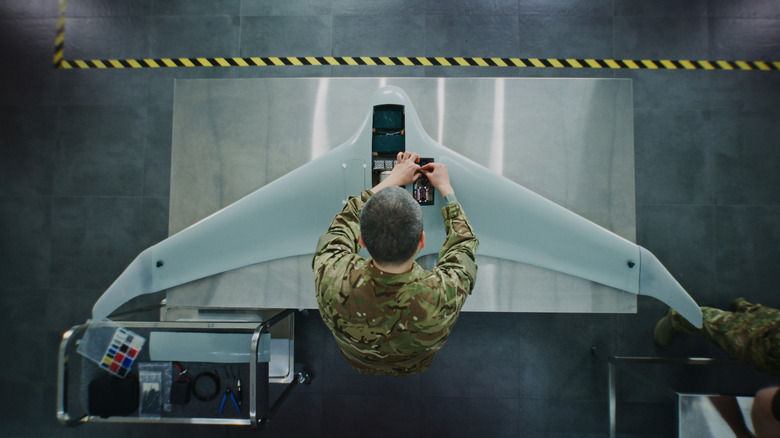
On February 3, 2026, members of the Michigan congressional delegation (via Elissa Slotkin's Senate webpage) announced that the National All-Domain Warfighting Center (NADWC) had been secured as a Department of Defense-designated drone testing site. Located in northern Michigan, the NADWC is a dedicated training environment with 148,000 acres of maneuverable ground and 17,000 square miles of designated military airspace, making the facility well-suited for testing drones in realistic combat scenarios.
Per the Department of Defense, Secretary Pete Hesgeth was quoted as saying, "We will deliver tens of thousands of small drones to our force in 2026, and hundreds of thousands of them by 2027." In the context of this effort to rapidly take numerous uncrewed aerial systems to the field, a well-equipped site like the NADWC is an intuitive choice for testing the technology. However, the Michigan delegation had its own incentives for pushing the NADWC as the selected site. In 2025, Senator Elissa Slotkin laid out a defense plan that would position Michigan as a leader in defense technology and manufacturing, which would also bring new defense-related jobs to the state.
According to U.S. Army Maj. Gen. Paul D. Rogers, the actual drone testing that will take place at the NADWC will entail developing, testing, and employing uncrewed systems "at operational tempo under realistic, all-weather conditions." The NADWC is also equipped with a dedicated sixty-mile-long drone corridor, emerging counter-UAV technologies, and a Beyond-Visual-Line-of-Sight (BVLOS) drone operation system to support the training effort.
How drone testing can change the future of warfare
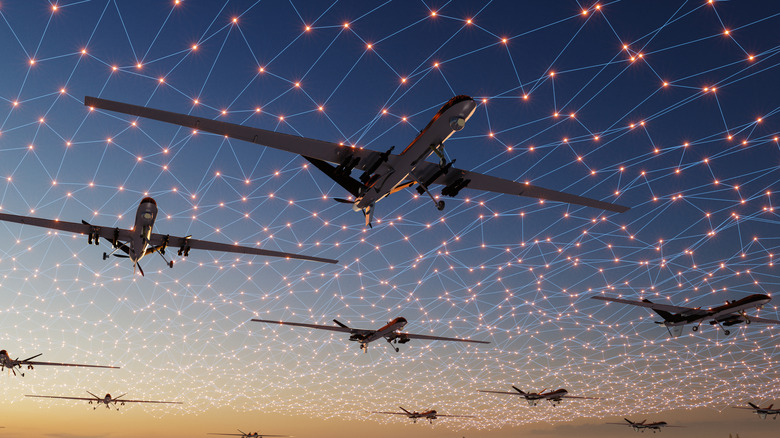
Drones are becoming more and more prominent as the face of modern-day warfare. It was already apparent that AI is transforming the U.S. military, but those changes aren't limited to strategy and day-to-day operations. The U.S. Navy has previously experimented with flying drones in AI-coordinated formations, and that's just one example of how the Department of Defense is implementing artificial intelligence in drone warfare.
The next step is to use those AI-coordinated drones to achieve strategic objectives. Recent advancements show that drone swarms pose a threat to aircraft carriers due to the sheer difference in size, speed, and numbers. Carriers have always been the masters of the ocean, but if drones stand a chance of usurping them, there's no telling what else they can achieve.
Recent use of drones in actual conflict overseas has shown that unmanned aircraft systems (UAS) allow for persistent surveillance capabilities, deception opportunities, and enhanced operational decision-making. The overall reach of a military operation is observably longer because of UAS technology, too. At the newly-designated Michigan drone testing location, U.S. forces will gain first-hand experience with new and emerging tactics that will change warfare in ways we can't even imagine yet.