

The F-15's Next Superweapon Is Just Around The Corner
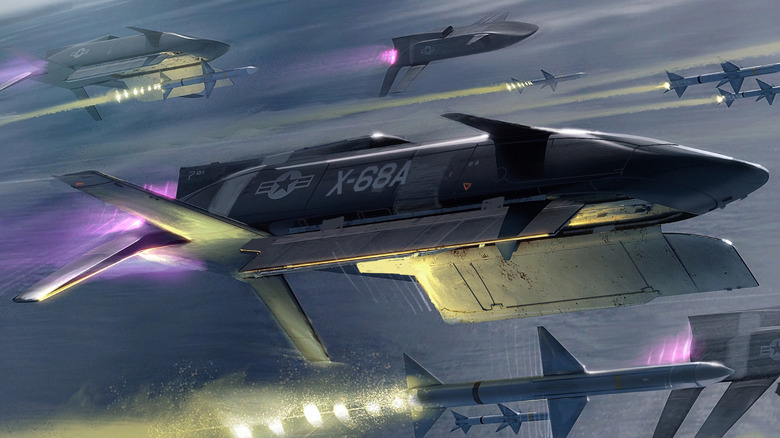
With the ongoing testing of military drones by the U.S. Department of Defense, air combat is changing rapidly. However, the U.S. military appears to have found a way to increase fighter pilot safety. Most notably by equipping fighter jets like the F-15 with deployable unmanned aircraft that can utilize its own air-to-air missiles in combat. The crux of the new superweapon is an aircraft that the Defense Advanced Research Projects Agency (DARPA) calls LongShot.
It is the product of a collaboration between DARPA and General Atomics Aeronautical Systems. DARPA says that it expects to see a massive effect on air combat once LongShot is up and running. For now, however, the agency says that it is seeing good things from the concept, and that it hopes to be flight-ready soon. There's no exact timeline on just how long that might be, though, as the LongShot weapon is still working toward completing all of the milestones needed for its integrated flight-test campaign.
A new superweapon for F-15 fighter jets
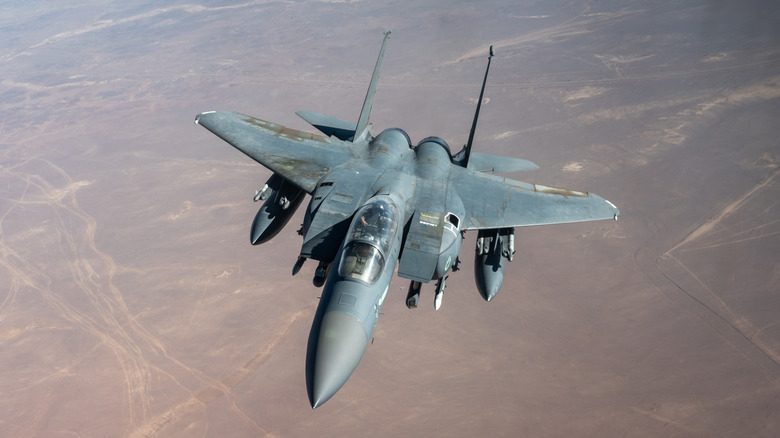
LongShot is being developed to work with the F-15 platform, one of the U.S. Air Force's primary fighter jets. However, DARPA says it plans to make the system platform agnostic, allowing it to be integrated with other fighters and bombers, giving multiple aircraft the opportunity to take advantage of the superweapon's unique features.
The main purpose of the LongShot program is to augment traditional air combat operations, instead of simply replacing them with unmanned fighters. That's because instead of relying solely on drones to do all the work, LongShot will require human pilots to get the weapon, which has recently been designated as X-68A, closer to its target. This means that fighter pilots will still be at risk, though with LongShot involved, the military hopes to limit how much exposure they have to the front lines of combat. Exactly how much the system will rely on artificial intelligence is unclear, though we do know that AI is transforming the military in several ways.
Colonel John Casey, who is the DARPA LongShot program manager, says that "LongShot burns down significant technical risk and presents a viable path for the military services to increase air combat reach and effectiveness from uninhabited, air-launched platforms." It does so by allowing pilots to fire off the unmanned device, then fall back as it takes part in combat, utilizing onboard missiles and other functionality.
When LongShot will be ready
While DARPA is making steady progress toward the milestones needed to get LongShot ready for flight, it estimates that won't happen until the end of 2026, at the earliest. The agency still needs to complete ground and integration testing, and from there it can move to flight-ready tests. This could happen quickly, depending on any problems that arise during testing. However, once testing has completed, the LongShot program's X-68A appears to be in a good place to assist pilots in combat scenarios.
It will be launchable from larger aircraft, and then it can fly ahead of the main force to engage with enemy targets. This could be useful for recon missions in heavily-controlled airspace, as well as for protecting bombers during important operations. With so many other countries working toward adding drones and unmanned robots to their operations — like China's rifle-toting robot dog– it makes sense that the U.S. military is looking to unmanned vehicles as a way to improve efficacy and safety for its fighter pilots.