

California Is Trying To Crack Down On E-Bikes To Solve A Growing Problem
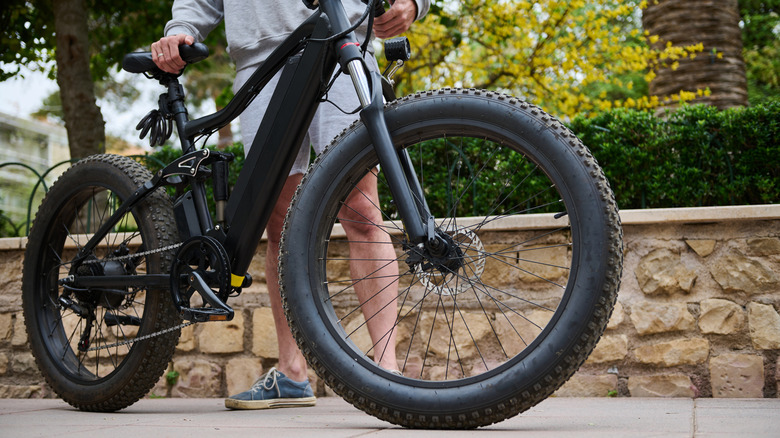
A bill being proposed in California would introduce updated requirements for e-bikes, ensuring they're registered with the state and fitted with license plates. The state has seen a significant rise in e-bike accidents during recent years and this is a measure aimed at cutting down on that problem.
How big of an issue is it really? Per the American College of Surgeons, e-bike accidents in California increased by 18.6 times over five years. In 2018, there were 184 accidents, a number that jumped to 3,429 in 2023. That's why, in 2025, California passed a law, SB-1271, to limit the power of these bikes and set additional parameters, like capping motorized assistance of Class I e-bikes beyond 20 mph. Some of the best cheap electric bikes currently top out at a 22 mph, for example.
But the latest bill, called the E-bike Accountability Act, aims to bring traceability and accountability to the field. It will require Class II and Class III e-bikes to be registered with the DMV in California. Moreover, qualifying bikes need to display a license plate, and riders must carry proof of ownership that matches the bike's serial number to aid in rider identification in the event of an accident.
The idea behind California's e-bike bill
The idea behind this bill that aims to crackdown on e-bike accidents in California is to encourage riders to be safer and more mindful while using e-bikes. According to Chief Ryan Hibbs of the Walnut Creek Police Department, who attended the bill's announcement, "We regularly see incidents where riders operate outside the boundaries of safe ridership, and without registration or license plates, it is nearly impossible to identify them.
The proposed legislation is a common-sense step that gives law enforcement the tools to protect riders, pedestrians, and drivers alike..." Medical professionals who have treated injuries related to e-bikes, agree. "Over the past year, our Trauma team has treated double the number of injuries to e-bike and e-scooter riders, as well as pedestrians hit by them," says Dr. Russell Rodriguez, the Chief Medical Officer at John Muir Health.
Some of the fastest e-bikes can reach speeds over 30 mph. Wearing a helmet is certainly important for safety, but what about additional protective gear for the body? At speeds above 20 mph, specialized gear may be necessary, like abrasion-resistant jackets or extra padding. But for now, this accountability bill will have to suffice.
Bringing accountability to e-bike conversion kit workarounds
Conversion kits exist to increase the power and speed of e-bikes. While federal regulations limit e-bike motors to 750 watts with fully operable pedals, conversion kits can break through these limitations with options on the market offering as much as 5,000 watts of power and top speeds of 45 mph. So, there may be modified electric bicycles cruising roadways at high speeds. It's not difficult to picture what kind of damage an e-bike traveling at 45 mph would cause in the event of a serious collision.
The e-bike accountability act seeks to address this problem. By requiring certain bikes to be registered through the DMV and the state of California, anyone bypassing federal regulations would likely have to answer for their law-breaking ways. Moreover, e-bike incidents can be more closely tracked when reported through law enforcement, where license and registration information would be collected.
If you're curious about this popular mode of transportation, be sure to check out some of the best e-bikes you can buy according to consumer reports. Many of these models offer similar power and speed ratings, although there are outliers like the Velotric Discover 2 that BGR reviewed. This particular bike boasts a 750-watt motor, a 65-mile range on a single charge, and a top speed of 28 mph.