

What Happens If Your Smart Thermostat's Battery Dies?
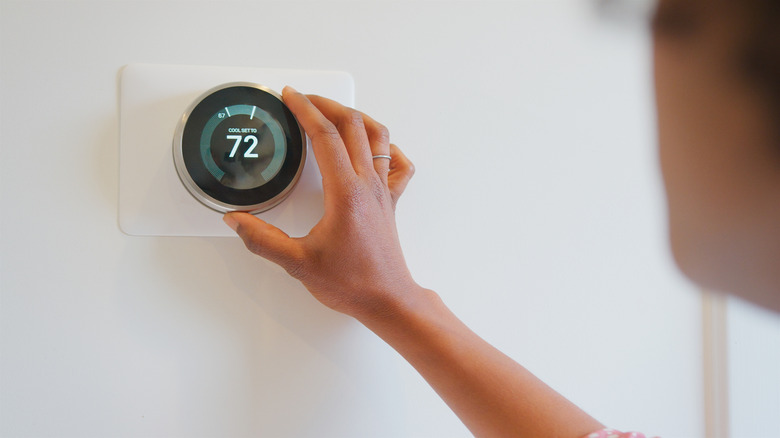
Some smart thermostats actually have a built-in battery that's meant to complement the hard-wiring, delivering power to the unit. Not everyone knows that, but it's true. Devices like the Google Nest Thermostat may even display a low-battery warning, which could leave users scratching their heads if they weren't aware of this. In the Nest thermostat, specifically, you cannot change those batteries; instead, you're supposed to charge the device using a USB cable.
But what about older or alternate brand thermostats? How do you change those batteries or handle a low-power indicator? It varies from thermostat type to type, as some do include interchangeable and disposable batteries while others don't. What you should know, however, is that the backup batteries are meant to act as an extra power source even when your home's power is steady and available. That battery powers the thermostat's internals, particularly the control board that's used to tell the heating or cooling system what to do. If the battery dies, even if there's still power, there's a chance the device may not communicate properly with the HVAC system, in which case, it won't work as intended.
Sometimes, a thermostat may seem to be working fine with a screen that powers on, but realistically, it's failing to maintain the correct temperatures or activate the auto climate controls as programmed. You might be able to use the basic features of a Google Nest thermostat without internet, but without power, that's a different story. The batteries ensure there's enough voltage for the internals at all times. Batteries should last for roughly eight months to a year of continuous use, and you should be changing them regularly, along with other maintenance tasks, like replacing air filters.
Why does the battery even matter in select units?

The first thing to note is that not all smart thermostats or Wi-Fi thermostats have batteries. There are some systems that use what's known as a C-wire or common wire, drawing their power from your home's main circuit breaker. In homes that lack the C-wire, battery-operated thermostats are necessary. But for some systems, they're always necessary — the Google Nest Thermostat is a great example. Frankly, there are a lot of major and relevant smart thermostats available, each with its own configurations.
Those batteries, in the units where they exist, provide necessary power to the internal components like the control board, but also help to save programmed settings and may keep the thermostat itself operational during power outages. For something like a smart thermostat where energy savings and smart operations are programmed — it's how they help you save money on energy bills — the batteries can certainly power the adaptive learning and keep the system memory working as intended. So, the short and simple answer is that yes, the batteries matter, regardless of whether the thermostat is connected to a main power source, and you want to keep the batteries swapped in and charged whenever applicable.