

Star Wars Actress Daisy Ridley Led A Zombie Movie That Deserves More Fans
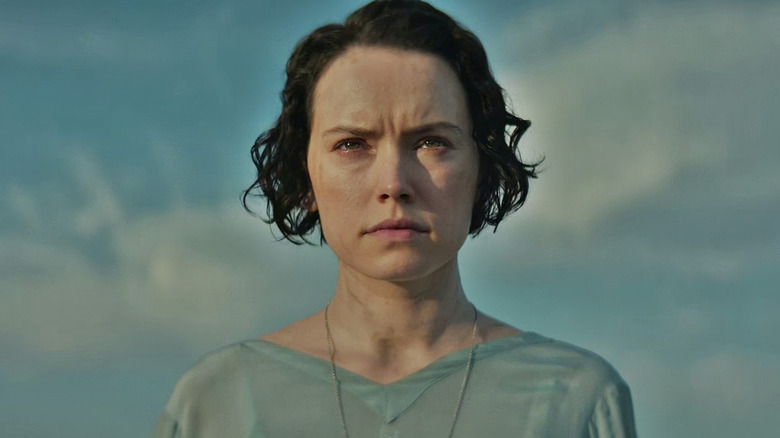
Australian filmmakers often tend to approach familiar, well-known subgenres from different angles, and writer-director Zak Hilditch's zombie drama, "We Bury the Dead," which premiered in North America in early 2026, is no exception. I suspect that his variation on the pretty exhausted and oversaturated genre that zombie horror has become is precisely why it didn't really click with audiences, while most critics adored it.
Based on its eerie trailer and premise, most viewers went into watching "We Bury the Dead" with the expectation of getting another suspense-filled gory horror (like Zack Snyder's "Dawn of the Dead," for instance), but as it becomes more evident the further the movie goes on, Hilditch has no interest in delivering another generic zombie flick. Instead, he gives viewers a personal drama that happens to involve the undead marginally, focusing more on the living and how they can (and can't) cope with loss and grief.
The plot follows Ava Newman (Daisy Ridley), an American physiotherapist, who joins a group of volunteers sent out to Tasmania to identify dead bodies after a US experimental weapon accidentally eviscerates the city of Hobart and leaves most of the island's population dead. Some of the victims, however, are somehow coming back from death in an essentially brain-dead state. Newman hopes that her husband (who was on the island when the incident happened) is one of them, and she can find and save him. But as she pairs up with another volunteer named Clay (Brenton Thwaites), and the two identify hundreds of deceased people, she slowly realizes the chance of recovery of whatever this condition might be is almost zero. Despite that, she doesn't give up finding her spouse, whether dead, alive, or something else.
Finding closure in the face of death
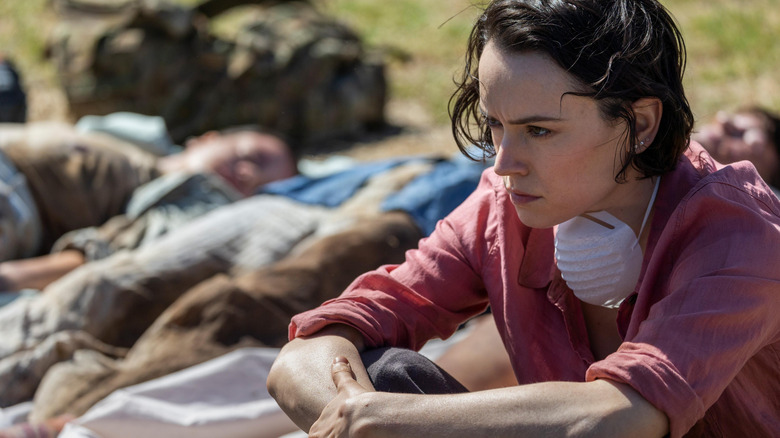
Despite the film's initial setup that deceptively seems to have all the makings of a classic zombie movie, "We Bury the Dead" quickly clarifies that most of the people who come back from the dead aren't really a threat. Few turn out to be violent, in fact, and most of them don't do much besides staring and moving slowly in an unconscious state. There's no apocalypse here but rather the aftermath of a tragic event that the military, with the help of volunteers, needs to resolve quickly and effectively. Therefore, violent confrontations are almost non-existent, and most of the dreadful scenes involving the undead quickly dissolve into harrowing emotional despair rather than anything menacing.
Thus, "We Bury the Dead" is more melodramatic than scary. Hilditch focuses on the loss and lack of closure his characters go through, and the different (often unhealthy, and in one case, mentally insane) ways they attempt to process the grief that inevitably overwhelms them in such a devastating scenario. In that aspect, Hilditch's unconventional vision succeeds beautifully. With "Star Wars" alum Daisy Ridley's grounded, affecting, and vulnerable performance, the film gradually becomes a strange yet incredibly poignant character study of a woman and wife who's willing to risk her life to find closure — even if she has to literally stare death in the face repeatedly.
Underneath its slightly misleading setting, it is truly an intriguing character-driven drama that finds a clever and emotionally resonant way to implement and leverage its undead creatures to reveal something inherently human. It's not as if this hasn't been done before (after all, there are plenty of zombie movies), just that it's nice to be reminded of what this genre can do and offer beyond the usual outings.