

Greenland Is Feeling Climate Change Differently Than Most Places - Here's Why
When most people think about climate change, their minds jump to increasing global temperatures, melting polar ice caps, and rising sea levels — and the fact that humanity sucks at curtailing the damage. However, climate change is far more complicated than these blanket environmental alterations. Climate change can cause unusual and extreme weather patterns, wreak havoc on the migrations of marine mammals, and cause sea levels to drop. Wait, what?
According to a recent study published in Nature, if climate change trends continue unaltered, the sea level around Greenland is expected to fall anywhere between 0.9 meters (2.95 feet) and 2.5 meters (8.2 feet) by around the year 2100. This can be confusing, considering the same study claims that Greenland's icy terrain will be a "primary contributor to rising sea levels" around the globe. It all starts with the country's name. It's no secret that Greenland isn't very green — that was a "marketing ploy" by Erik the Red. About 80% of Greenland is covered in ice sheets, and just like the Arctic ice sheets, these landbound glaciers are melting due to climate change.
Currently, Greenland is weighed down by the sheer mass of all that frozen water, pushing the island down into the Earth somewhat and raises its relative sea level. This phenomenon is known as solid Earth deformation, and as the ice melts, Greenland will rise higher than the waters produced by the ice thaw. According to the study, the release of solid Earth deformation will account for most of Greenland's dropping relative sea levels. But why not all of it? That is where explanations get a little weird.
The Moon isn't the only body that can gravitationally attract oceans
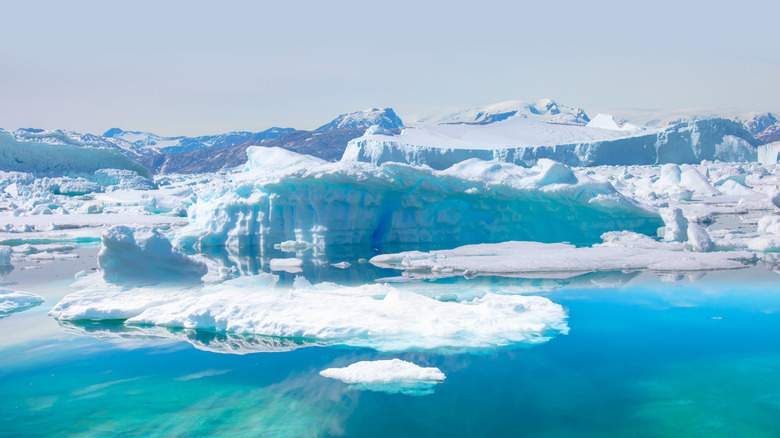
While melting glaciers aren't good for the environment, they have resulted in many discoveries. People have uncovered long-lost frozen bodies in Alaska thanks to glacier melt, and if enough of Greenland's ice sheets disappear, it might be discovered that the island is hiding a sub-glacial lake. However, the biggest discovery learned so far is that, when big enough, an ice sheet can have a noticeable gravitational field.
According to the study, Greenland's titanic ice sheet exudes a slight gravitational tug on the surrounding ocean water. This is, of course, accentuated by the Earth's own gravitational influence on the oceans, but the key takeaway is that as Greenland's ice melts, it will pull on the ocean less and less. Couple that with an overall gravitational shift due to all of the water from Greenland's glaciers pouring into the ocean, and you get a non-insignificant supplemental force driving down the island's relative sea level. Or at least that's what would be said if these forces hit Greenland uniformly.
The height of the ocean relative to any given coastline is as much a product of the amount of seawater on the planet as it is the thermal expansion of water, undersea currents, and various gravitational forces. According to the study's calculations, while most of Greenland will experience a receding sea level by 2100, the sea level is expected to rise between 0.28 meters (0.9 feet) and 0.62 meters (2.03 feet) for a "small area" in the "northwest" region of the island. Oceans are complex systems that don't always act as one.