

Ukraine's New Drone-Hunting Buggy Needs To Be Seen To Be Believed
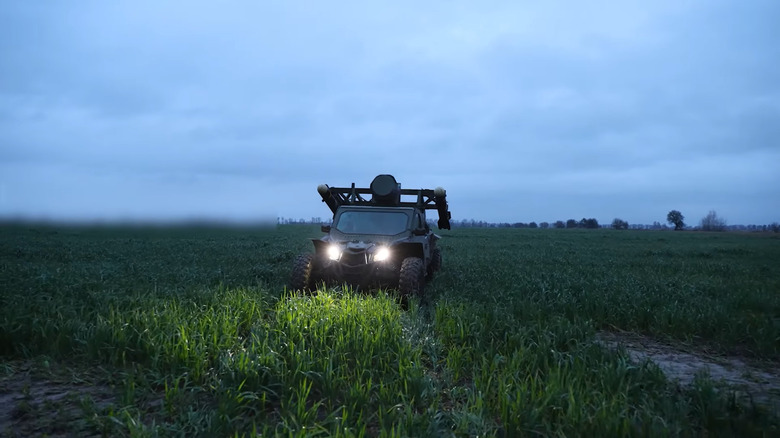
The rise of drone warfare has pushed Ukraine to pursue increasingly creative means of combatting Russia's cheap, mass-produced one-way attack UAVs. Now accounting for roughly 70% of the conflict's casualties, Ukraine's military, civilians, and infrastructure have suffered untold damage. Tasked with defending an ever-widening swath of civilian and military targets, Ukraine has deployed novel defense strategies from high-tech laser guns to lining hundreds of miles of roads and infrastructure with drone-catching fishing nets. One recent addition to Ukraine's cadre of anti-UAV weapons is a rocket-strapped buggy known as the Tempest.
At first glance, the Tempest looks like the lovechild of combat-heavy video games like Halo and Twisted Metal. Designed to counter uncrewed aerial systems (C-UAS), the Tempest is essentially a Can-Am Maverick X3 side-by-side off-roading vehicle equipped with a dual Hellfire missile launcher, radar, and potentially a passive radio frequency detection system. This use of retail components should make it a cheap, replicable alternative to other military vehicles. Built by V2X, a Virginian defense manufacturer, the Tempest was publicly debuted in October 2025 at the Association of the United States Army exhibition, and Ukraine got its hands on a few by at least December 2025.
While at least two of the buggies have already killed over 20 Russian drones, the number of Tempests in Ukraine's arsenal remains unclear. With that said, V2X's success has already garnered some attention, as the Marine Corps Systems Command awarded the defense firm a sole-source contract to construct what it dubbed the Denied Area Sprinter-Hellfire (DASH) system.
The Tempest is armed to the teeth
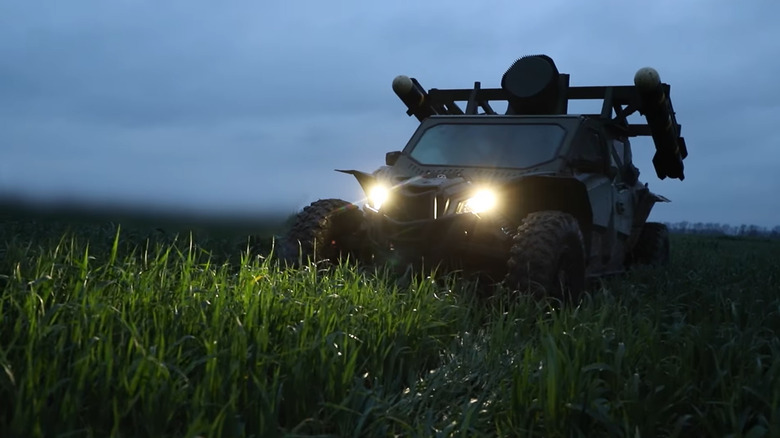
The Tempest appears to be equipped with a dual launcher of Lockheed Martin's AGM-114 Hellfire missiles, a weapon that gained notoriety as the air-to-ground missile deployed by the AH-65 Apache helicopter. Although somewhat eschewed for the Joint Air-to-Ground Missile system, the Hellfire has received praise as a cheap, versatile missile. More than likely, these are the Longbow version, a smaller Hellfire missile equipped with 20 pounds of explosives that uses radar to track its targets. Conversely, the missile's larger variant requires lasers to follow targets.
The Hellfire will undoubtedly make the Tempest a formidable opponent of cruise missiles, fixed-wing aircraft, helicopters, and attack drones that venture within its five-mile range. However, it may also prove too expensive to deploy against drones en masse, as the average cost of Hellfire missiles in 2021 was approximately $200,000. Meanwhile, Russia's Iran-manufactured quadcopter Shahed drones cost as low as $35,000, representing an economic hurdle found across the anti-UAV defense industry.
The Tempest's top-mounted radar is used to detect enemy aircraft. While no electro-optical or infrared cameras have been confirmed, The War Zone reports that an instrument resembling a passive radio frequency detector is visible. Such systems are an increasingly popular drone defense tactic as they enable passive 360-degree detection without emitting their own radio frequency, lighting up like a Christmas tree for enemy drones. Although not a flawless system, as autonomous drones and fiber optic wire-controlled drones do not emit radio frequencies, it could potentially give the Ukrainians more flexibility.
Building advanced anti-drone defenses
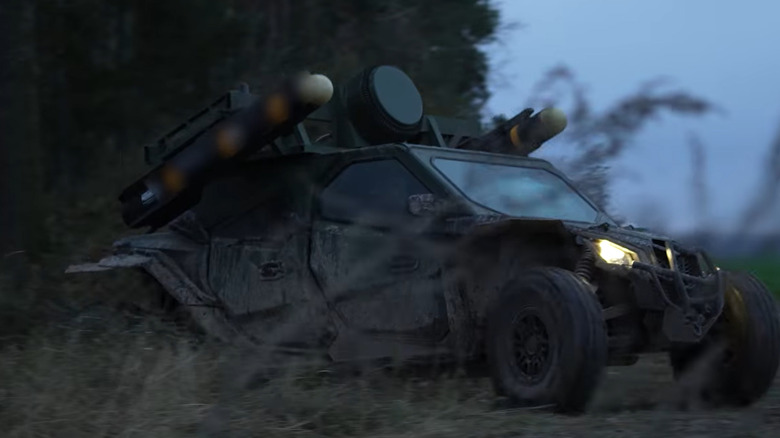
Ultimately, the Tempest's greatest advantage may be its mobility. Exhibiting multi-terrain functionality in a Ukrainian-released video (via Facebook), the Tempest's chassis is designed for extreme off-roading environments. Ukraine hopes that such mobility will provide 'shoot and scoot' capabilities, in which the country's air defenses can continually attack targets from different locations to avoid counterattacks. Movement skills are at a premium as the Ukrainian military looks to protect an ever-widening set of targets as UAVs continue to expand the geographic scope of targets, targeting critical infrastructure, military encampments, and civilian installations far from the battlefield. As such, tools that enable quick, flexible, multilayered responses are critical to handle the scale, speed, and breadth of Russia's daily aerial attacks.
The Tempest will likely be part of a vast network of anti-drone defenses. According to a video posted by Ukraine's Air Command Center, the combat buggy downed at least 21 Russian Shahed drones. The success attests to both the weapon's utility and limited scope. Although likely effective in small doses, even a fleet of Tempest drone-killers cannot ward off the hundreds of daily Russian attacks. According to the Institute for Science and International Security, Russia launched over 54,500 UAVs in 2025 (via ISIS), while Air-alarms counted over 19,000 air alerts across the country. One September 2025 attack counted over 800 drones.
In order to survive the war, Ukraine's air defense forces are building their own iteration of Israel's Iron Dome aerial defense system — a multilayered network of interceptor drones, short-range rockets, electromagnetic defense systems, and roughly 2,500 miles of anti-drone nets. Novel weapons systems such as the Tempest or the truck-mounted Sunray high-energy laser gun could effectively supplement these large-scale defenses.