

3D Printed Houses Have One Huge Advantage Over Traditional Homes
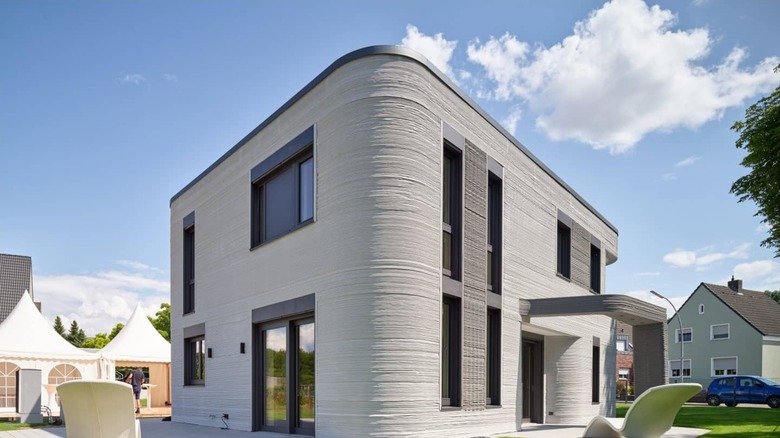
Houses come in all shapes and sizes, but you can also add fabrications to that list. You've got your traditional construction abodes, prefabricated container houses that you fold out like tents and could once buy on Amazon for around $40,000, and then there are 3D-printed houses that result in less waste. And it's not just construction waste — the biggest advantage 3D-printed houses have over traditional homes might just be their energy efficiency.
As the name implies, 3D-printed houses are buildings that are primarily constructed by an automated arm extruding a special concrete mix. This material builds up the shell of the house layer by layer, which can reduce building costs by up to 35% and labor costs by as much as 80%, while also decreasing the amount of wasted material after completion. The process is mostly automated, but human workers are still on hand to install all the plumbing, electrical wires, insulation, HVAC systems, and roofs.
Thanks to 3D printers, houses can go up in days. In fact, Europe's biggest 3D-printed building was constructed in just under 6 days, and the world's largest house printer can build a home in a little over 3 days. And of course, reduced build time also means less energy needed for the process. Efficiency is the name of the game here.
3D-printed houses can be up to 60% more energy efficient than standard builds
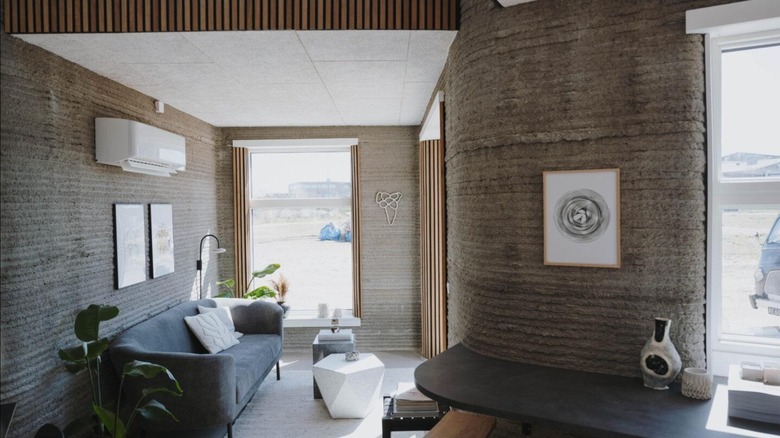
Since 3D printing houses is more efficient than traditional building methods, this process might just help solve the housing crisis. The costs of labor, energy, and materials are comparatively lower (especially if material waste isn't tabulated into the price), so those savings could hypothetically be passed on to buyers. However, the savings might not stop there.
The single biggest advantage of 3D printing houses boils down to this: While traditional homes rely on insulation, 3D-printed wall systems are often built with insulated cavities and high-thermal-mass concrete that help manage heat flow. This can lead to lower energy and electricity bills — in fact, some 3D-printed homes are reportedly 40 to 60% more energy efficient than standard new builds.
Another selling point of 3D-printed houses is speed. Since machines can erect 3D-printed homes within a matter of days, buyers can potentially move in as soon as they're done packing up. Plus, because of how the printers lay down materials, home designs are somewhat moddable, so owners can hypothetically pick a layout that finds a middle ground between size and speed. And of course, the faster houses go up, the more there are on the market, saturating availability and driving prices down even further.
The process is revolutionary, not perfect
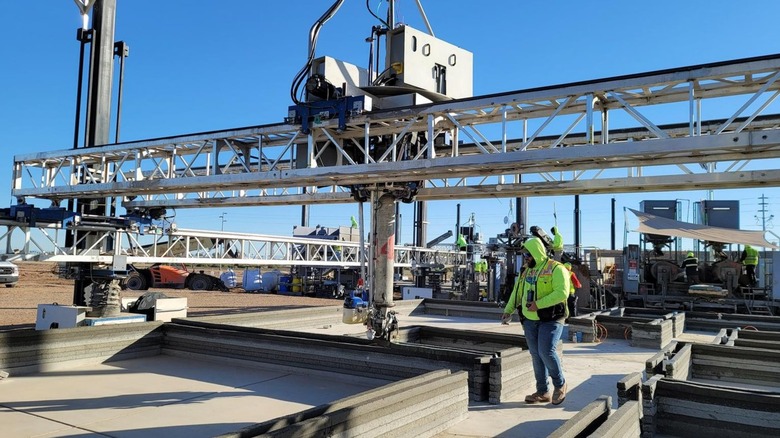
While 3D printing can produce houses on the cheap, the process still has several limitations that make traditionally built houses comparatively more appealing. For starters, while the special concrete mix used in 3D-printed homes can lead to less waste, the material is finicky if not mixed properly. If any of the ingredient ratios are off, the concrete won't bond to other layers properly (leading to structural issues and gaps) and potentially crack.
That leads into the issue of repairs. You can replace damaged sections of most houses relatively easily, but many 3D-printed houses are designed to be built in one continuous stream. You can repair a busted wall, but it has to be rebuilt using a different process and materials.
Another problem with 3D printing homes is the aesthetics. While the printing armature can produce houses in a wide variety of sizes and layouts, they all have a wavy, rounded look that might not appeal to every buyer. Not a right angle in sight. Unfortunately, this is a side effect of the 3D extruder arm — rounded corners and waves are easier for the printer and help it maintain the speed and material efficiency that make the process so appealing in the first place. Engineers might one day figure out how to add right angles to 3D-printed homes, but for now, round walls are a necessary evil.