

San Francisco's Muni Metro Still Runs On Floppy Disks - Here's Why
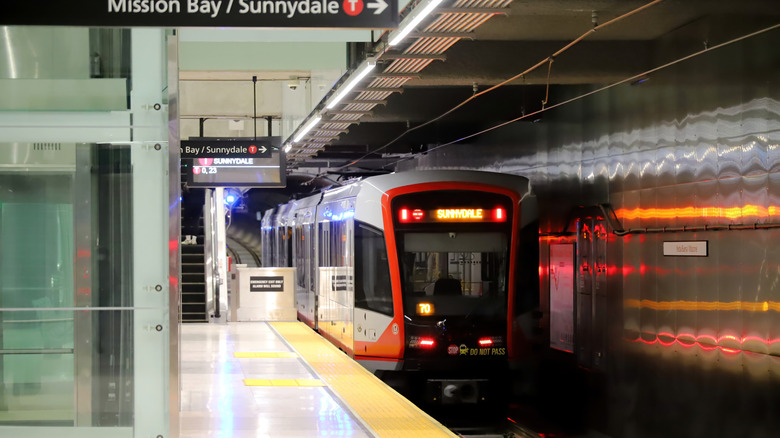
Many modern vehicles utilize computers and computer chips to some degree. Without them, you wouldn't be able to control a car with your phone. However, virtually the entire population of San Francisco relies on vehicles that use technology so ancient that the people who run them call them "the programming equivalent of Ancient Babylonian." San Francisco's Muni Metro, the city's system of subway and above-ground trains, primarily relies on floppy disks.
These aren't the 3.5-inch hard plastic cartridges associated with games like "DOOM" and "The Oregon Trail," but the even more ancient 5.25-inch variety. The Muni Metro isn't alone in this practice, as many airplanes still use floppies to load their systems. The Muni trains utilize the outdated technology because that's what was available when the Muni Metro's Automatic Train Control system (ATCS) was installed in 1998, when you could fit all of the DOS software needed for the system onto three floppy disks. These disks allow the ATCS server to control train speeds, as well as switches and signals, but switch to manual control the moment they leave the subways.
When engineers developed the ATCS, they designed it to last up to 25 years. In the spirit of fairness, in 2018, the San Francisco Municipal Transportation Agency (SFMTA) started drafting plans to update the Muni Metro and do away with its reliance on floppy disks by 2028. But you know what they say about the best laid plans of mice and men, especially when COVID-19 forces you to postpone work for a year and a half.
San Francisco's plans for the Muni Metro are back on track
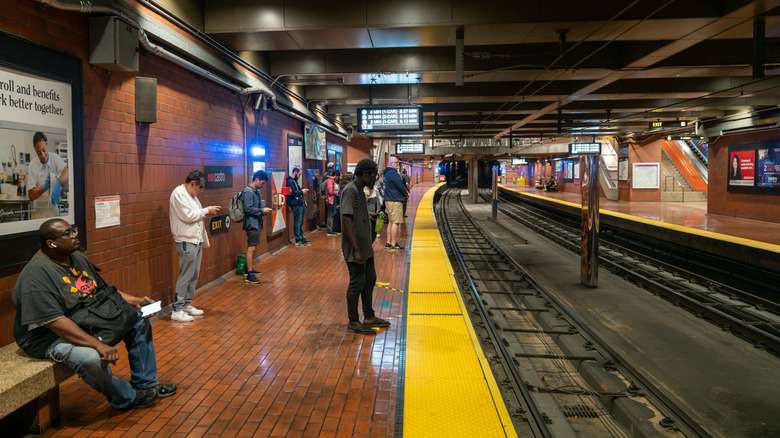
In order to completely remove floppies from the equation, the SFMTA is performing a complete overhaul of its train systems. Dubbed the Train Control Upgrade Project (TCUP), the procedure will ditch the ATCS and replace it with a system designed by Hitachi Rail, as well as rip out the subway's loop cable system (how the ATCS communicates with trains) and replace it with Wi-Fi. The upgrade is expected to cost around $700 million and tentatively finish in 2034.
Not only are floppies antiquated, but the loop cable system transmits data at a downright glacial pace compared to modern systems. Moreover, floppy disks degrade over time, so if the ATCS isn't upgraded, a catastrophic system failure that halts all Muni Metro transportation would be a matter of when, not if. And technically speaking, the ATCS's floppies passed their expiration date back in 2023. To make matters worse, the loop cable wires are fragile, and many components necessary for the Muni Metro system as it currently stands are out of circulation, so engineers who work on the Muni Metro are watching the system rot before their eyes.
The new system will have more precise control over trains and a more accurate picture of where they all are at any given time. Plus, signals will be stronger and more reliable, resulting in a more efficient subway system. If only SFMTA was installing levitating trains like in China.