

This New Android Phone Reminds Us Of LG's Failed 2016 Experiment
At the annual Mobile World Congress (MWC) event held in Barcelona, Spain, as per the norm, various companies in the mobile industry showcased a variety of devices and concepts that had been in the works for the past year. There was a lot of stuff going on — this year's highlights were Chinese phones, 6G, and dancing robots — but one of the more interesting gadgets was a handset that might give you a sense of déjà vu.
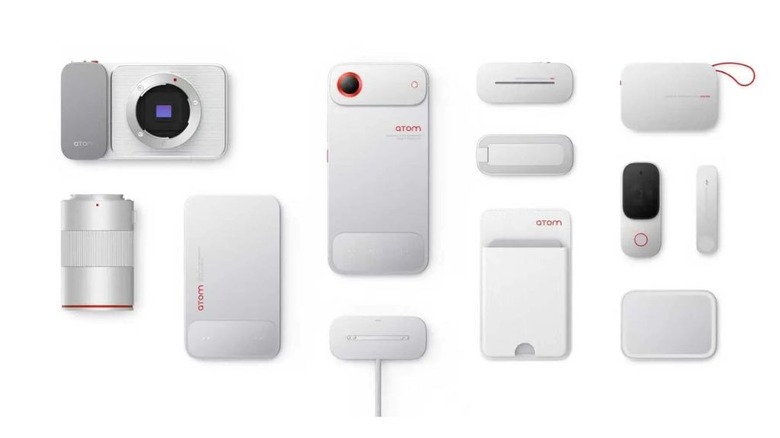
Chinese smartphone company Tecno showcased over 10 concept devices at the expo. One of these was the Atom, a concept phone that comes with a slim profile by default and stands out from the crowd by offering modular components that can be attached or detached based on your needs. These include a telephoto lens, an action camera, a stackable battery module, and a speaker for better sound. The phone uses magnets to connect the components, a system Tecno is referring to as Modular Magnetic Interconnection Technology.
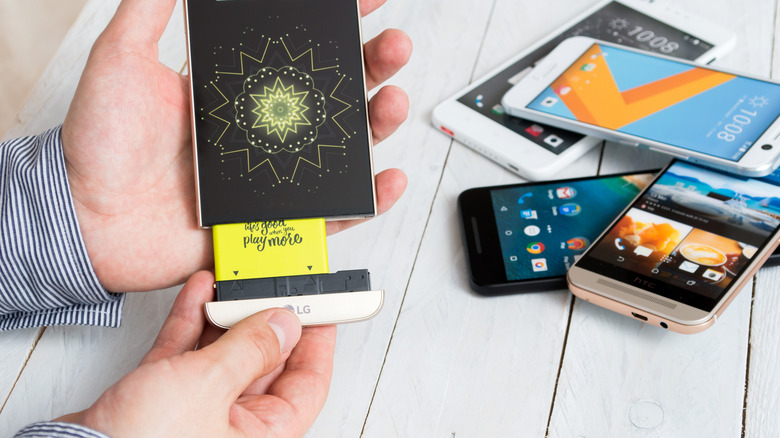
If that concept sounds familiar, you might remember the LG G5 smartphone from 2016, which featured modular components that let you customize the hardware — albeit without magnets. It came at a time when Android was going through its modular phase, with Google's own Project Ara promising similar levels of hardware customization. While the LG G5 was one of the more mainstream modular phones, being sold at carrier stores and Best Buy, it was ultimately a failure, as LG returned to a more traditional form factor the very next year.
The modular phone concept isn't new
If you weren't keeping up with the smartphone scene in 2016, LG launched its flagship G5 phone in April of that year, and it came mere months before Samsung recalled its exploding Galaxy Note 7. While the G5 packed all the underpinnings of a flagship phone from that year, it was special for offering a modular design where users could buy accessories and attach them for enhanced functionality, like a 360-degree camera and a wide-angle lens.
Meant to save the company's struggling mobile business at the time, the G5 ultimately came and went without much fanfare, and LG officially shut down its mobile division a few years later. According to The Wall Street Journal, the brand "struggled to convince consumers to pay for additional modules for the G5." However, LG's modular device wasn't quite as practical as Tecno's Atom concept since it required the phone to be powered off just to swap battery modules – unlike the Atom, where you simply attach the battery to the back, and you can even stack more than one if you want to.
After disappointing sales figures for the G5, LG ultimately scaled back on modularity. While the Atom reminds us of LG's failed experiment, it's unclear whether Tecno is dedicated to seeing this concept come to life in an actual device that you can buy. After all, the brand is known to showcase various concepts at trade shows that don't always see widespread availability, so you might not want to hold your breath for a spiritual successor to the LG G5 on store shelves.