

China's Smart Public Toilets Give You A Quick Medical Check-Up - Here's How
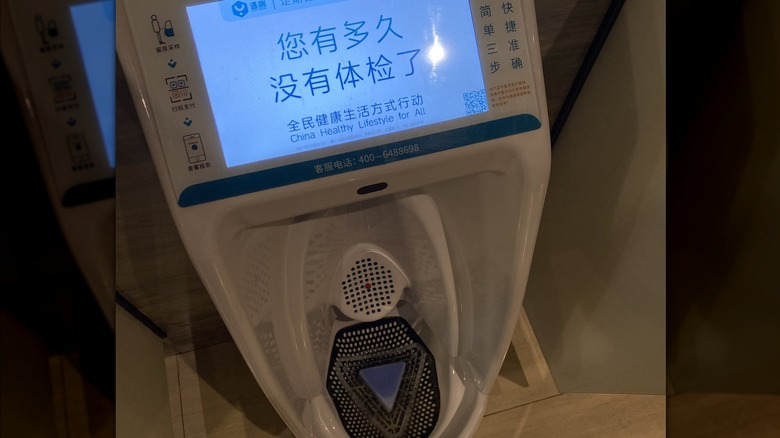
Regular doctors' visits are crucial to maintaining your health, and while many people schedule annual appointments, sometimes conditions can sneak up on you before you realize it. You'd be surprised just how much health data you're literally flushing down the toilet every time you urinate, which is why a company installed urinals across China that give users a quick check-up. For a fee, of course.
The urinals were first reported by documentary director Christian Peterson-Clausen on his X account. After using a specially-built device in a public bathroom, he paid RMB 20 (approximately $2.89) for a "private company" to provide a urinalysis report, a common medical test that can detect issues such as diabetes or kidney disease by measuring the pH and glucose levels of urine. Normally, urinalysis is performed with microscopes and dip sticks, but these Chinese urinals, according to Mission_Green_Mumbai on Instagram, use built-in sensors and AI to check for markers in "glucose, vitamin C, creatine, white blood cells, and more."
Moreover, Peterson-Clausen received his results after a few minutes, which implies the devices employ an AI for speedy analysis. Although plenty of companies also use AI doctors to diagnose patients. Peterson-Clausen posted an entire thread about his experience, stating that he found another urinalysis urinal in a different part of the city and that the unnamed company was "installing [these devices] all over China." Privacy concerns did arise in the chat and thread — especially because Peterson-Clausen paid via WeChat, a messaging platform that supports apps that can control farming robots or tell users if their neighbors have too much debt.
The Chinese apparently urinals never caught on
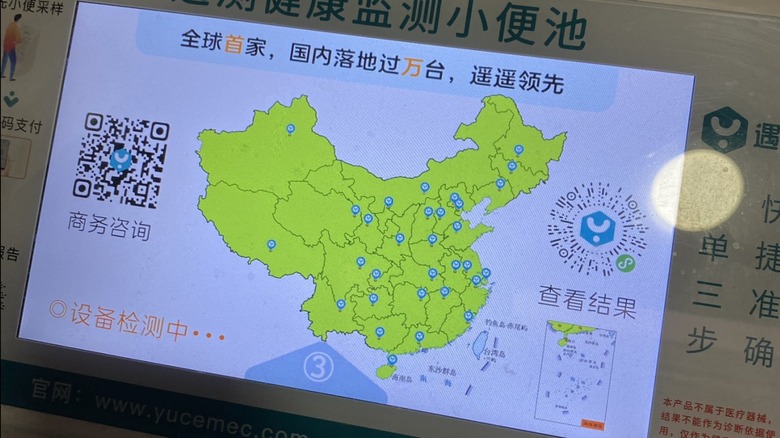
Peterson-Clausen was less concerned about passersby learning about his general health and more concerned with the benefit of quickly learning if he is in decent shape. To him, the convenience of this technology outweighed everything else. Despite their convenience, there hasn't been much talk about them. That's because they're still quite rare; you can only find them in some major Chinese cities, including Beijing and Shanghai. Plus, people who are interested in this technology might be in the minority.
After Petersen-Clausen showed his wife the urinal, he shared on X that she "could not have cared less." Also, since the methods these urinals use to test samples are a closely guarded secret, many potential users have questioned the accuracy of their results and how the equipment is disinfected – cross-contamination can result in wildly inaccurate data. Another shortcoming is that the service is attached to urinals, which aren't exactly common in women's bathrooms. A definite oversight or limitation in the technology to be sure, as urinalysis isn't limited to just men's health.
Peterson-Clausen thought that even if these devices don't replace doctor's visits (and they shouldn't), they could at least tell users if they need to make an appointment. After all, his cardiologist allegedly claimed that an increase in Apple Watch users led to an uptick in visits.