

Could We Ever See Walking Vehicles In The Future?
From "Star Wars" movies to countless video games, walking vehicles are a common sci-fi and action trope. In fiction, these vehicles usually take the form of futuristic armored tanks that lumber their way through battlefields as they rain laser beams upon helpless victims. However, given how many actual inventions have been inspired by science fiction, you might wonder if there are any real-life equivalents of these vehicles — or whether they'll ever exist.
It turns out some well-known names in the automotive and electronics worlds have experimented with developing walking vehicles in the past. Some explored the concept decades ago, while others have been working on walking vehicle prototypes as recently as the last few years. Although widespread adoption of these machines hasn't happened yet, the ongoing testing and development suggests legged vehicles might one day walk out of the movie screen and into our daily lives.
Companies like GE and Hyundai have experimented with walking vehicles
None other than General Electric worked on a walking tank concept years before filmgoers were introduced to the idea in "Star Wars: The Empire Strikes Back." Footage of the vehicle, which GE dubbed the "Pedipulator" (sometimes referred to as the Quadruped), depicts a human operator moving the four legs of the machine using a hydraulic system that follows the movements of the operator's limbs. The video's narrator explains GE developed this walking tank for the U.S. Army with the goal of providing a vehicle that could help troops navigate otherwise tricky terrain. The company only created one unit, as budget cuts halted any further development of the Pedipulator.
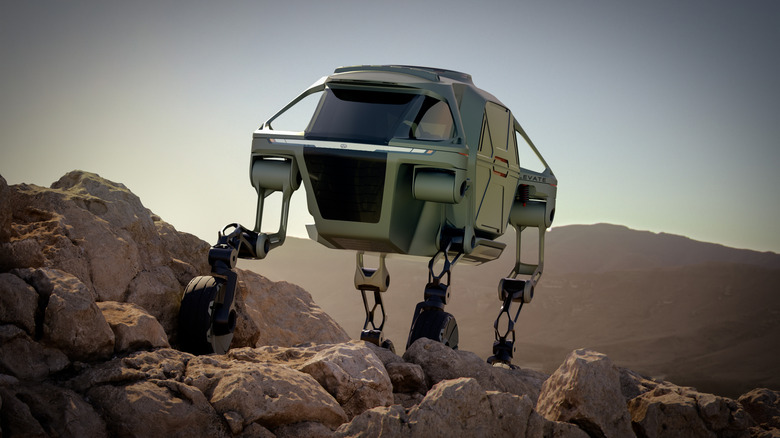
Fast-forward to 2019, and it appears a related idea from Hyundai may have experienced a similar fate. In a 2019 press release, the company revealed it was working on what it claimed would be "the first Ultimate Mobility Vehicle (UMV)," named "Elevate." A concept video shows how the vehicle would consist of a chassis with four extendable legs that would allow for different "walking modes" when terrain renders driving ineffective or impossible. The press release stated the vehicle could help first responders traverse debris fields without having to do so on foot, or that it could act as an accessible cab that elevates — no pun intended — its chassis, so a passenger in a wheelchair could enter the vehicle. Unfortunately, aside from this press release, there have been no updates about Hyundai's Elevate for almost half a decade now.
The above are just two examples of walking vehicles that never made it far beyond the concept stage, but other walking vehicles were made in the past. For instance, the Finnish company Timberjack built a walking harvester decades ago, and the U.S. Forest Service even offers an image of such a prototype.
Why walking vehicles haven't caught on
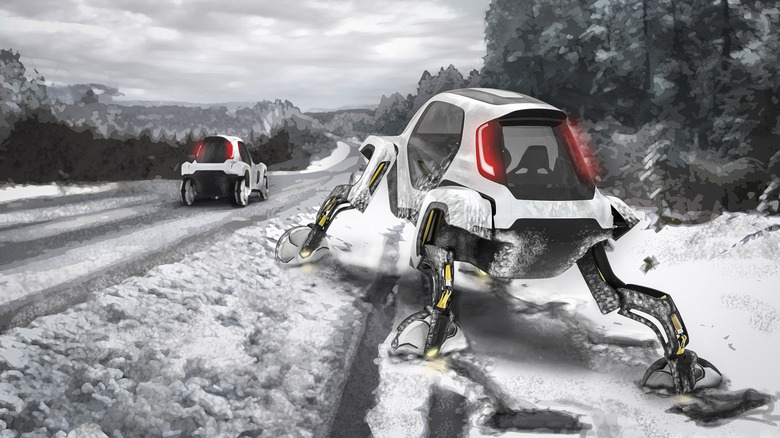
The appearance of walking vehicles in both sci-fi movies and real-world design concepts reflects the fact that we seem to have a fascination with walking vehicles. Why, then, have they never become mainstream? The complex nature of walking itself provides insights into this question.
To some extent, walking vehicles have an advantage over wheeled models because they can move over terrain that's impassable on wheels. Aside from this benefit, though, walking vehicles are generally cumbersome and slow because it's hard for them to replicate a walking motion, which is a limitation that stands in the way of them becoming more commonplace. Quite simply, they're difficult to design, build, and operate.
That's not to say these vehicles will always be relegated to fiction. Not too long ago, the idea of autonomous vehicles was pure sci-fi. Now, you can find robotaxis in cities across the United States. Similarly, robots that walk like spiders have escaped from our nightmares and joined our reality. As the technology continues to develop, walking vehicles may one day become genuinely feasible.