

Is Our Universe Stuck Inside A Black Hole? Here's What Scientists Say
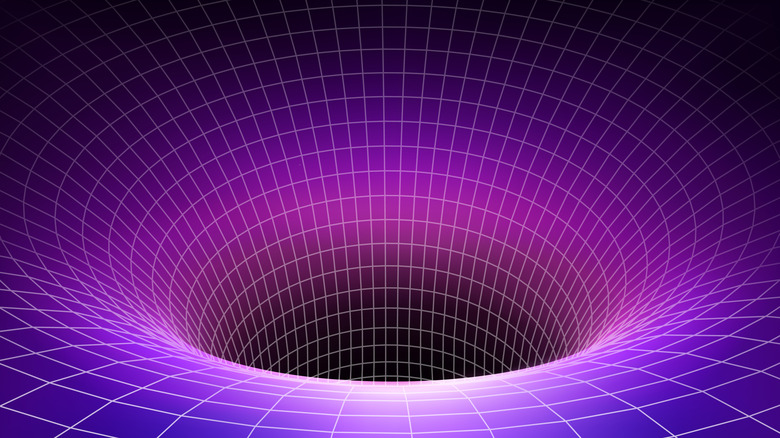
The nature of black holes has long been shrouded in mystery, but some astronomers believe the answers are a lot closer to home than expected. A fringe astronomical theory known as "black hole cosmology" proposes that all of us are actually living inside of a black hole. That black hole could even exist within another universe, itself inside of a black hole, with the model having no clear end. The idea has been around for half a century now, but it wasn't taken very seriously at first. However, a series of recent studies has brought newfound attention to this mind-bending model of the cosmos.
Black hole cosmology was introduced by theoretical physicist Raj Kumar Pathria in a 1972 study published in the journal Nature. He was inspired by Einstein's theory of relativity (now supported by a new map of dark matter) and the work of Karl Schwarzschild, the astronomer who first solved Einstein's general relativity equations. Schwarzschild's work showed that there is a limit to how much mass can occupy a given space, and that every physical object, if compressed into that space, will collapse into a black hole. This limit is known as the Schwarzschild radius. For example, the Schwarzschild radius of the sun is about two miles. If you compressed the sun into a sphere with just a two-mile radius, it would become a black hole.
What Pathria realized is that the radius of the observable universe is the same as the Schwarzschild radius of the universe's mass. That's something you'd typically only expect from a black hole.
New evidence for black hole cosmology
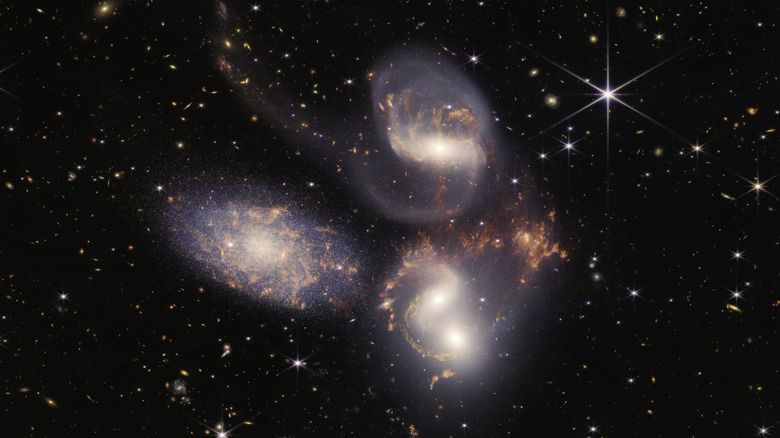
When Raj Kumar Pathria first proposed black hole cosmology, also known as Schwarzschild cosmology, the theory failed to gain mainstream traction. However, two studies from 2025 could change that. The first was a paper published in Monthly Notices of the Royal Astronomical Society, which looked at images of more than 250 distant galaxies captured by the James Webb Space Telescope, which is now being improved with AI. It showed that roughly two-thirds of the galaxies rotate in a clockwise direction, while the rest rotate counterclockwise. On a scale as large as the universe, the split should theoretically be even. The fact that a majority of galaxies rotate in a specific direction could imply that the universe itself is rotating. There's no clear explanation for this, but it would fit with the behavior of a black hole.
Another study published in Physical Review D went a step further by proposing a new model for the formation of the universe that fits with the theory of black hole cosmology. It proposes that the gravitational collapse of a black hole can also create a "bounce" back, switching from compressing matter to expanding matter. In this model, the Big Bang was not the beginning of all things, but rather one such bounce. It actually makes surprising sense if you think about it. The Big Bang came from a singularity, and the gravitational collapse that creates black holes also results in a singularity. What if the singularity that preceded the Big Bang was itself created by gravitational collapse?
A universe in every black hole
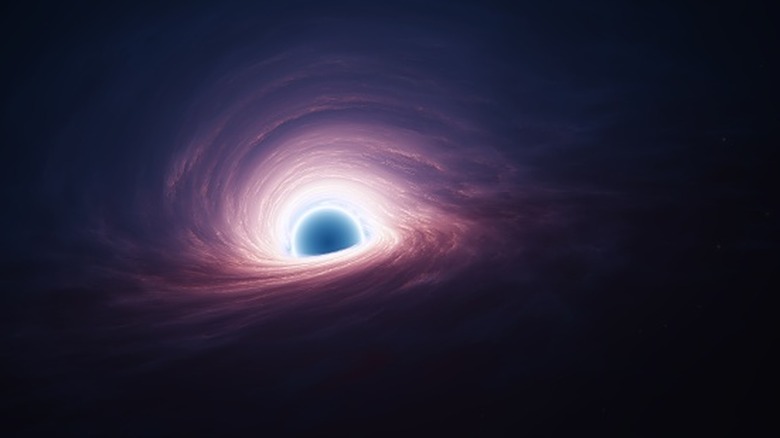
If our universe is inside of a black hole, it raises a couple of huge questions. First of all, what is that black hole contained within, and second, what is contained within the black holes in our own observable universe? 20 years after Raj Kumar Pathria published his groundbreaking paper outlining black hole cosmology, physicist Lee Smolin published a book called "The Life of the Cosmos," in which he argues that the formation of every black hole also creates a new universe. Therefore, our universe is contained within another universe, and every black hole that we can observe contains another universe within it.
Smolin proposed that each time a new universe is created inside of a black hole, a few random variations occur to make that universe unique from all the others. This mirrors Charles Darwin's theory of evolution, in which random genetic variations set a precedent for future generations. Through the force of "cosmological natural selection," our universe accrued traits like stars, and ultimately, life itself.
It's impossible to firmly prove or dismiss the theories of black hole cosmology and cosmological natural selection with the tools and data we have now, but if it were true, it would help tie up some loose ends in our cosmic knowledge, like the evidence that dark matter could predate the Big Bang. It also opens up a much looser view of the cosmos, one where laws are not as rigid as we once believed.