

Mark Hamill's Underappreciated Live-Action Anime Adaptation Is Streaming For Free

We may receive a commission on purchases made from links.
When it comes to science fiction and action films, veteran actor Mark Hamill is all but royalty. Naturally, he's best known for his role as Luke Skywalker in the original "Star Wars" trilogy, though after he hit it big with that trilogy, he landed numerous other roles in films like "Slipstream" and "Midnight Ride," not to mention his voice acting work as the Joker in "Batman: The Animated Series." One role that is often forgotten about, however, is that of Max Reed in 1991's "Guyver," a cult-classic sci-fi film you can watch for free on Tubi.
"Guyver" is a sci-fi superhero action film loosely based on a Japanese manga series that began in the 1980s called "Bio Booster Armor Guyver." That manga series spun off into several anime adaptations, one of which was an international cooperation to bring the film to Western audiences. While the movie didn't exactly do spectacularly in its time, it's fondly remembered as a mildly cheesy production with some excellent practical and special effects, not dissimilar to the tokusatsu genre of Japanese film and television.
Bio Booster Armor Guyver started as a manga series in 1985
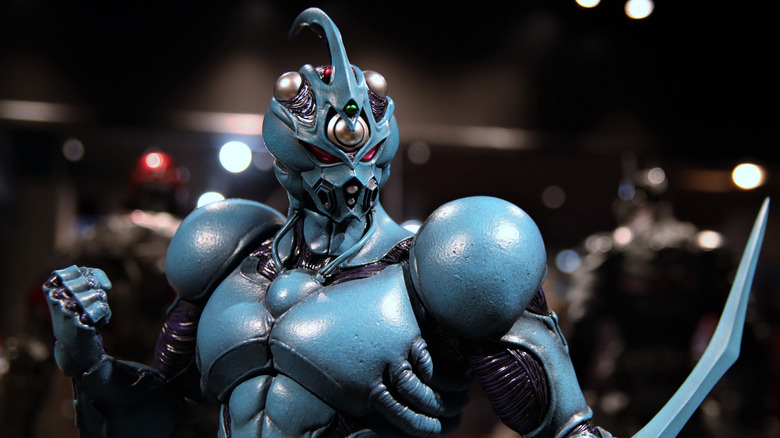
"Bio Booster Armor Guyver," written by Yoshiki Takaya, got its start in 1985 and swiftly became a hit with Japanese readers. The story follows a teenager named Sho Fukamachi who, by chance, stumbles upon the titular super-powered armor in its dormant state. The activated armor renders Sho virtually indestructible and extremely powerful, but it also attracts the attention of its creators, the evil Chronos Corporation, who send mutant monsters called Zoanoids after him.
Sho is forced to defend himself against the mutants, as the suit is completely bonded to his body, and if its critical control center is damaged, it will eat him alive. The manga was generally dark and serious in tone, with Sho living in fear that the suit's mysterious technologies will completely rob him of his humanity. It was actually running continuously until going on hiatus in 2016, a long run that could even rival the likes of "One Piece." In the years following its initial publication, "Guyver" has been adapted to screens several times.
In 1986, it received a standalone OVA titled "Guyver: Out of Control," followed by a 12-episode OVA series titled "The Guyver: Bio-Booster Armor," which received an additional 12 episodes in 1992. The most recent anime adaptation came in 2005, titled "Guyver: The Bioboosted Armor." In between all of that, over in America, came "Guyver" in 1991.
The 1991 film echoes tokusatsu productions like Kamen Rider

The 1991 western film, "Guyver," follows the same loose overview of the manga, swapping out a few details to account for the change in locale. Again, the Chronos Corporation is experimenting with alien technology and DNA, producing the Guyver units, one of which is stolen by Dr. Tetsu Segawa (Greg Joung Paik) and ends up in the hands of young Sean Barker (Jack Armstrong). Sean goes on the run with Dr. Segawa's daughter, Mizuki (Vivian Wu), and is aided along the way by Mark Hamill's character, CIA agent Max Reed. While Hamill is only a secondary character, he is the focal point of one of the film's most memorable sequences, in which Reed transforms into a giant cockroach monster with a human face.
Compared to its source material, "Guyver" is much campier in tone, with action one-liners and rubber-suited monsters. While not exactly serious cinema, though, it is fondly remembered amongst the classics of sci-fi B-movies, and is a remarkably apt American take on the Japanese tokusatsu genre of film and television, a genre encompassing shows and films like "Kamen Rider" and "Godzilla" that makes extensive use of practical effects and suits.
"Guyver" actually did well enough for itself to get a 1994 sequel, "Guyver: Dark Hero." This film swapped Jack Armstrong out for David Hayter and upped things from PG-13 to a full R rating, and was better received for it. Mark Hamill isn't in this one, unfortunately, but it is available for paid digital rental on Amazon Prime Video.