

How The Big Bang Theory's Whiteboards Were So Scientifically Accurate
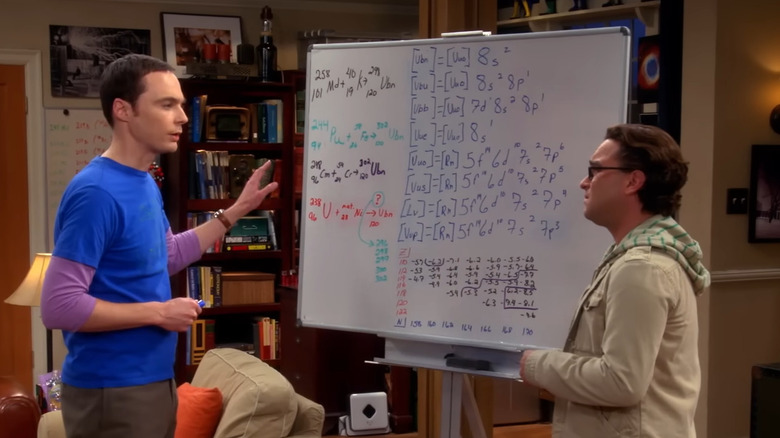
"The Big Bang Theory" is considered to be one of the best TV sitcoms of all time. During its 12-year run, CBS' comedy series about two socially awkward physicists, their geeky friends, and actress neighbor, won 10 Emmys — four of which were for Jim Parsons' portrayal of quirky genius Sheldon Cooper — and attracted an average of 17.3 million viewers per episode. Even after the show's finale in 2019, it continues to be a hugely popular show to binge on streaming platforms, with Max subscribers watching a combined 29.1 billion minutes of the hit TV show in 2024.
But "The Big Bang Theory" also brought about a major cultural shift: It made nerd culture cool. The main characters were unapologetically geeky, regularly (and passionately) discussing topics like "Star Trek," Dungeons & Dragons, and comic book collecting, exposing a mainstream audience to a culture that many may have been unaware of before — or even mocked.
More importantly, "The Big Bang Theory" didn't shy away from deeper, scientific subjects; in fact, it embraced them. The sitcom regularly paid homage to renowned scientists, with some, including Bill Nye, Stephen Hawking, and George Smoot, even making cameo appearances in the show. But it was the surprisingly accurate portrayal of real scientific theories and concepts that was particularly impressive. So much so that real scientists were pitching their results to the show's scientific consultant, David Saltzberg, in hopes of a coveted spot on the sitcom's whiteboards.
Who was the scientific consultant on The Big Bang Theory?
Throughout the popular sitcom's 12-season run, "The Big Bang Theory" showrunners enlisted the help of a scientific consultant to ensure the accuracy of the show's science depictions. David Saltzberg, an experimental particle physicist and professor at the University of California, consulted on the scientific elements of each episode's scripts and dialog. He also ensured the equations and diagrams presented on the whiteboards — including the one in Sheldon and Leonard's apartment — were accurate.
For each episode of "The Big Bang Theory" Saltzberg would take a few hours in an evening to look over the scripts and put things on the whiteboard before attending the taping of the show. The scientific consultant also revealed that, as the show gained popularity, he began receiving pitches from real scientists who wanted their latest results to appear on one of the sitcom's whiteboards. "It's sort of become a thing to get on the whiteboards," he told Science in an interview. "Dozens of scientists are watching those boards."
These boards aimed to reflect current real scientific research, so when gravitational waves were discovered in 2015 — a breakthrough in astronomy — Saltzberg made sure to include it in the show in a special place: Professor Stephen Hawking's white board (with his permission, of course). The consultant explained that the discovery of gravitational waves also made it into the show's writing because, as the characters in "The Big Bang Theory" are meant to be physicians, it makes sense that they would be discussing real breakthroughs, adding to the reality of the sitcom's universe.
Following the show's finale in 2019, Saltzberg has gone on to be a consultant for other productions, including Christopher Nolan's "Oppenheimer" and " The Big Bang Theory" spin-off "Young Sheldon."