

William Shatner's Classic Twilight Zone Episode Inspired A Real World Airplane Feature
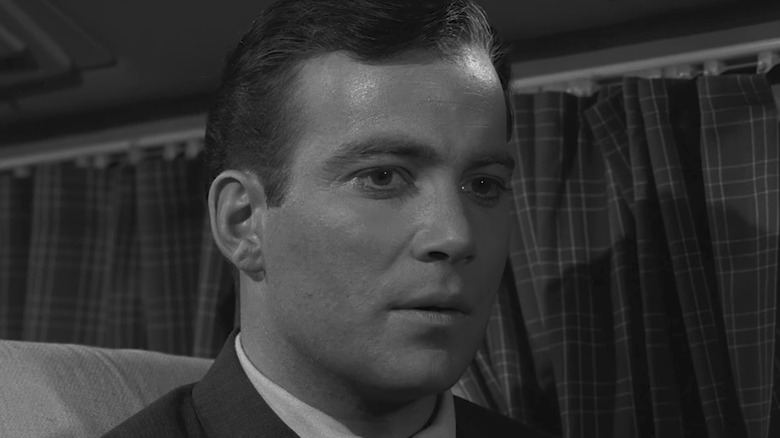
Mark Twain once said, "There is no such thing as a new idea." Virtually every modern concept and invention was spawned from another one. There are at least a dozen real-life inventions that were inspired by science fiction, and those small black (or sometimes red) triangles you occasionally find on the walls of airplanes were inspired by an iconic William Shatner freakout. All in character and completely fictional, of course.
The black triangle inside airplanes indicates the location of the "William Shatner Seat," a special chair that gives the ticket holder a perfect view of the wing. The name was inspired by the legendary "Twilight Zone" episode "Nightmare at 20,000 Feet," where a passenger, Bob Wilson (Shatner), sees what he thinks is a gremlin on the wing of an airplane trying to wreck it. He goes crazy trying to convince everyone that he's right and that if he doesn't stop the alleged creature, the whole plane will go down. The episode is a masterclass in tension that makes you wonder if Bob is hallucinating (spoiler: He isn't) and is one of the best episodes of the "Twilight Zone."
The William Shatner Seat serves a functional purpose
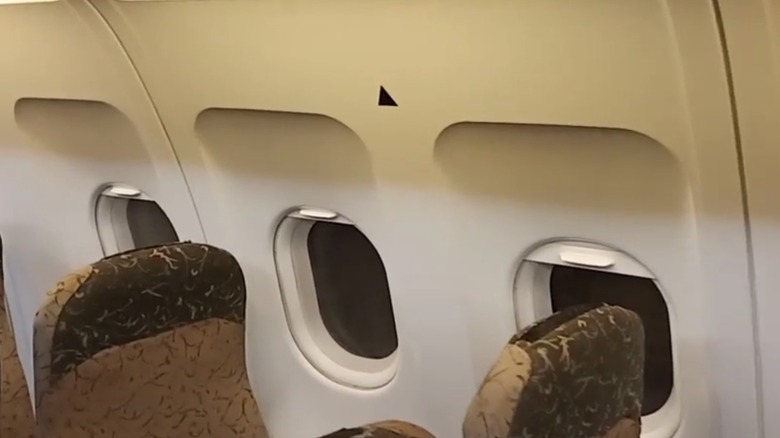
If the William Shatner Seat was just a cute little joke among pilots — little more than a real-world Easter egg — that would be more than enough for pop culture aficionados. But since it provides an unobstructed view of the wing, crewmembers can use it to monitor the component's status.
Contrary to popular belief, airplane wings aren't a single static piece; they are covered in slats and flaps that shift to turn the plane and help it climb and descend. According to Henny Lim on YouTube, who is a flight attendant and content creator, if crewmembers think something is wrong with the wings and need to physically inspect them while in flight, the triangles help them quickly locate the William Shatner Seat. This is also crucial during wintery weather, as staff can look through the windows next to the William Shatner Seats to see if the wings are icing up.
When that happens, the flaps and slats can't function properly. You could probably say that ice on the wing is the closest you'll ever get to real-world gremlins. While companies and researchers are always trying to invent new wing styles, including stretchy metal polymers that lead to shape-shifting wings and more hush-hush designs that allegedly will cut down on fuel consumption, the William Shatner Seat is probably here to stay. Better safe than sorry, especially when you're 30,000 feet in the air.