

Touchscreen Computer Monitors Might Not Be Worth It For You - Here's Why

Touchscreens are a staple of today's tech. If you've ever used a smartphone or a tablet, you have experience using this type of screen. Thus, you might wonder if upgrading to a full touchscreen monitor for your computer is a worthwhile investment. Although there are valid use cases for these types of displays, for many, they may not be the best option, due to factors like physical limitations, placement requirements, and the potential for damage.
It's generally important to consider how you're planning to use a monitor when making an upgrade. For example, some monitors are better for work and gaming than others. You also have to account for your budget. If you're not planning on buying a touchscreen monitor, for example, you can get a quality unit for less than you might assume. If you are curious about touchscreens, though, it's wise to consider their limitations before making a purchase. Understanding what this type of monitor is and isn't good for can help you decide if it's the right option for your needs.
Potential drawbacks of a touchscreen monitor
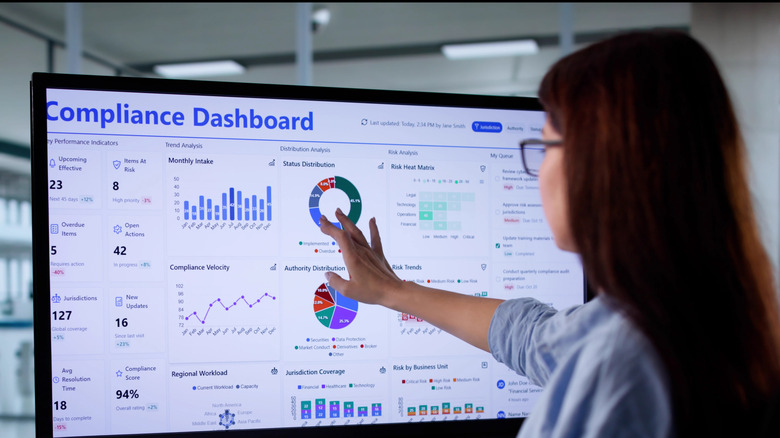
It's easy to understand how a touchscreen monitor can offer a degree of convenience, given that being able to directly touch the screen is perhaps the simplest way to interface with a monitor. However, using a monitor in this capacity involves certain clear restrictions. For example, you need to be very close to the unit to take advantage of its touchscreen capabilities. That could be challenging, depending on your office setup. In addition, regularly touching a screen can result in marks, spots, and streaks, boosting the cleaning and maintenance requirements of a unit. Touchscreen monitors may also be more prone to scratches than other types.
Using a touchscreen monitor can also become physically uncomfortable for several reasons. Because using a touchscreen requires being relatively close to the monitor, a user may be more susceptible to eye strain than if they were using another type of monitor. They might also find that the loss of sensory feedback from a keyboard makes it difficult to type accurately. Cold temperatures can also make it difficult to navigate a touchscreen accurately. Unfortunately, several touchscreen monitors aren't compatible with gloves.
The importance of research when buying a monitor
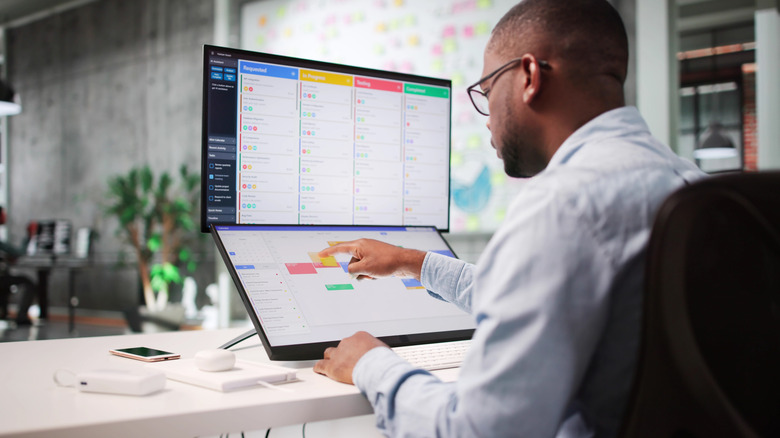
None of this is meant to suggest there are no potential benefits to using this type of monitor. A touchscreen can save space due to not requiring as much additional hardware (like a mouse or keyboard) as other types of monitors. This can also theoretically reduce costs. On top of that, some users might simply prefer a touchscreen because it feels more natural to them. A reasonably large touchscreen monitor can also be ideal for presentations, lectures, classroom activities, and similar uses.
Just remember that touchscreen monitors represent only one alternative to traditional monitors. If you're looking for something other than what you've been accustomed to using, explore all your options before deciding which is best. If you decide a touchscreen monitor isn't worth your money, you might nevertheless discover you still want to use something new, like a curved monitor. Doing your research ahead of time will boost your odds of feeling satisfied with your choice of monitor in the long run.