

Tesla's Lithium Refinery Is Accused Of Dumping Black Wastewater In A Ditch
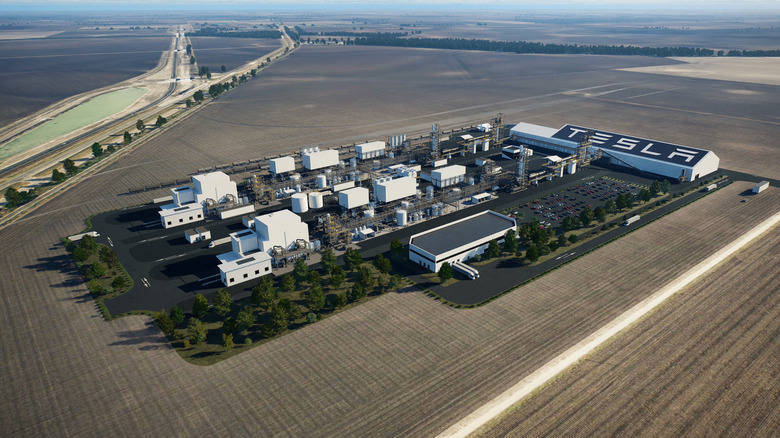
Tesla's lithium refinery in South Texas has been accused of dumping waste into a nearby ditch. The plant of over 1,200 acres was announced in 2023, and officially began operations at the start of 2026. Part of its purpose is to increase production of lithium for Tesla's car batteries, like for the Model S and Model X. The complaint was raised back in January, but Tesla claimed that a year prior, the Texas Commission on Environmental Quality (TCEQ) issued a permit to utilize the unnamed ditch for waste.
The Senior Manager of the Corpus Christi Site Operation, Jason Bevan, wrote in a letter dated January 26, that he's happy to hear from Texas officials to discuss the issue. However, Bevan again used the ruling from the TCEQ to excuse any claims of pollutants in the ditch. Local news in the area had not been able to get Tesla to comment in the meantime.
Bevan also used Tesla's previous participation in wider environmental awareness schemes, like Earth Day Bay Day, or the Big Shell Beach Cleanup, to show that Tesla is "committed to being a good neighbor." Reports from local news outlets, like Kris-TV, an NBC affiliate, have indicated that the waste looked far worse than Tesla or the state records currently state.
Claims of dark and murky water from Tesla pipe
Steve Ray, a consultant on drainage, said in an interview with Kris-TV that the waste "was very dark and murky. I would say it was actually black. We're used to seeing good running water, and so we didn't know exactly what it was." The ditch drains out to an at-risk location, Baffin Bay. If Tesla were to discharge a massive amount of waste into the ditch either deliberately or through error, it could contribute to an ecological nightmare.
However, the two investigations opened into the ditch were closed in February. Both TCEQ reports indicate that the wastewater was clear, and no violations have been issued as a result of them. Since February 26, Tesla hasn't been investigated again by the environmental body, with no updates since. The latest complaint in the area is aimed at a portable toilet company dumping sewage.
However, the Nueces County officials involved claim that they weren't notified of the pipe, despite the evidence to the contrary. In actuality, according to the permit itself, Tesla wasn't allowed to use "private or public property" when dumping its waste. The pipe in question apparently runs through what would be classed as part of the district's out-of-bounds area.
Tesla water issues come as Corpus Christi suffers drought
This comes as Corpus Christi wrestles with a drought issue. The water shortage in the eighth-largest city in Texas is exacerbated by the weather and the industrial activity in the area. According to a CNN report, the city might only have a few months of water left, with one individual interviewed comparing it to "a lawn." The city has now implemented a Stage 3 Drought Status, which brings in restrictions such as no lawn watering and car washing now limited to a five-gallon bucket. Shortage levels have now hit 7.8% as of April 20.
Tesla stated that its lithium plant needed 400,000 to 800,000 gallons of water per day to operate in 2022. As of 2026, it's old consulting company Raftelis that this number could hit 8 million gallons. This was a concern among residents in the area before the plant was built, but the company could now find itself at the center of the problem.
Musk's other facilities are also causing water issues. Boxtown, in Memphis, is suffering since xAI introduced an AI data center in the town (this is Musk's artificial intelligence company that runs Grok). People in the area are now reporting that the Colossus plant is "poisoning" them, as it uses gas generators to power it. In March 2025, the Environmental Protection Agency announced it was going to rip up the protections that Boxtown could have used as leverage, and it has recently completed gutting the "Obama-era 2009 Greenhouse Gas (GHG) Endangerment Finding" and other methods of fighting back against climate change.